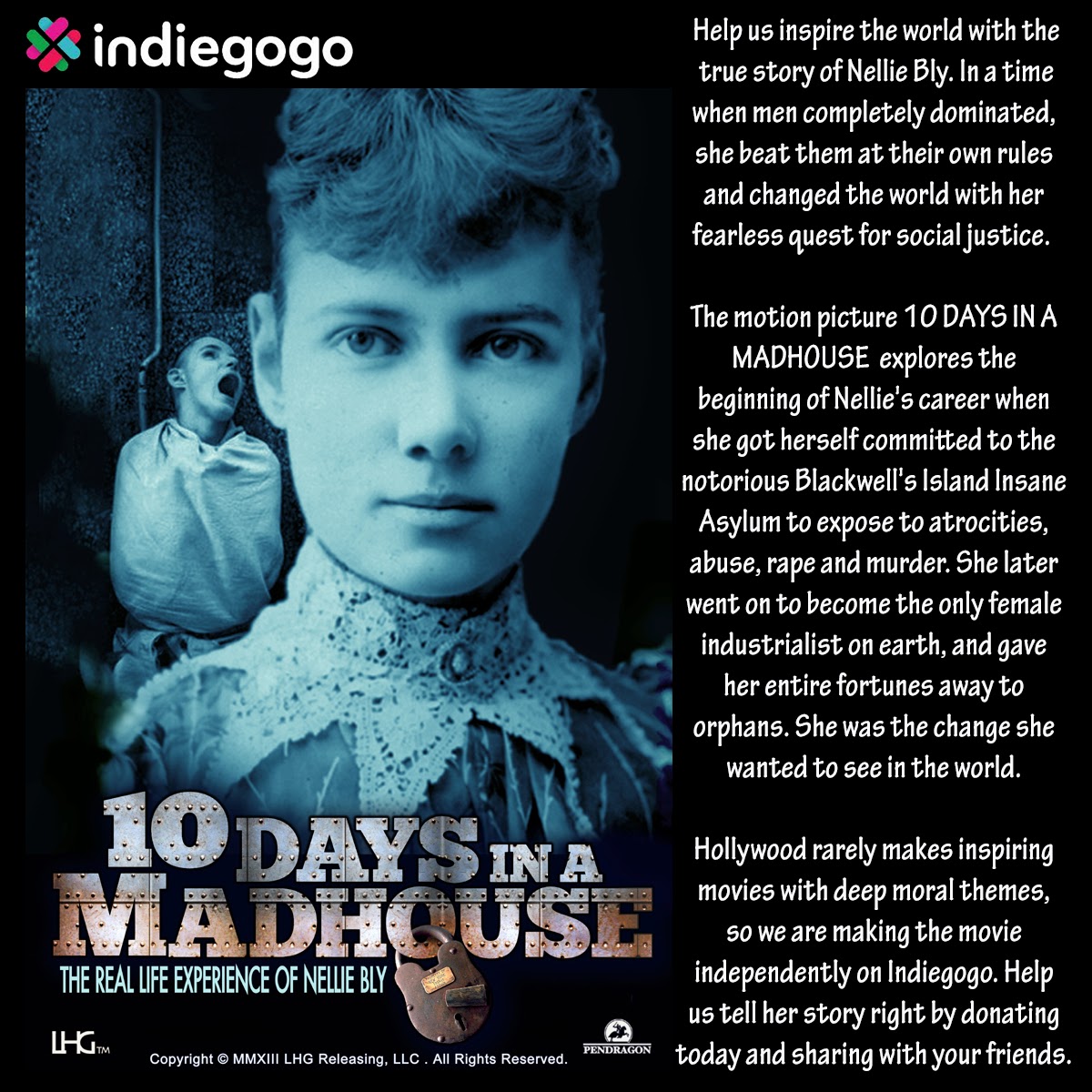
Movies about journalism usually feature a lot of clacking typewriters and whiskey-soaked editors. But 10 Days in a Madhouse movie is a different beast entirely. It’s gritty. It's uncomfortable. It tackles the real-life exploits of Nellie Bly, the woman who basically invented undercover investigative reporting by getting herself committed to an insane asylum in 1887.
Honestly, the film—directed by Timothy Hines—is a weird mix of period piece drama and psychological horror. It doesn't always feel like a polished Hollywood blockbuster. In fact, its low-budget aesthetic actually makes the grit feel more authentic to the 19th century. If you’ve seen it, you know exactly what I mean. Caroline Barry, who plays Nellie, captures that transition from "ambitious reporter" to "terrified inmate" with a vulnerability that’s hard to shake off.
The Real Nellie Bly vs. The Film
People often forget that before this movie existed, there was just the book. And before the book, there was a series of articles in the New York World. Joseph Pulitzer—yeah, the guy the prize is named after—hired Nellie Bly to see if she could pull off the impossible. She had to fake insanity to get inside the Blackwell’s Island Insane Asylum.
She did it.
The movie sticks surprisingly close to the source material. It captures the "tests" she had to pass to prove she was "crazy." It shows the cold baths. The rotten food. The physical abuse by nurses who clearly weren't there to help anyone. What’s wild is that the film emphasizes how quickly a sane person can start to lose their grip when they are treated like an animal. This isn't just a "based on a true story" tag; it's a direct adaptation of the nightmare Bly documented.
Why This Movie Matters Right Now
We live in an era of "fake news" and "citizen journalism." Looking back at 10 Days in a Madhouse movie reminds us what actual, high-stakes reporting looks like. It wasn't just about a headline. It was about reform. Because of Nellie’s work, the city of New York increased the budget for the Department of Public Charities and Corrections by $1,000,000. That was massive money in 1887.
The film doesn't shy away from the feminist angle, either. Nellie Bly wasn't just fighting bad doctors; she was fighting a system that thought women were either delicate flowers or hysterical lunatics. When you watch her manipulate the male doctors in the movie, it’s a masterclass in using someone’s own biases against them.
The Tone Is... Divisive
Let's be real for a second. Some critics hated this movie. They thought the acting was too theatrical or the lighting was too harsh. But here's the thing: it feels like a stage play in a way that works for the claustrophobia of the asylum. It’s not meant to be "pretty." Blackwell’s Island wasn't pretty. It was a dumping ground for the poor, the immigrant, and the unwanted.
Christopher Lambert (yes, the Highlander himself) shows up as Dr. Dent. His presence adds a weird sort of gravitas to the medical staff. He’s not a mustache-twirling villain, which is actually scarier. He’s just a man of his time who genuinely believes these women are "broken."
Behind the Scenes: The Making of 10 Days in a Madhouse
Timothy Hines spent years researching this. He didn't just want to make a movie; he wanted to make a statement. The production was independent, which allowed for a raw edge that a major studio might have polished away. The script pulls dialogue directly from Bly’s own writings.
- The "ice-cold baths" depicted were a real form of torture.
- The "rope" they used to lead patients around like cattle was factual.
- The "judges" who committed Nellie after a five-minute interview were based on the real legal system of the 1880s.
Watching it makes you realize how thin the line between "citizen" and "inmate" was. If you didn't have a family to vouch for you, or if you spoke with a heavy accent, you could be locked away for life.
The Legacy of Blackwell's Island
Blackwell's Island is now Roosevelt Island. If you go there today, you can see the Octagon. It’s a luxury apartment building now. Seriously. The very building where Nellie Bly witnessed systemic torture is now a place where people pay $4,000 a month for a studio. There’s a strange irony in that. The movie helps bridge that gap between the historical landmark and the human suffering that happened inside those walls.
How to Watch and What to Look For
If you’re going to sit down with 10 Days in a Madhouse movie, don't expect Shutter Island. It’s not a thriller with a twist ending. It’s a biographical drama that borders on a documentary. Pay attention to the sound design. The screams in the background aren't just filler; they are meant to mimic the constant noise Bly described in her journals. It was a place where silence didn't exist.
The film also does a great job of showing the "nurses." In many ways, they were more terrifying than the doctors. They were often uneducated women who were given total power over others. It’s a classic study in the Stanford Prison Experiment—give someone a badge and a key, and see how fast they turn cruel.
Key Takeaways for Today's Viewers
You can’t watch this without thinking about modern mental health care. While we don't dump people on islands anymore (mostly), the stigma remains. Nellie Bly’s courage wasn't just in going in; it was in having the mental fortitude to stay sane while everyone around her was telling her she was mad.
Actionable Steps After Watching
If the movie piques your interest, don't just stop at the credits. There are a few things you should actually do to get the full picture of this story:
- Read the Original Book: Nellie Bly’s Ten Days in a Mad-House is in the public domain. It’s a quick read—maybe two hours—and it’s chilling.
- Research the "Nellie Bly Memorial": There is a stunning art installation on Roosevelt Island called "The Girl Puzzle." It honors her and the women she wrote about.
- Support Investigative Journalism: Organizations like ProPublica carry on the spirit of Nellie Bly today. They do the deep, dangerous work that local newsrooms can't afford anymore.
- Compare and Contrast: If you’re a film buff, watch this alongside Shock Corridor or One Flew Over the Cuckoo's Nest. It’s fascinating to see how the "asylum" subgenre has evolved over a century.
The 10 Days in a Madhouse movie serves as a brutal reminder that progress is a slow, painful process. It took a young woman risking her life and her sanity to change the law. That’s a story that never gets old, no matter how many times it’s told.