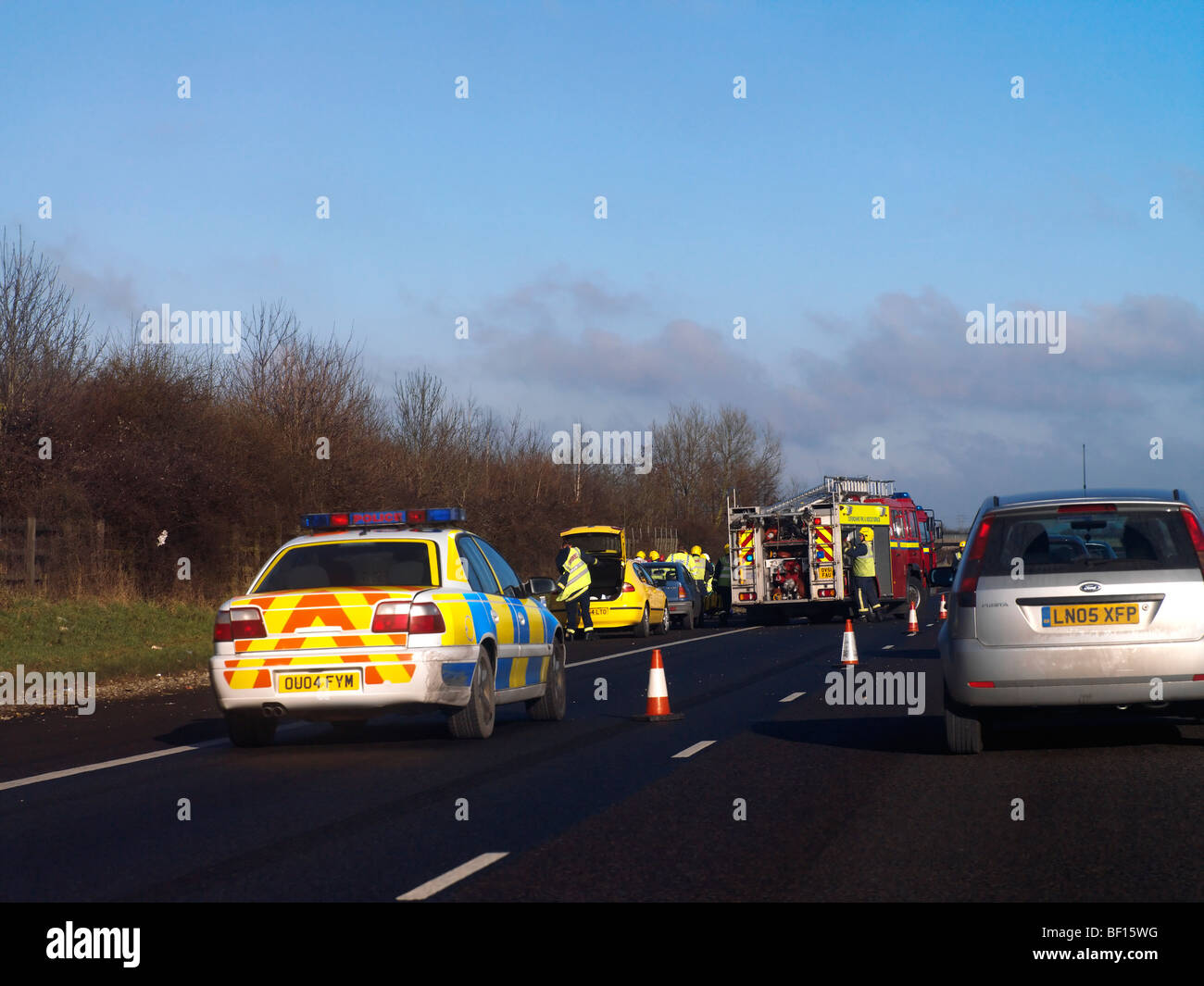
You’re sitting there. The red lights are pulsing against the roof of your car. Somewhere up ahead, maybe three miles past the Warwick services or just before the High Wycombe turn-off, there’s been another accident on the M40. It’s a familiar, frustrating reality for anyone who commutes between London and Birmingham. But while we all groan about the delay and check Google Maps for a frantic detour through some tiny village in the Cotswolds, there is a massive, complex machine that kicks into gear the second that 999 call is placed.
It's chaotic. It's loud. And frankly, it's a miracle it doesn't happen more often given the speeds involved.
The M40 is a bit of an outlier in the UK motorway network. Unlike the M1 or the M6, which feel like perpetual construction sites, the M40 often feels "fast." It’s wide. It’s relatively straight. That’s exactly why when things go wrong, they go spectacularly wrong. High-speed impacts aren't just about dented bumpers; they involve kinetic energy levels that the human body wasn't designed to handle. We're talking about physics at its most unforgiving.
The First Golden Hour After an Accident on the M40
Emergency responders talk about the "Golden Hour." This isn't just a catchy phrase from a TV drama. It’s the window where medical intervention has the highest chance of preventing a fatality. When an accident on the M40 occurs, the Thames Valley Police or Warwickshire Police—depending on where you are—are usually the first to coordinate the response. National Highways (formerly Highways England) are the ones who actually manage the "traffic car" side of things, setting up those lane closures that make you sigh behind the wheel.
It starts with the sensors. The M40 uses MIDAS (Motorway Incident Detection and Automatic Signalling). If the flow of traffic suddenly drops or stops, the system knows. It triggers the overhead gantries. But here is the thing: the gantries can't tell the difference between a minor breakdown and a multi-vehicle pile-up. That requires "eyes on." Usually, that’s a mix of CCTV and the first callers on the scene.
Most people don't realize that the hard shoulder isn't a safe haven. It’s actually one of the most dangerous places to be. Data from National Highways consistently shows that a stationary vehicle on a motorway is a sitting duck. If you’ve been involved in a shunt, the advice is always the same: get out, get over the crash barrier, and stay well back. Even if it’s raining. Especially if it’s raining.
Why the M40 Is "Different" for Crash Investigators
There’s a specific stretch of the M40, particularly through the Chiltern Hills, where the weather plays a massive role. You’ve probably noticed it. You’re driving in clear sunshine near Beaconsfield, and suddenly, you hit a wall of fog or a localized downpour near Stokenchurch. The elevation change creates micro-climates. This leads to "shunting" accidents where drivers haven't adjusted their following distance for the reduced visibility.
When a serious accident on the M40 happens, the road doesn't just "stay closed" because the police are being slow. It stays closed because of the Forensic Collision Investigation (FCI). These teams treat the motorway like a crime scene. They use 3D laser scanners—specifically instruments like the Leica RTC360—to create a digital twin of the crash site. They have to map every skid mark, every fragment of glass, and the final resting position of every vehicle.
Why? Because if there's a fatality or a life-changing injury, the Crown Prosecution Service (CPS) needs evidence that holds up in court. If they move the cars too early, that evidence is gone forever. You might be sitting in traffic for four hours, but a few hundred yards ahead, someone is meticulously measuring the friction coefficient of the tarmac to see if a car was speeding or if the road surface was at fault.
The Logistics of Clearing the Carriage
Let’s talk about the cleanup. It’s a nightmare. A single HGV fire can reach temperatures exceeding 1,000 degrees Celsius. That doesn't just melt the truck; it melts the road. The bitumen in the asphalt essentially "cooks." If an accident on the M40 involves a fire or a significant fuel spill, National Highways often has to plane off the top layer of the road and resurface it before they can let you back on.
Diesel is particularly nasty. It eats through the binder in the tarmac almost instantly. If you see a "hydro-blaster" truck on the scene, that's what they're doing—trying to save the road surface so they don't have to keep the motorway closed for a full resurfacing job.
Then there’s the recovery. Specialized heavy recovery operators, like those seen on Motorway Cops, use massive rotators to lift flipped lorries. It’s a delicate dance of hydraulics. If they drop it, they break the road. If they don't secure it, it tips. It’s high-stakes engineering under the pressure of thousands of angry motorists.
Dealing With the Psychological Aftermath
We focus a lot on the metal and the tarmac. But there's the human side. Survivors of a major accident on the M40 often deal with Acute Stress Disorder (ASD), which can evolve into PTSD. The sound of a motorway at 70mph is a constant white noise; after a crash, that noise becomes a trigger.
Charities like Brake do incredible work supporting victims, but the immediate aftermath is often a blur of insurance claims and police statements. If you're ever a witness, your dashcam footage is gold. The police will often set up a dedicated portal for a specific incident to collect this data. It’s the modern version of the "witness appeal" sign on the side of the road.
Honestly, the best thing you can do if you're stuck in the backlog is to stay in your vehicle. It sounds counterintuitive if you've been stopped for two hours, but people wandering onto the other carriageway or trying to walk to the nearest exit cause "secondary incidents." A secondary incident is exactly what it sounds like: a second crash caused by the distraction or chaos of the first one. These are often more dangerous than the original wreck.
How to Check for Real-Time M40 Updates
If you're currently trying to figure out if you'll make it home for dinner, don't rely on one source. Google Maps is great for traffic flow, but it's "laggy" with official closures.
- National Highways (X/Twitter): Their regional feeds (@HighwaysEAST or @HighwaysWMIDS) are the most accurate for official reopening times.
- Waze: Better than Google for user-reported hazards like debris or cars on the shoulder.
- Radio 2 (188 kHz or 88-91 FM): Old school, but their traffic bulletins are still incredibly fast because they get direct feeds from the police control rooms.
Staying Safe: The Proactive Approach
Look, most accidents on the M40 are preventable. Tailgating is the number one cause of the "ripple effect" braking that leads to pile-ups. If you can't see the tires of the car in front of you touching the road, you're too close. Simple as that.
Also, check your tires. Seriously. Motorway speeds generate immense heat. If your tires are under-inflated or the tread is low, that's when blowouts happen. A blowout at 70mph on the M40 isn't a "pull over and change it" situation; it’s a "fight to stay in your lane" situation.
Practical Steps to Take Right Now:
- Download the "What3Words" App: If you crash on a rural stretch of the M40, telling the operator "I'm somewhere between junction 11 and 12" isn't helpful enough. Giving them three words can pinpoint your car to a 3-meter square.
- Keep a High-Vis in the Glovebox: Not the boot. The glovebox. You want to be able to put it on before you step out of the car.
- Check the "Red X": If you see a red X on a gantry, the lane is closed. Not "closing soon." Closed. Driving under a red X is an automatic fine and points, but more importantly, it's how recovery workers get killed.
- Dashcam Maintenance: Ensure your SD card hasn't "looped over" or failed. A working dashcam can save you thousands in insurance premiums if an accident isn't your fault.
The M40 is a vital artery for the UK. When it stops, the country feels it. Being aware of the risks and the "why" behind the delays doesn't just make you a more patient driver—it might just keep you out of the statistics.
Next Steps for Road Safety:
- Check your vehicle's tire pressure and tread depth before any long-distance motorway journey.
- Review the Highway Code's specific sections on smart motorways and hard shoulder usage.
- Register your vehicle's emergency contact details on your phone's "Medical ID" feature for first responders.