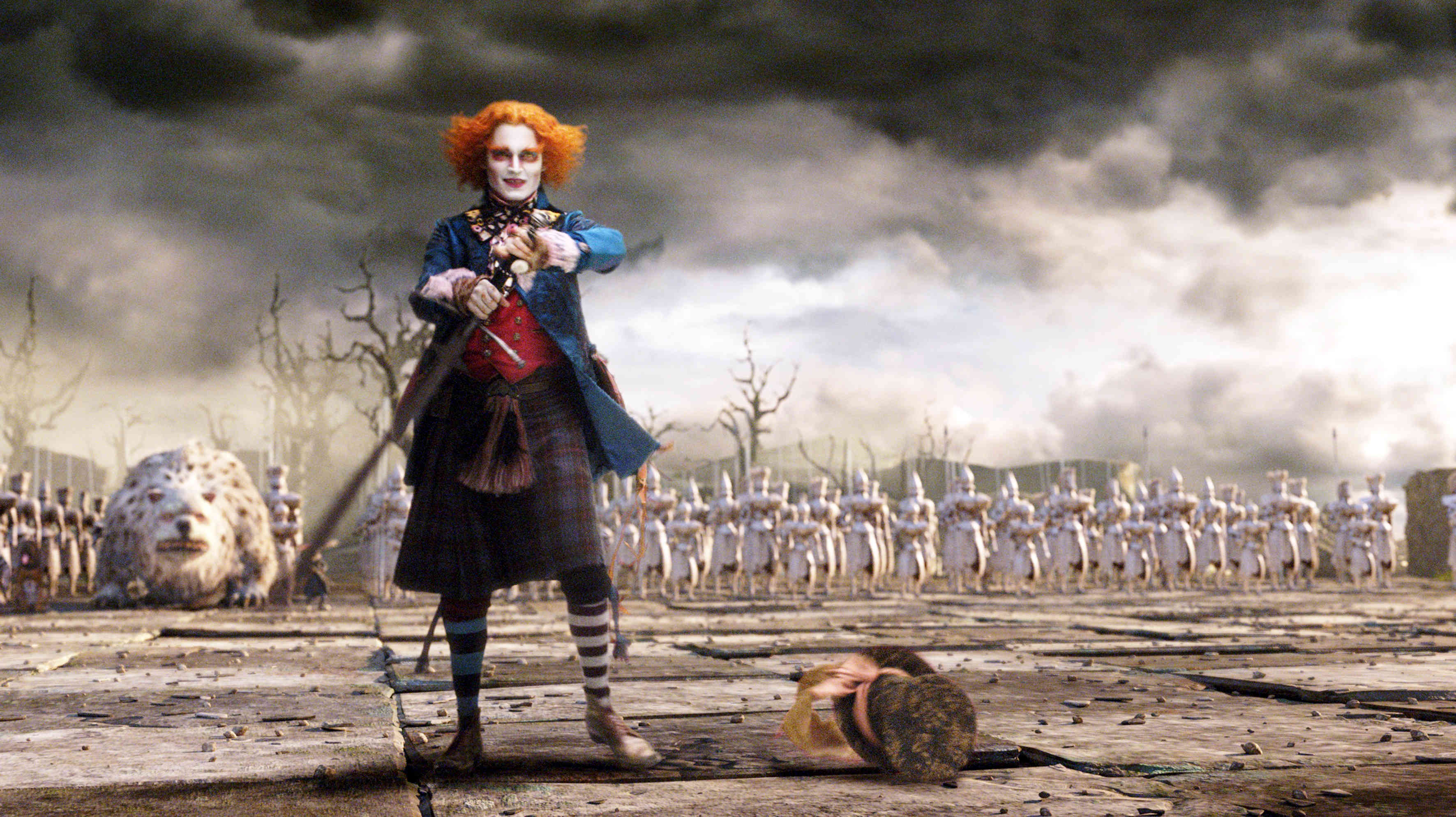
When Disney dropped the first trailer for Tim Burton’s take on Alice in Wonderland back in 2009, the internet basically melted. People weren't just looking at the neon-colored landscape or the weirdly elongated neck of the Red Queen. They were staring at Alice in Wonderland with Johnny Depp. Specifically, they were staring at those glowing orange eyes, the shock of frizzy carrot-colored hair, and a gap-toothed grin that felt more like a fever dream than a Disney character. It was a massive gamble.
It worked. At least, financially.
The movie raked in over a billion dollars. It kicked off an entire era of Disney live-action remakes that we’re still living through today. But if you look back at the 2010 release, the conversation isn't really about Alice herself. It's about how Depp took a secondary character—the Mad Hatter—and shoved him right into the center of the frame. Some people loved the eccentricity. Others felt it was the moment "Peak Depp" started to feel a bit like a caricature. Honestly, it’s a complicated legacy.
The Method Behind the Makeup
Most people think Depp just threw on some face paint and winged it. That’s actually not true. He spent months researching the "Mad as a Hatter" phenomenon. Historically, 19th-century hatters suffered from actual mercury poisoning because they used the chemical to cure the felt in hats. It caused tremors, mood swings, and hallucinations. Depp took that literal medical history and baked it into his performance.
"I think he was poisoned," Depp once said in an interview with Hero Complex. He didn't see the Hatter as just "crazy" for the sake of being a cartoon. He saw him as a man whose mind was physically eroding.
If you watch closely, you'll notice the Hatter’s skin tone and clothes change based on his mood. It’s a subtle touch from the VFX team, but it anchors Depp's performance. When he’s scared, he turns gray. When he’s manic, the colors pop. It’s wild. This wasn't just a paycheck role; it was a character study wrapped in a neon-colored CGI wrapper.
Why the Mad Hatter Became the Lead
In Lewis Carroll’s original book, the Mad Hatter is a set piece. He’s a guy at a tea party who asks a riddle with no answer. In the movie, Tim Burton and screenwriter Linda Woolverton turned him into a revolutionary. He’s the heart of the resistance against the Red Queen.
Why? Because it’s Alice in Wonderland with Johnny Depp. You don't hire the biggest movie star on the planet to sit at a table for five minutes and talk about ravens and writing desks.
This shift changed the stakes of the story. Suddenly, Alice had a mentor—or maybe a soulmate? The chemistry between Mia Wasikowska and Depp was purposefully vague and a little bit haunting. It gave the film an emotional core that the original story lacked, even if it frustrated the purists who wanted a literal adaptation of the book.
The Futterwacken Controversy
We have to talk about it. The dance.
At the end of the film, when the Jabberwocky is defeated, the Mad Hatter breaks out into a breakdancing routine called the "Futterwacken." For many critics, this was the "jump the shark" moment. It felt disjointed. It felt like "too much." Even today, if you browse film forums, the Futterwacken is cited as the peak of Tim Burton’s late-career indulgence.
But for kids in 2010? They loved it. It was meme-worthy before memes were even a primary currency of the internet. It showed a version of Depp that was completely uninhibited. He wasn't trying to be cool. He was being a weirdo.
The Visual Impact of Alice in Wonderland with Johnny Depp
The costume design by Colleen Atwood won an Oscar, and for good reason. The Mad Hatter’s outfit is a masterpiece of detail. His bandolier isn't filled with bullets; it’s filled with spools of thread. His hat has a 10/6 price tag pinned to it—a direct nod to the original illustrations by John Tenniel.
Depp actually did his own watercolor sketches of what he thought the Hatter should look like. He imagined the character with orange hair because mercury poisoning often caused hair to thin or change color. When he showed the sketches to Burton, the director reportedly said, "That’s it."
- The Eyes: Digitally enlarged by about 10% to make him look more like a creature than a human.
- The Voice: Depp used a distinct Scottish lilt when the character became aggressive or emotional, a nod to his "darker" side.
- The Hands: He’s always fiddling with something. It’s that mercury-induced "hatter’s shake."
Critical Reception vs. Reality
Critics were harsh. The movie sits at a 51% on Rotten Tomatoes. They called it style over substance. They said Depp was doing "Jack Sparrow in a top hat."
But the audience didn't care. The movie grossed $1.025 billion. It proved that there was a massive appetite for dark, gothic retellings of childhood stories. Without this film, we probably don't get Maleficent, Cinderella, or the Beauty and the Beast remake. For better or worse, Alice in Wonderland with Johnny Depp changed the business model of Hollywood for a decade.
The 2016 Sequel: Through the Looking Glass
When the sequel arrived, the novelty had worn off a bit. James Bobin took over the directing chair from Burton. The story focused even more heavily on the Hatter’s past—specifically his relationship with his father, played by Rhys Ifans.
While the sequel didn't hit the heights of the first one, it added a layer of tragedy to Depp’s portrayal. We saw the Hatter as a broken son, not just a whimsical tea-drinker. It’s a quieter performance. Less Futterwacken, more grief. It’s worth a re-watch if you only remember the loud parts of the first movie.
Practical Insights for Fans and Collectors
If you're a fan of this specific era of film, there’s actually a lot of depth to explore beyond the screen.
First, look for the "Making Of" featurettes that focus on the physical props. Most of the movie was shot on a green screen, but the costumes and some of the tea party props were physical. Seeing Depp interact with a green void while wearing that level of prosthetic makeup is a masterclass in acting.
Second, if you're a collector, the Alice in Wonderland pieces from this era are actually holding their value. The Disney Store released a series of "Limited Edition" dolls modeled after Depp’s Hatter and Helena Bonham Carter’s Red Queen. Because they were so polarizing, they’ve become cult favorites.
Lastly, check out the original Lewis Carroll text again. If you read it after watching the movie, you’ll realize how much of Depp’s dialogue is actually pulled from the book—but delivered with a completely different subtext. It’s a fascinating exercise in how a performer can change the meaning of words just by shifting their tone of voice.
Next Steps for the Alice Enthusiast
To truly appreciate the craft, watch the film again but mute the sound during the tea party scene. Observe Depp’s physical tics. The way he moves his fingers, the way his eyes dart around. It’s a very physical performance that gets overshadowed by the CGI. Afterward, compare his performance to the 1951 animated version. You'll see that while the 2010 version is "darker," it actually honors the chaos of the original character more than most people give it credit for.
Ultimately, the film stands as a time capsule of a specific moment in cinema. It was the peak of the Burton-Depp partnership. It was the birth of the modern Disney remake. And it was a showcase for a movie star who wasn't afraid to look absolutely ridiculous in the name of art.