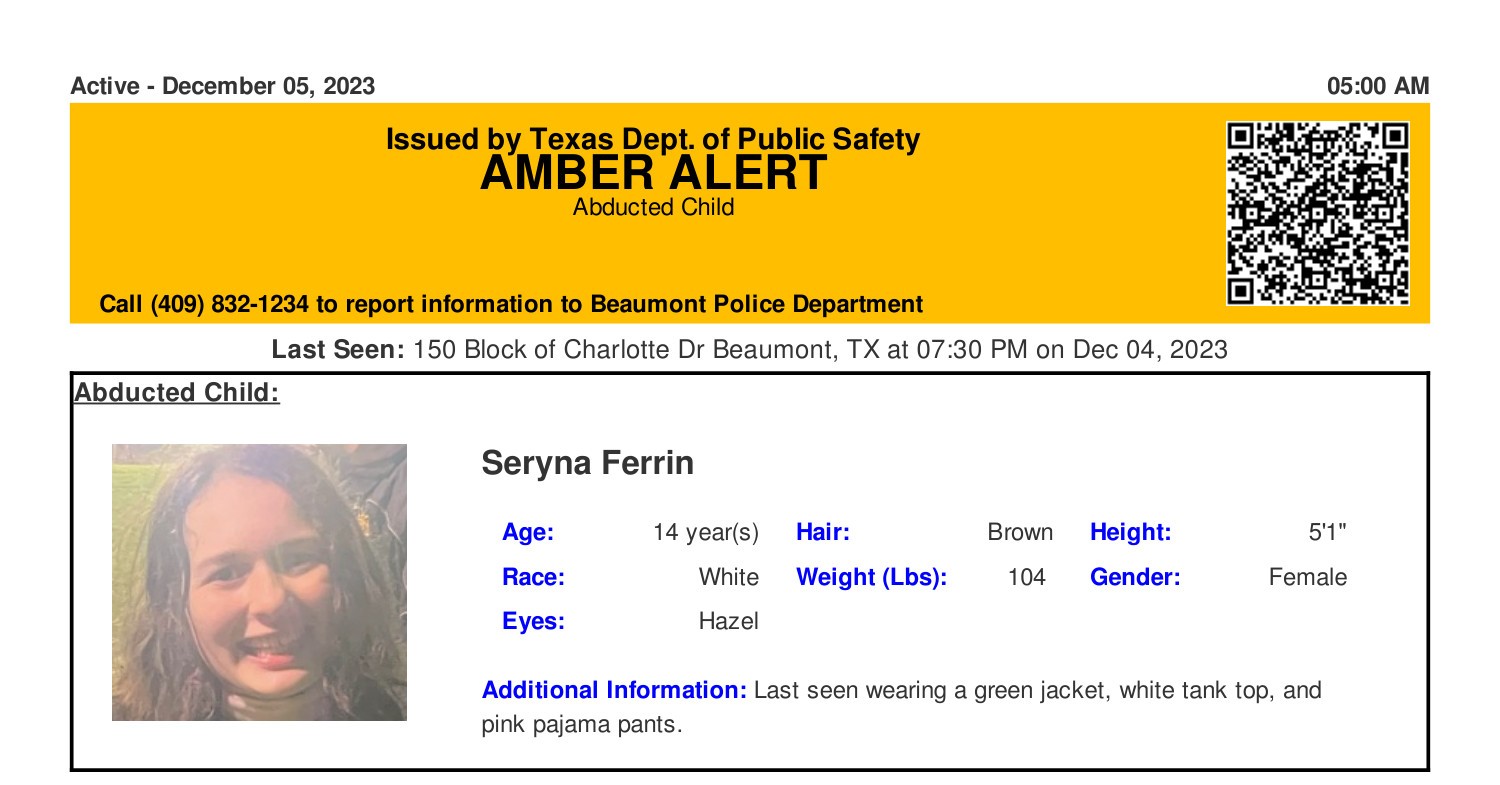
Your phone starts wailing. That jarring, high-pitched screech interrupts your dinner or wakes you from a dead sleep. You glance at the screen and see a wall of text about a license plate and a vehicle description. It’s an AMBER Alert. Most people know it has something to do with a missing kid, but the meaning of AMBER Alert goes way deeper than a simple notification. It’s a high-stakes race against the clock where every second literally determines if a child comes home or becomes a statistic.
It's terrifying. Truly.
The system isn't just a random alarm; it’s a sophisticated partnership between law enforcement, broadcasters, and transportation agencies. It stands for America's Missing: Broadcast Emergency Response. But let's be real—the name is also a tribute. It’s named after Amber Hagerman, a nine-year-old girl who was abducted while riding her bike in Arlington, Texas, back in 1996. Her story ended in tragedy, and the community response to that horror eventually birthed the system we have today.
The Tragic Origin That Changed Everything
In January 1996, Amber Hagerman was just being a kid. She was riding her bicycle in a grocery store parking lot. A man in a black pickup truck grabbed her. A neighbor saw it happen and called the police immediately, but it wasn't enough. Four days later, her body was found in a creek. The killer was never caught.
The community was outraged and heartbroken. They didn't want this to happen to anyone else. Local radio stations in Dallas-Fort Worth teamed up with police to create a system that would alert the public immediately after a kidnapping. They figured if everyone knew what to look for within minutes, the kidnapper wouldn't have anywhere to hide. They were right.
Honestly, the system stayed local for a while. It took years for it to become the national powerhouse it is now. By 2003, President George W. Bush signed the PROTECT Act, which formally established the national AMBER Alert coordinator position within the Department of Justice. Now, it's in all 50 states, plus territories like Puerto Rico and the U.S. Virgin Islands. It’s even gone international with similar systems in Canada, Mexico, and parts of Europe.
What Triggers the Screeching Alarm?
Not every missing child case gets an alert. This is a point of huge confusion for a lot of people. You might hear about a runaway teen and wonder why your phone didn't go off. There are strict criteria set by the Department of Justice, though states have some wiggle room to tweak them.
Police have to believe an abduction has actually occurred. They can't just send it out for a kid who wandered off into the woods or a teenager who skipped town with a boyfriend. There has to be a reasonable belief by law enforcement that the child is in imminent danger of serious bodily harm or death. This is the "life or death" threshold. If they cried wolf every time a kid was late for curfew, people would just disable the alerts entirely.
Descriptive information is the third big pillar.
If the police don't have a license plate, a vehicle make/model, or a solid description of the suspect, an alert might not be issued. Why? Because without actionable data, the public is just looking at every car on the road with suspicion, which causes chaos and slows down the actual investigation. The child also generally has to be 17 years of age or younger. Finally, the information has to be entered into the National Crime Information Center (NCIC) system immediately.
The Meaning of AMBER Alert vs. Other Notifications
You’ve probably seen "Silver Alerts" or "Blue Alerts" pop up too. It gets a bit crowded on your lock screen. A Silver Alert is usually for missing seniors with Alzheimer's or dementia. Blue Alerts are for when a suspect who has killed or seriously injured a law enforcement officer is on the loose.
Then you have the WEA—Wireless Emergency Alerts. This is the tech that actually pushes the message to your smartphone. It uses cell tower geofencing. If you’re in the search area, your phone pings. If you drive ten miles out of that zone, it stops. It’s incredibly precise, which is why you should never ignore one just because you "don't live in that neighborhood." You might be driving through the very intersection where the suspect is sitting at a red light.
Why People Get Annoyed (and Why They Shouldn't)
We’ve all been there. You’re in a movie theater or a quiet meeting, and twenty phones go off at once. It’s startling. Some people even go into their settings to turn them off.
"Fatigue" is a real thing in the world of emergency management. If you hear the alarm too often, you stop looking. But the statistics are hard to argue with. According to the National Center for Missing & Exploited Children (NCMEC), over 1,100 children have been successfully recovered specifically because of AMBER Alerts as of early 2024. That’s over a thousand families who didn't have to bury a child.
The system works because it turns the entire population into "force multipliers" for the police. Instead of two cops looking for a white sedan, you have two million people looking for it. The kidnapper suddenly realizes that every person with a smartphone is a potential informant. That pressure often leads to the suspect abandoning the child in a safe place just to get away from the heat.
The Ethics of the Alert System
It's not all sunshine and rainbows, though. There are legitimate criticisms regarding how these alerts are issued. Data has shown that there can be racial disparities in which cases get the "full court press" of an AMBER Alert.
Some studies suggest that white children are more likely to meet the "imminent danger" criteria in the eyes of investigators compared to minority children, who might be more quickly labeled as "runaways." This is a heavy, uncomfortable truth that the DOJ and various advocacy groups are constantly working to fix. The "meaning of AMBER Alert" has to be the same for every child, regardless of zip code or skin color.
There's also the "Family Abduction" complication. A huge chunk of kidnappings aren't "stranger danger" scenarios; they are parents taking children in violation of custody orders. These are still dangerous, but the public sometimes perceives them as "lesser" emergencies. Law enforcement disagrees. A desperate parent facing a loss of custody can be just as dangerous to a child as a stranger.
What You Should Actually Do When You See One
Don't just swipe it away. You don't need to go out and play Batman, either.
- Read the vehicle description twice. Memorize the color and the last three digits of the plate if they’re provided.
- Scan your immediate surroundings. If you're driving, look at the cars next to you at the next light. If you're at a gas station, look at the pumps.
- Check your mirrors. 4. Share on social media? Maybe. Only share if it’s from an official police source. Old alerts circulate for years after a child is found, which actually hurts the system by clogging up feeds with "stale" news.
- Call 911 only with a sighting. Don't call the police to ask for more info or to complain about the noise. You’re tying up lines that need to stay open for the person who actually sees the car.
If you do see the vehicle, don't follow it. Stay back. Note the direction of travel and the nearest exit or cross street. Give the dispatcher as much detail as possible about the driver's appearance.
The Future of the System
We are moving past just simple text. In 2026, we’re seeing more integration with digital billboards, Uber and Lyft driver apps, and even delivery van networks. The goal is to make the "search net" so tight that a kidnapper can't travel five miles without being spotted.
Technologists are also working on "silent" alerts that might vibrate your watch or pop up on your car's infotainment screen without the heart-attack-inducing sound, though the "loudness" is arguably a feature, not a bug. It demands your attention. It forces you to look.
Ultimately, the meaning of AMBER Alert is a collective promise. It’s a society saying that the safety of a child outweighs the minor inconvenience of a loud noise. It’s a legacy for a little girl in Texas who didn't have a whole nation looking for her when she needed it most.
Actionable Steps for Your Personal Safety Plan:
- Audit Your Settings: Go to your smartphone's "Notifications" or "Emergency Alerts" section. Ensure AMBER Alerts are toggled ON. While you're there, check that "Public Safety Alerts" are also active.
- Educate Your Family: Explain to your kids what that sound is. Tell them it means everyone is working together to help a child get home. This reduces their fear if your phone goes off while you're driving.
- Follow Official Sources: Follow the National Center for Missing & Exploited Children on a platform you use regularly. They provide the most accurate, real-time updates that go beyond what fits in a text alert.
- Observe Your Surroundings: Make it a habit to be "situationally aware." When an alert hits, take 30 seconds to look at your environment. That small window of focus is often the difference between a cold case and a rescue.