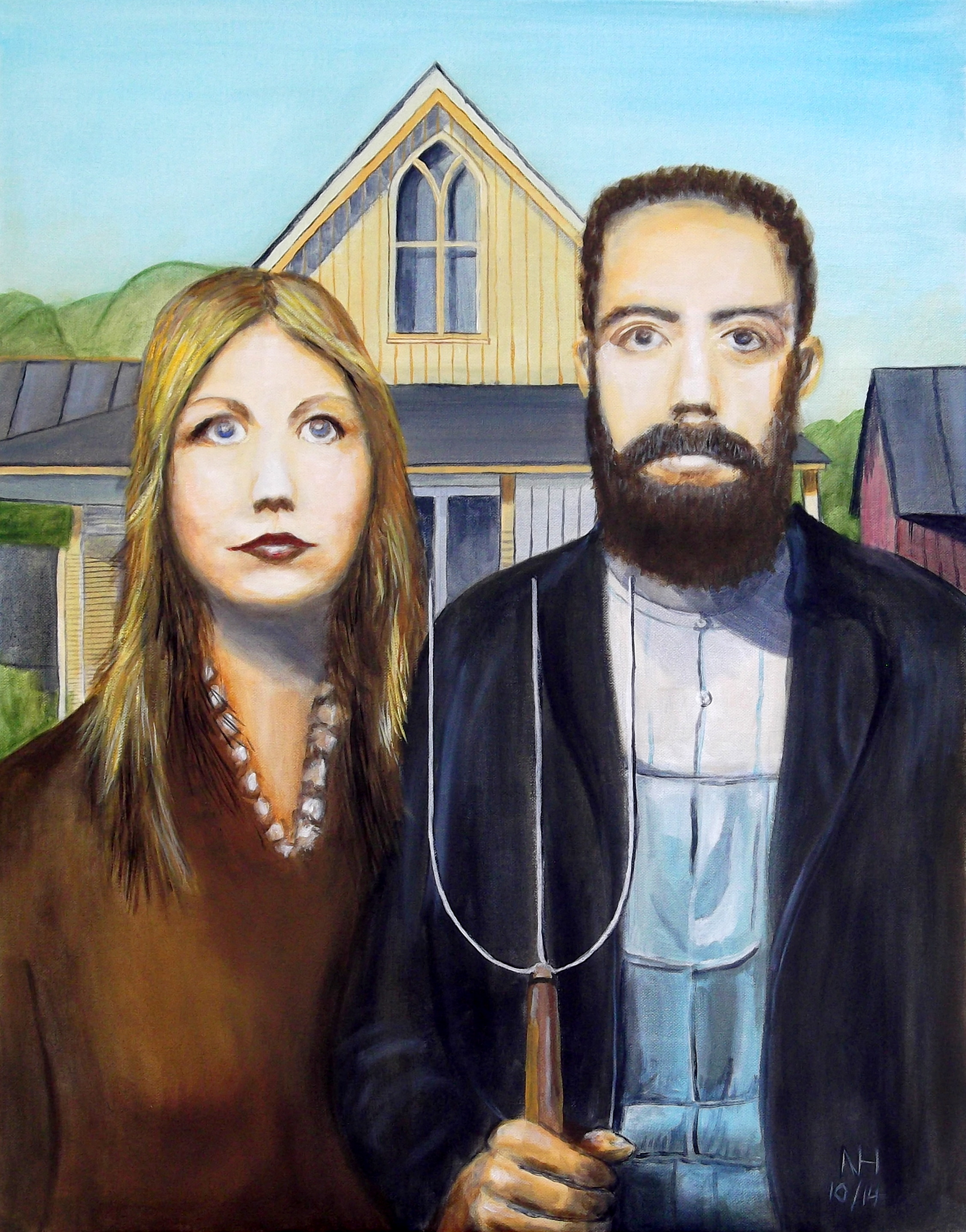
You’ve seen it everywhere. It's on cereal boxes, political posters, and a million low-effort memes. The man with pitchfork painting—officially titled American Gothic—is arguably the most parodied work of art in history. But honestly? Most people get the story completely wrong. They think it’s a husband and wife. They think it’s a tribute to "salt of the earth" farmers.
It isn't. Not really.
Grant Wood, a guy from Iowa who liked to wear overalls even when he wasn't farming, painted this in 1930. He’d just come back from Europe, where he’d been obsessed with Northern Renaissance art. You know, those crisp, almost eerie paintings by guys like Jan van Eyck. He wanted to bring that sharp, unforgiving detail to the American Midwest.
The result? A masterpiece that managed to offend almost everyone in Iowa the moment it went public.
Who Are These People, Anyway?
Let’s kill the biggest myth first. The people in the man with pitchfork painting are not a married couple. They’re a father and his spinster daughter. Wood actually used his sister, Nan Wood Graham, and his family dentist, Dr. Byron McKeeby, as models.
He didn't even paint them together.
Dr. McKeeby stood for his portrait separately. Nan stood for hers. Wood stretched her face out in the painting to make her look older and more "severely" Midwestern. Nan wasn't thrilled about it. She spent years telling people it was a father-daughter duo because the idea of her being married to a man twice her age (the dentist) was, frankly, gross to her.
The pitchfork is the real star of the show. If you look closely at the man’s denim overalls, the stitching on his shirt, and even the windows of the house in the background, you’ll see the three-pronged shape of the pitchfork repeated. It’s a visual anchor. It suggests a defensive posture. It says, "Stay off my lawn," before that was even a thing.
The House That Started It All
Wood didn't just invent the scene. He was driving through Eldon, Iowa, and saw a tiny white house built in the "Carpenter Gothic" style. It had this ridiculously fancy window—the kind you’d see on a cathedral—stuck onto a humble wooden frame.
It was weird. Wood thought it was "formidably printable."
He sketched the house on an envelope. He didn't care about the people living there at the time; he just wanted to imagine what kind of "narrow-minded" people would live in a house like that. That’s the irony. The painting that we now view as a patriotic symbol of American resilience was actually intended, at least partially, as a satire.
Why 1930s Iowans Hated It
When the painting won a bronze medal at the Art Institute of Chicago and the story hit the Des Moines newspapers, Iowa went ballistic. Farm wives felt insulted. One woman reportedly told Wood he should have his head "bashed in." They thought he was portraying them as grim, pinched, and out of touch.
They weren't wrong.
But then the Great Depression hit hard.
Suddenly, the perception shifted. The man with pitchfork painting stopped being a joke about rural "rubes" and started being a symbol of the "pioneer spirit." People saw the man’s firm grip on his tool and the woman’s protective stance and thought: These are people who survive. They aren't smiling because life is hard, and they are tougher than the dust storms and bank failures.
The Subtle Details You’re Missing
Look at the woman's hair. One single lock has escaped her tight bun. It’s a tiny crack in the armor of her perfectionism. Or look at the plants on the porch. Those are snake plants and geraniums—hardy, domestic plants that survive even when ignored.
The man’s hand is also interesting. It’s huge. It’s a worker’s hand, but he’s wearing a formal black jacket over his work clothes. This wasn't a candid snapshot of a farmer at work. This was them "dressed up" for a portrait, showing their best, most rigid selves to the world.
Why the Pitchfork Matters Today
The pitchfork represents more than just hay. In the context of the 1930s, it was an outdated tool. By then, most farmers were moving toward mechanization. By giving the man a hand-tool, Wood was intentionally looking backward. He was capturing a version of America that was already disappearing even as he painted it.
This is why the painting is a "meme" in the truest sense of the word. It’s a flexible container for our anxieties about class, tradition, and "the heartland." Whether you see it as a celebration of hard work or a critique of religious rigidity, you're right. Wood was notoriously vague about his "true" meaning, likely because he enjoyed the debate.
How to Experience American Gothic Properly
If you actually want to understand the man with pitchfork painting, you can't just look at a digital thumbnail. The texture matters. The way Wood used oil and Beaver Board (a type of fiberboard) gives it a flat, almost clinical feel that mimics 15th-century Flemish art.
- Visit the Art Institute of Chicago. It lives there. Stand close enough to see the individual brushstrokes on the man's face.
- Go to Eldon, Iowa. The house is still there. It’s a museum now. You can actually stand in front of it and take your own "Gothic" photo.
- Read Grant Wood’s manifesto. He wrote a piece called Revolt Against the City. It explains why he hated the New York art scene and why he thought painters should stay in their own backyards.
- Look at the parodies with a critical eye. From The Muppets to The Rocky Horror Picture Show, every parody changes the power dynamic between the two figures. Ask yourself: who is holding the pitchfork in this version?
The man with pitchfork painting isn't just a piece of Americana. It’s a mirror. It reflects whatever we feel about rural life, family, and the defensive walls we build around our homes. It’s uncomfortable because it’s honest about our desire to be seen as respectable, even when we’re just barely holding on.
Next time you see it, don't just laugh at the sour expressions. Look at the grip on that pitchfork. It’s not just a tool; it’s a statement of defiance.