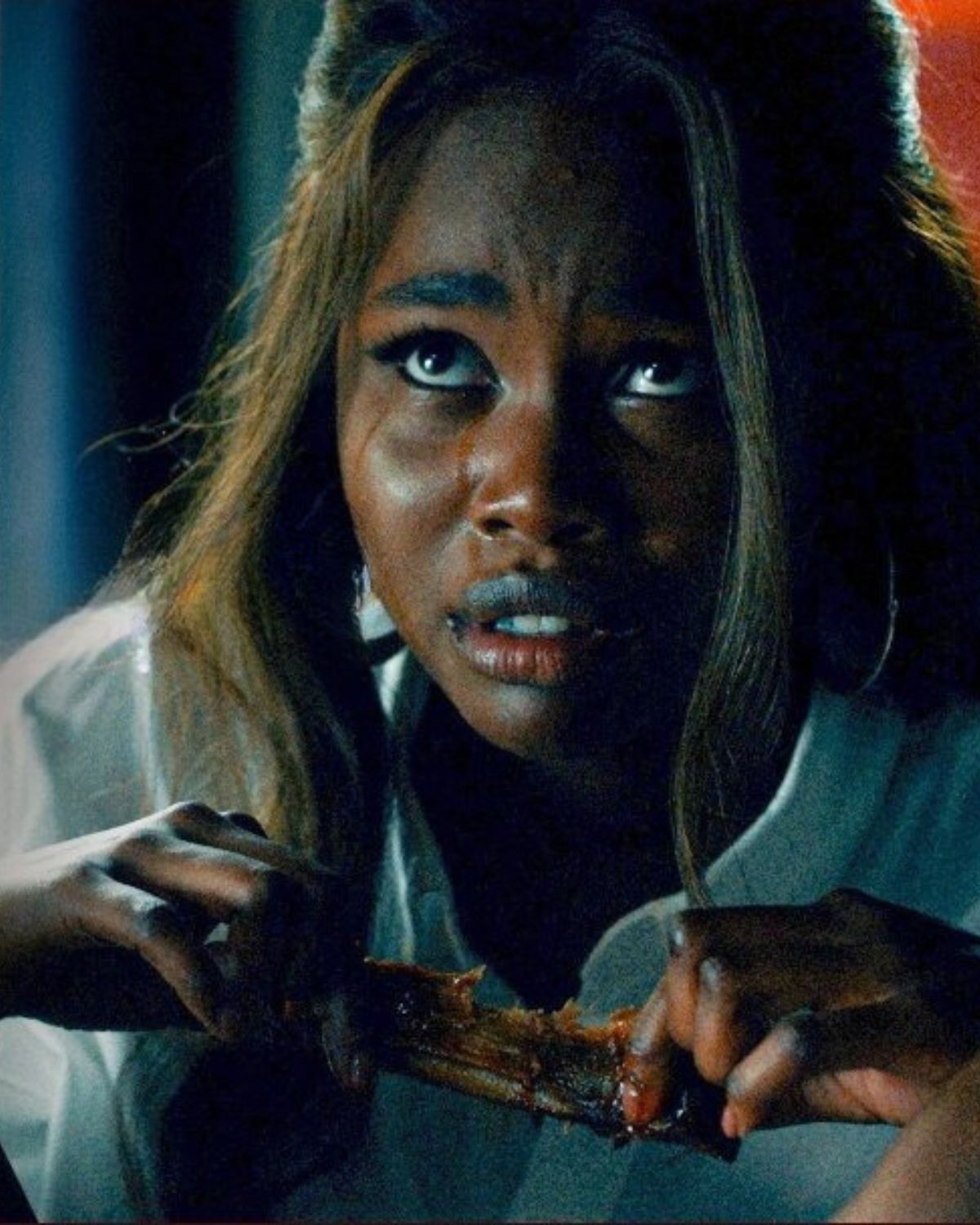
Body horror is a tricky beast. Some people hate it. Others crave that skin-crawling sensation that makes you want to jump out of your own skeleton. When American Horror Stories dropped the episode titled "Tapeworm" during its third season, it didn't just push the envelope; it basically shredded it. Honestly, it’s one of those hours of television that stays with you long after the credits roll, mostly because it taps into a very specific, very primal fear about what we put into our bodies and the lengths we’ll go to for "perfection."
The episode stars Laura Kariuki as Vivian, an aspiring model who is desperate to make it in an industry that demands the impossible. It’s a classic Faustian bargain scenario. You've seen this trope before, right? Someone wants fame, someone wants beauty, and they pay a price that is way too high. But "Tapeworm" takes that concept and makes it literal, visceral, and deeply gross.
Vivian is told she isn't "thin enough" for the high-fashion world. It’s a critique she’s heard a million times. Then she meets a mysterious doctor—played with a chilling, detached vibe by Rob Yang—who offers her a "supplement." It’s a tapeworm. Not just any parasite, though. This thing is ancient, biological, and has a hunger that defies the laws of nature.
The Reality Behind the American Horror Stories Tapeworm Nightmare
Let’s get one thing straight: the "tapeworm diet" isn't just a horror movie invention. It’s a real, terrifying piece of history. Back in the Victorian era and even into the early 20th century, people actually sold pills that allegedly contained tapeworm larvae. The idea was simple: eat whatever you want, and the worm eats the calories.
In reality, it’s a recipe for disaster. Real tapeworms, like Taenia saginata (beef tapeworm) or Taenia solium (pork tapeworm), don't just "eat your extra calories." They cause malnutrition, abdominal pain, and in severe cases, they can migrate to your brain or other organs. It's called cysticercosis. It’s deadly.
In American Horror Stories, the "Tapeworm" isn't a standard parasite. It’s something much more aggressive. It’s a narrative device used to critique the "heroin chic" aesthetic and the brutal standards of the modeling industry. Vivian’s transformation is fast. She gets the look. She gets the jobs. She becomes the "it girl." But the cost is her humanity. She’s literally being eaten from the inside out while she smiles for the camera.
The pacing of this episode is frantic. One minute she's eating a burger with a weirdly intense joy, and the next, she's experiencing internal movements that look like a scene out of Alien. It’s that contrast between the glamorous exterior and the rotting interior that makes the American horror stories tapeworm plot so effective.
Why Body Horror Works (And Why This Episode Is So Effective)
Horror thrives on the loss of control. When a slasher is chasing you, you've lost control of your environment. When a ghost haunts your house, you've lost control of your sanctuary. But body horror? That’s losing control of your own physical self.
Vivian thinks she’s using the worm as a tool. She thinks she’s the one in charge. But parasites, by definition, take over. The episode does a fantastic job of showing the shift in power. Eventually, Vivian isn't the one hungry anymore; the worm is. And it has a preference for more than just salad.
The visual effects in "Tapeworm" are surprisingly high-quality for a spin-off series. There’s a scene involving a bathroom mirror and a very long, very thin piece of... well, let’s just say it’s the parasite making an appearance. It’s the kind of practical-looking effect that makes your stomach do a flip.
The Social Commentary Most People Miss
It’s easy to dismiss this as just a "gross-out" episode. But if you look closer, "Tapeworm" is a scathing indictment of the "wellness" industry and social media's obsession with filtered perfection. We live in an era of Ozempic and extreme "biohacking." People are taking massive risks with their health to achieve a specific look.
Vivian’s doctor represents that segment of the medical world that prioritizes aesthetics over ethics. He doesn't care if she lives or dies; he cares if she fits the sample size. The American horror stories tapeworm is a metaphor for the industry itself—it consumes young talent, uses them until they’re hollow, and then moves on to the next host.
There’s a specific nuance in Laura Kariuki’s performance. You can see the moment her ambition turns into addiction. It's not about the modeling anymore; it's about the feeling of being "empty." It’s a haunting portrayal of an eating disorder amplified by a supernatural element.
Comparison to Other AHS Body Horror
Ryan Murphy and Brad Falchuk love body horror. We’ve seen it in Nip/Tuck, and we saw it in AHS: Asylum with the experiments of Dr. Arden. But "Tapeworm" feels more grounded in modern anxiety.
Unlike the over-the-top gore of AHS: Hotel, this episode feels claustrophobic. It stays close to Vivian. We feel her hunger. We feel her panic when the "supplement" starts demanding more. It’s much closer in tone to something like David Cronenberg’s The Fly than a standard slasher.
What Actually Happens at the End? (Spoilers Ahead)
The ending of the American horror stories tapeworm episode is where things get truly dark. Vivian realizes she can’t live with the thing inside her, but she also can’t live without what it gave her. The resolution isn't a happy one. It’s a "be careful what you wish for" cautionary tale taken to its most extreme conclusion.
Without giving away every single beat, the finale involves a high-stakes fashion show where Vivian’s internal passenger decides it’s time for its runway debut. It’s messy. It’s loud. It’s undeniably American Horror Story.
What’s interesting is the reaction from the audience within the show. They don't run in terror immediately. For a second, they think it’s art. That’s the most biting part of the commentary—the idea that the industry is so desensitized to suffering that it mistakes a literal life-and-death struggle for a bold fashion statement.
The Science (or Lack Thereof)
Look, obviously, a tapeworm isn't going to turn you into a supermodel overnight or develop a consciousness that allows it to manipulate your vocal cords. But the episode plays with "biological plausibility" just enough to make you uncomfortable.
Medical experts have long warned against the "worm diet." Dr. Patricia Schlagenhauf, a researcher in travel medicine, has noted that parasitic infections can lead to serious neurological issues. While the show treats the worm as a sort of "alien entity," the real-world horror of parasites is plenty scary on its own. The show just adds a layer of supernatural aggression to the mix.
How to Process the "Tapeworm" Episode
If you're planning on watching it (or re-watching it), here’s a tip: don’t eat while you do. Seriously.
But beyond the "ick factor," think about what the episode is saying about our current culture.
- The pressure to look "perfect" at any cost.
- The way we commodify our own health for social status.
- The terrifying reality that sometimes, we are our own worst enemies.
Vivian isn't a villain. She’s a victim of a system that told her she wasn't enough. The tapeworm was just the thing that finally took her literally.
Actionable Insights for Horror Fans
If you enjoyed the "Tapeworm" episode and want to explore this subgenre or understand why it resonates, here is how to dive deeper into the world of body horror and its themes:
1. Watch the Classics of Body Horror
To truly understand where "Tapeworm" gets its DNA, you need to see the masters. Start with David Cronenberg’s Videodrome or The Fly. These films explore the intersection of technology, biology, and the human form in ways that make AHS look tame.
2. Research the History of "Snake Oil" Medicine
Understanding the history of the tapeworm diet makes the episode much more chilling. Look into the Victorian "diet pills" and the rise of patent medicines in the 19th century. It’s a fascinating, albeit gross, look at how long humans have been willing to swallow literal poison for the sake of beauty.
3. Analyze the "Final Girl" Trope in a New Light
In "Tapeworm," the protagonist doesn't follow the typical "final girl" trajectory. Instead of overcoming the monster, she becomes a vessel for it. Think about how this subverts your expectations of a horror lead.
4. Limit the "Body Perfection" Content in Your Feed
If the social commentary of the episode hit a little too close to home, take a break from the "idealized" world of Instagram or TikTok. The episode is a heightened version of reality, but the psychological pressure it depicts is very real.
5. Explore the Rest of American Horror Stories Season 3
"Tapeworm" is part of a four-episode "Huluween" event. The other episodes, like "Bestie" and "Daphne," explore similar themes of modern isolation and the dangers of technology. They offer a great companion piece to the biological horror of the tapeworm plot.
The legacy of the American horror stories tapeworm episode isn't just the gross-out scenes. It’s the way it makes you look at your own reflection and wonder what you’d be willing to sacrifice for the "perfect" image. It reminds us that some hungers can never truly be satisfied, no matter how much you feed them.