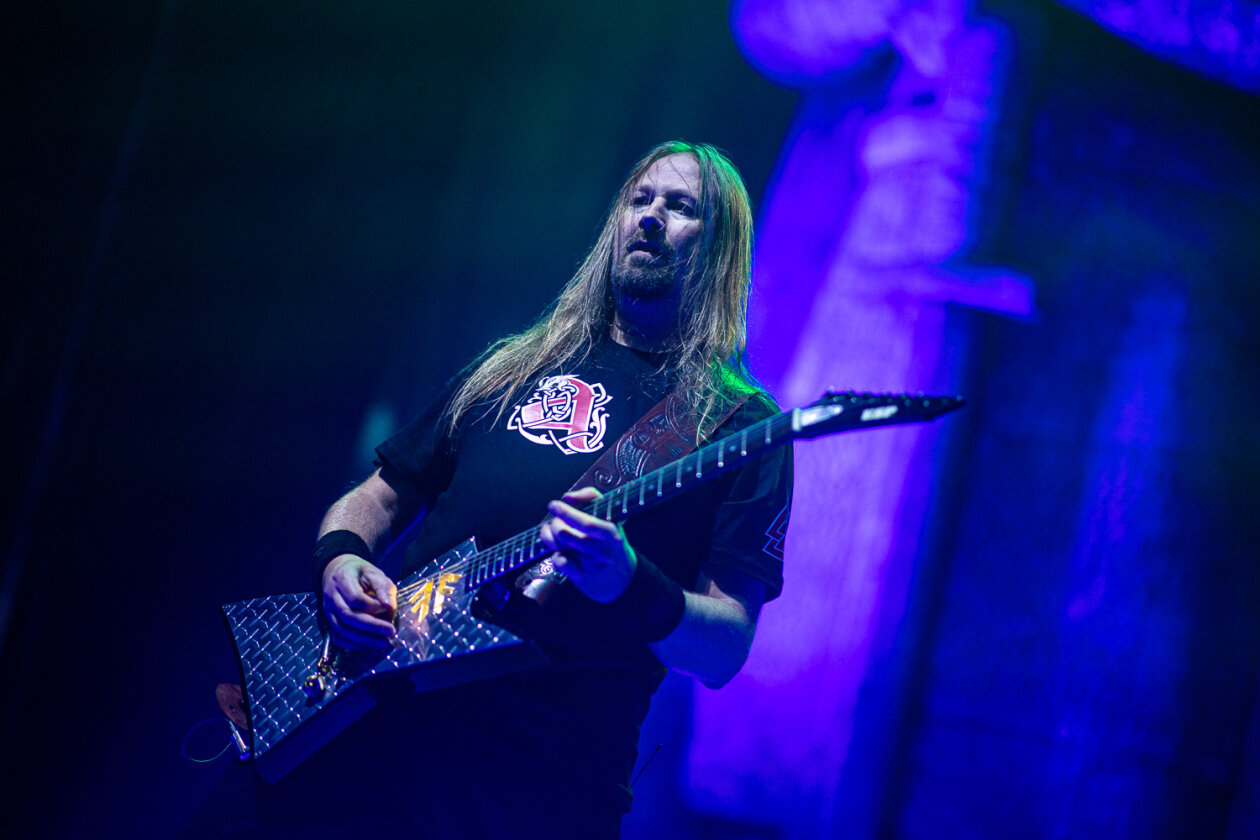
They aren't actually a "Viking metal" band. Well, technically.
If you ask Johan Hegg—the hulking, bearded frontman with a voice like grinding tectonic plates—he’ll tell you Amon Amarth is a death metal band. Period. They just happen to write about Norse mythology. Every single song. For over thirty years. It’s a distinction that matters to the purists, but to the thousands of fans rowing invisible longships in the middle of a muddy festival pit, it’s all the same glorious, beer-soaked chaos.
Amon Amarth has reached a level of consistency that’s honestly kind of terrifying. Most bands have a "experimental phase" where they lose the plot or a "dark period" where the albums suck. Not these guys. Since they emerged from Tumba, Sweden, in the early 90s, they’ve stayed remarkably true to a specific formula: melodic hooks, galloping rhythms, and lyrics that make you want to go reclaim a fjord.
The Tolkein Connection Nobody Mentions Anymore
It’s easy to forget where the name came from. If you aren't a massive nerd, you might not realize that Amon Amarth is Sindarin for "Mount Doom." Yes, the very same volcano from J.R.R. Tolkien’s The Lord of the Rings.
In the early days, back when they were still called Scum, the sound was raw. It was ugly. But when they rebranded in 1992, they found their North Star. They realized that the grim, ice-cold atmosphere of the Swedish death metal scene could be married to the epic storytelling of their ancestors. While their peers were singing about gore or Satan, Hegg and his crew were looking toward the Aesir.
How Amon Amarth Conquered the Mainstream Without Selling Out
Usually, when a metal band gets big enough to headline arenas, they "soften" their sound. They add clean singing or radio-friendly choruses. Amon Amarth didn't do that. They just got bigger.
Everything about their live show is dialed up to eleven. We aren't just talking about some strobe lights and a backdrop. We’re talking about a literal life-sized Viking ship on stage that serves as a drum riser. We’re talking about choreographed stage fights with shields and spears. It’s theater. It’s pro-wrestling meets heavy metal.
Olavi Mikkonen and Johan Söderberg, the guitar duo, have perfected a style of riffing that is surprisingly catchy. Take a song like "The Pursuit of Vikings." It’s basically a pop song structure played through a wall of distorted Marshalls. You can hum the lead line. That’s the secret sauce. They write anthems.
The Great Heathen Army and the Modern Era
In 2022, they dropped The Great Heathen Army. By this point, people were wondering if they’d finally run out of myths to talk about. How many times can you mention Thor’s hammer before it gets old?
Apparently, the answer is "at least one more time."
This record felt a bit grittier. It leaned into the darker side of the Viking age—the actual invasion and conquest of England. Working with producer Andy Sneap, who has worked with everyone from Judas Priest to Megadeth, they polished the edges without losing the grit. It’s a fine line to walk. If the production is too clean, it sounds like "Disney Metal." If it’s too dirty, the melodies get lost.
The title track is a perfect example of their evolution. It’s heavy, mid-tempo, and percussive. It feels like a march. They’ve mastered the art of "the vibe." You don't just listen to an Amon Amarth record; you inhabit it.
The "Rowing" Phenomenon: Organic Marketing or Metal Tradition?
If you go to an Amon Amarth show today, something weird happens during the song "Put Your Back Into The Oar." Thousands of people—grown men in battle vests, teenagers, parents—all sit down on the floor.
Then they start rowing.
It started organically at festivals like Wacken Open Air. The band didn't tell people to do it; the fans just decided that this was how they would celebrate. Now, it’s a staple. It’s one of those rare moments in modern music where the fourth wall completely evaporates. You aren't just watching a band; you’re part of the crew.
Critics sometimes call it cheesy. And honestly? It is. It’s incredibly cheesy. But in an era where everything is hyper-serious or layered in five levels of irony, there is something deeply refreshing about a band that fully embraces the spectacle. They know exactly who they are. They aren't trying to be the next Radiohead. They want to be the best Amon Amarth they can be.
Reliability in an Unstable Industry
Let's look at the lineup. Metal bands are notorious for revolving-door memberships. Amon Amarth has stayed remarkably stable. Aside from the drum stool—which was famously occupied by Fredrik Andersson for 17 years before Jocke Wallgren took over—the core has remained.
- Johan Hegg: Vocals (The face of the band)
- Olavi Mikkonen: Lead Guitar (The primary songwriter)
- Ted Lundström: Bass (The rhythmic anchor)
- Johan Söderberg: Rhythm Guitar (The harmonic depth)
This stability translates to the music. You can hear the chemistry. They know how to lock in. When they play live, it doesn't feel like a group of hired guns; it feels like a brotherhood.
The Misconceptions: Politics and History
Because they use Viking imagery, Amon Amarth occasionally gets lumped in with some of the more unsavory elements of the "folk metal" scene. It’s a problem that plagues anyone using Norse runes or symbols.
Hegg has been very vocal about this. He’s repeatedly stated that the band has no political agenda and that Viking culture belongs to everyone. They view the mythology as a rich tapestry of human emotion—betrayal, courage, loss, and triumph. They aren't trying to recreate the 9th century; they’re telling stories about the human condition through a mythological lens.
Historically, they take liberties too. They aren't trying to be a history textbook. If a story sounds cooler with a bit of extra thunder, they’ll add the thunder. They’re entertainers first.
Why "Twilight of the Thunder God" Still Reigns Supreme
Even with all their new success, 2008’s Twilight of the Thunder God remains the benchmark. It was the moment they truly "arrived" in North America. The title track is arguably the perfect melodic death metal song.
It’s got everything:
- A frantic, driving opening riff.
- A chorus that you can shout even if you don't speak a word of Swedish.
- A guest solo by Roope Latvala (ex-Children of Bodom).
- A sense of impending doom that fits the Ragnarök theme.
Every album since has been a struggle to top that peak. Some have come close—Jomsviking was a bold move into "concept album" territory—but Twilight is the one that every fan owns.
Actionable Steps for the Aspiring Metalhead
If you’re just getting into the band, don't just hit "shuffle" on Spotify. You’ll miss the progression.
Start with the "Big Three" Albums:
Listen to Twilight of the Thunder God first to understand the hype. Then, jump back to Versus the World to hear their heavier, darker roots. Finally, put on The Great Heathen Army to see where they are now.
Watch a Live DVD (or YouTube Set):
Amon Amarth is a visual band. Seeing the Viking ship and the pyrotechnics is essential to "getting" it. Their 2017 documentary The Pursuit of Vikings: 25 Years in the Eye of the Storm gives a great behind-the-scenes look at how a bunch of guys from a small Swedish town built an empire.
Check the Lyrics:
Actually read along. Hegg is a gifted storyteller. If you like Neil Gaiman’s Norse Mythology, you’ll appreciate the lyrical depth here. They aren't just screaming; they’re retelling the Eddas.
Support the Scene:
If they come to your city, go. Even if you aren't a "metal person," the energy is infectious. Wear something you don't mind getting sweaty in. And be prepared to row.
Amon Amarth has proven that you don't need to change your sound to stay relevant. You just need to get better at being yourself. They are the blue-collar workers of the metal world—consistent, hardworking, and loud as hell. As long as there are stories to tell about Odin and Thor, they’ll have a job. And we’ll be right there in the pit, rowing along with them.