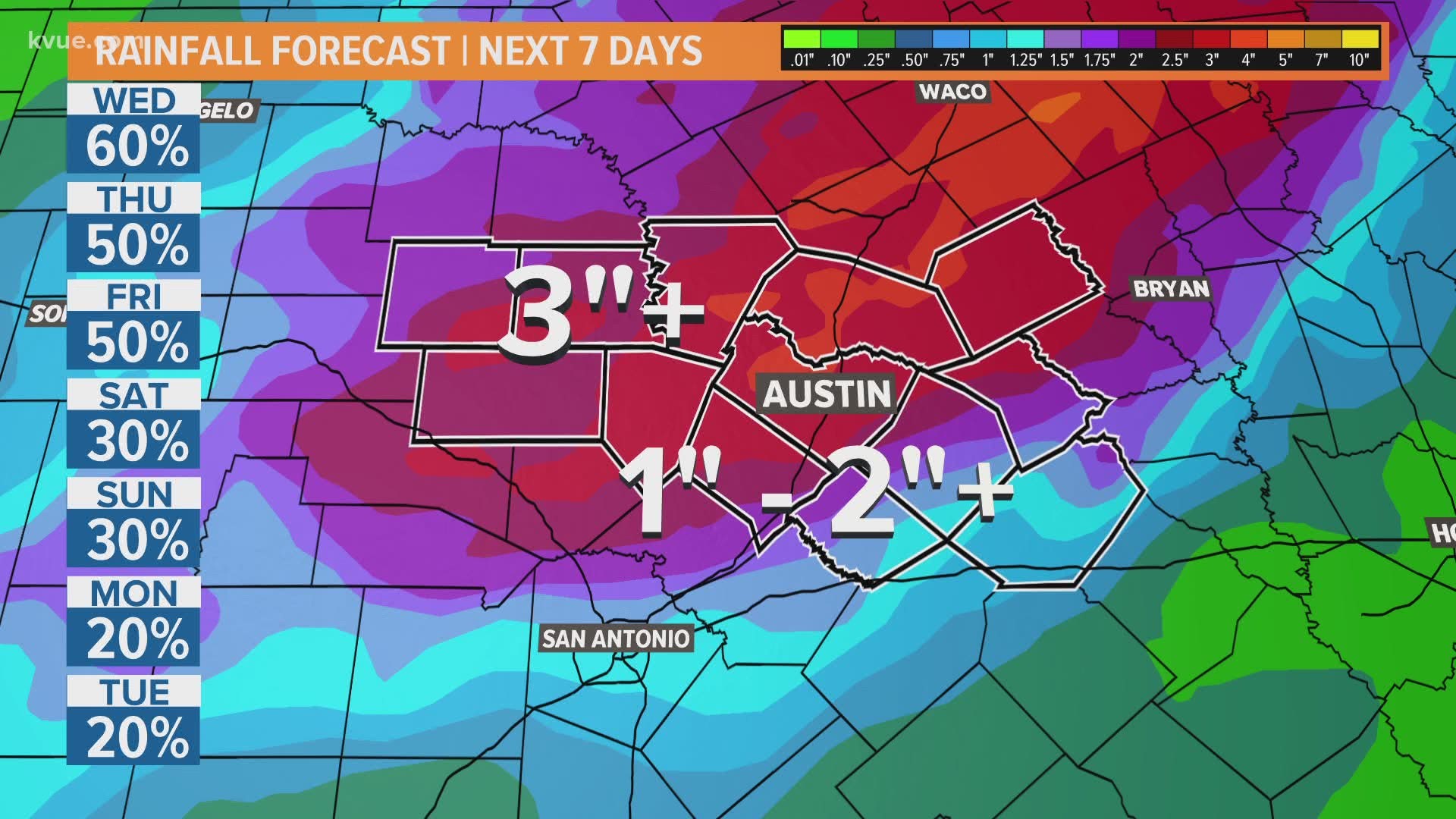
If you’ve lived in Central Texas for more than a week, you know the drill. You check your phone, see a 20% chance of rain, and five minutes later, you’re watching a literal wall of water turn I-35 into a parking lot. It’s wild. Honestly, relying on a simple "sun or cloud" icon is a rookie mistake in this part of the world. To actually survive—and thrive—in the ATX, you have to know how to read an austin tx weather map like a local meteorologist.
The Balcones Escarpment basically acts as a giant ramp for storms. It creates this weird microclimate where it can be bone-dry in Round Rock while South Congress is getting hammered by a cell that popped up out of nowhere. Most people just look at the green blobs on their screen and think, "Oh, it's raining." But there is so much more to the story.
Decoding the Colors on Your Austin TX Weather Map
Most folks think green means rain and red means "get inside." That's technically true, but it's incredibly oversimplified. If you’re looking at a high-resolution radar—like the ones from the National Weather Service (NWS) office in New Braunfels—the nuances matter.
Yellow and orange typically indicate heavy rain, but when you start seeing those deep "hamburger meat" reds or bright pinks, you're looking at something else entirely. In Austin, those colors often signify large hail. Because our atmosphere gets so volatile in the spring, the radar beam bounces off ice pellets differently than it does water droplets. If that "red" has a sharp, jagged edge on the map, you'd better clear the driveway and get the car under the carport.
The Mystery of the Purple Polygons
Ever see those purple or blue boxes pop up over Travis County? Those aren't just suggestions.
- Red Polygons: Tornado Warning. This means a tornado has been sighted or indicated by radar. Take shelter. No excuses.
- Yellow Polygons: Severe Thunderstorm Warning. Expect winds over 58 mph or hail the size of a quarter (or bigger).
- Green Polygons: Flash Flood Warning. In a city built on limestone, this is arguably the most dangerous map feature we have.
Flash flooding is the silent killer here. Since our soil is basically rock, the water has nowhere to go but the creeks. If you see a green box covering Shoal Creek or Waller Creek on your austin tx weather map, stay off the roads. "Turn around, don't drown" isn't just a catchy slogan; it's a rule for staying alive in the Hill Country.
Why the "Radar View" Isn't Enough
If you only look at the "Past" loop on your weather app, you're always living in the rearview mirror. You want to look at the "Future Radar" or "Predictive Modeling" layers. These use algorithms to guess where the cells will drift over the next two hours.
But even those are kinda finicky.
The real pros in Austin look at the Velocity Map. While the standard reflectivity map shows you what is falling (rain, hail, etc.), the velocity map shows you how the air is moving. If you see bright green right next to bright red in a tight circle, that’s "rotation." That is the signature of a developing tornado. Even if the news hasn't cut in yet, seeing that on your map gives you a five-minute head start.
Dealing with the "Austin Shield"
You’ll hear locals talk about the "Austin Shield" all the time. It’s this weird phenomenon where a massive line of storms looks like it’s going to demolish the city, only to split in half right at the city limits and go around us.
Is it real? Sorta.
The Urban Heat Island effect—all that concrete and asphalt in downtown—creates a bubble of warm air that can occasionally disrupt smaller storm cells. However, don't bet your life on it. The "shield" fails plenty of times, especially during those massive "Cedar Chopper" cold fronts that sweep in from the north. When those fronts hit the humidity coming off the Gulf, the map turns into a Christmas tree of warnings pretty fast.
Real-World Sources to Watch
Don't just trust the default app that came with your phone. They often use global models that don't understand the specific topography of the Texas Hill Country.
- KXAN First Warning Weather: Their app is widely considered the gold standard for local accuracy because their team (guys like David Yeomans) actually lives here and knows the local quirks.
- NWS Austin/San Antonio (weather.gov/ewx): It looks like a website from 1998, but it is the most accurate data you will ever find. Period.
- Troy Kimmel: If you want the "no-nonsense" version of what's happening, his weather blog and Twitter feed are legendary among long-time Austin residents.
Seasonal Survival: Map Reading for Each Phase
Austin doesn't really have four seasons. We have "Cedar Fever," "Flash Flood Spring," "The Surface of the Sun," and "Is it going to ice this year?"
During the summer, your austin tx weather map will mostly show you "Heat Advisories." This is when you want to look at the Dew Point layer. In Austin, a temperature of 100°F with a dew point of 70°F feels significantly more dangerous than a "dry" 105°F. If the map shows high humidity levels creeping up from the coast, your risk of heatstroke spikes.
In the winter, the map is even more deceptive. We rarely get snow. What we get is "Ice Storms." On the radar, freezing rain looks exactly like regular rain. You have to toggle the "Precipitation Type" layer. If you see pink or salmon colors, the bridges on MoPac are likely already turning into ice rinks.
Actionable Next Steps for You
Stop just glancing at the "current temp" on your lock screen. To actually stay ahead of the weather in Austin, do these three things:
- Download a High-Resolution Radar App: Get something like RadarScope or the KXAN weather app. These allow you to see the actual polygons and velocity data rather than just smoothed-out "pretty" graphics.
- Set Up Multiple Alerts: Don't just rely on one app. Enable Wireless Emergency Alerts (WEA) on your phone and follow the NWS Austin/San Antonio social media accounts.
- Learn Your Watershed: Open a map of Austin and find the nearest creek to your house or office. When you see a Flash Flood Warning on your austin tx weather map, check if it overlaps with your specific watershed.
Living in Austin means respecting the atmosphere. One minute you're paddleboarding on Lady Bird Lake, and the next, you're tracking a supercell on your phone. If you know how to read the map properly, the weather becomes a lot less scary and a lot more manageable. Stay weather-aware, keep your gas tank full when a front is coming, and never, ever drive through standing water on a low-water crossing.