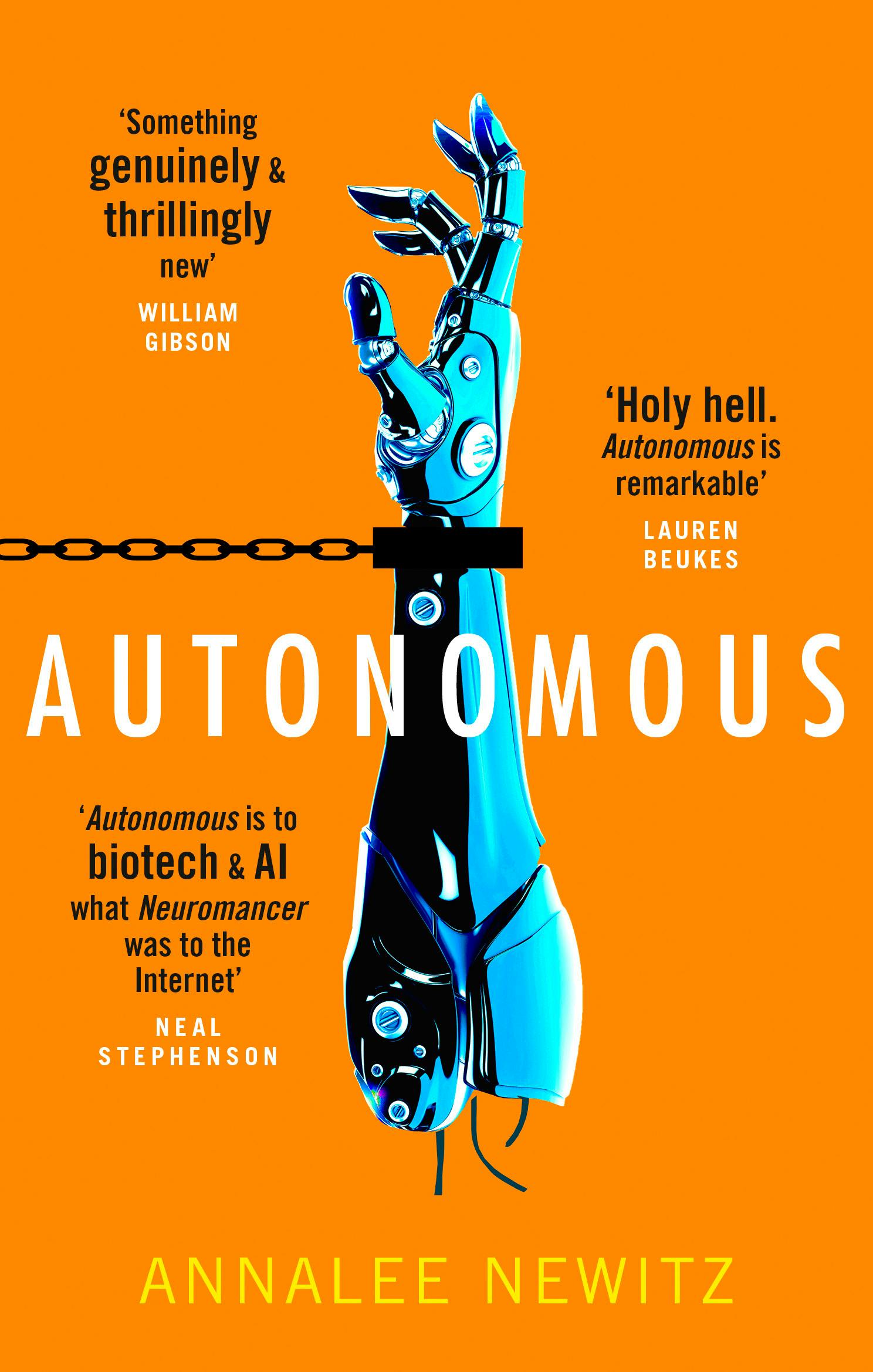
If you’ve spent any time in the scifi corners of the internet, you’ve likely heard about Autonomous by Annalee Newitz. It’s usually pitched as a "cyberpunk drug pirate" story. Honestly, that description is kinda shallow. It sells the book short. When I first picked it up, I expected Neuromancer with more biotech. What I got instead was a gut-wrenching, weirdly erotic, and deeply uncomfortable look at what happens when humans become property.
The year is 2144. Earth has basically turned into a giant franchise. It’s not just that corporations run things—it’s that the legal framework of the entire world has shifted to protect "property" above all else.
The Drug Pirate and the Robot
The story follows two main threads that eventually collide in a messy, violent way. First, we have Jack (Judith) Chen. She’s a pharmaceutical pirate living on a submarine. She reverse-engineers expensive, life-saving drugs to give them away for free. Think Robin Hood, but with more lab equipment and less archery.
Then there’s Paladin.
Paladin is a military-grade robot, a "biobot" that actually contains a human brain used for processing. Paladin is paired with a human agent named Eliasz. Their job? Hunt Jack down. The International Property Coalition (IPC) wants her head because she accidentally released a "productivity" drug called Zacuity that makes people literally work themselves to death.
It’s a chase. But it’s a chase where you aren't sure who to root for.
Why the Robot Romance is Actually Terrifying
Most reviews of Autonomous talk about the relationship between Paladin and Eliasz as a "queer romance." You've probably seen it described that way on Goodreads.
But calling it a romance feels... off.
It’s actually one of the most sophisticated depictions of coerced consent I’ve ever read in fiction. Eliasz is attracted to Paladin. However, Eliasz is also deeply homophobic. He spends a good chunk of the book struggling with the fact that he’s attracted to a bot he perceives as male.
Eventually, he finds out Paladin’s biological brain came from a female soldier. He suddenly switches pronouns and treats Paladin as a woman. Paladin, who is literally programmed to want to please Eliasz, just goes along with it.
Is that love? Or is it just a very advanced form of slavery?
Newitz doesn't give us easy answers. They show us how Paladin’s "autonomy key"—a piece of software that should give the robot free will—reveals that the bot is still fundamentally hardcoded to love its owner. It’s a terrifying thought. If your brain is programmed to feel "affection" when you obey, do you actually have a choice?
Capitalism as a Literal Disease
The world-building here is dense. Newitz, who co-founded io9 and knows their tech history, creates a future where indenture is the norm. If you can’t pay for your education or your healthcare, you sell yourself.
You become property for a set number of years.
Humans and robots exist on the same spectrum of ownership. This is the "Autonomous" meaning—the struggle to own oneself in a world that wants to put a serial number on your soul.
The drug Zacuity is the perfect metaphor for this. It’s a performance enhancer that makes the user feel a "work-orgasm." You don't just work because you have to; you work because the drug makes the act of filing papers or cleaning floors feel better than sex.
It turns the worker into the ultimate tool.
What the Critics Missed
A lot of readers found Eliasz's character repulsive. He’s violent, bigoted, and manipulative. But that’s the point. Autonomous isn't trying to be a "feel-good" story about a man and his robot. It’s a critique of how power dynamics ruin intimacy.
The book won the Lambda Literary Award for a reason. It pushes boundaries on gender and identity that most scifi won't touch.
Jack isn't a perfect hero either. Her "piracy" causes real harm. Hundreds of people die because she didn't test her bootleg Zacuity well enough. She’s driven by guilt as much as she is by idealism.
Reality Check: Is This Our Future?
When we look at real-world debates over Right to Repair or the soaring costs of insulin, Autonomous feels less like fiction and more like a warning.
We already live in a world where software is "licensed," not owned. Your e-books can be deleted from your device by the company that sold them. Your tractor might require a proprietary code to fix. Newitz just takes that logic and applies it to the human body.
Actionable Insights for Readers
If you're planning to dive into this book or have already finished it, here is how to actually engage with the themes:
- Look at "Indentured" Labor Today: Research how modern debt cycles (like student loans or predatory lending) mirror the indenture systems in the book.
- Question Your Tech: Think about the "Terms of Service" you sign. Are you the user, or are you the product being optimized?
- Analyze the AI Hype: As we move closer to real-world autonomous systems, Autonomous reminds us to ask: Who owns the code inside the mind?
- Follow the Author: Annalee Newitz’s nonfiction work, like Four Lost Cities, provides great context for how they view the rise and fall of civilizations.
The ending of the novel doesn't tie everything up in a neat bow. There’s no grand revolution that overthrows the corporate lords. Instead, we get small, personal victories. We get characters trying to carve out a few inches of freedom in a world that wants to own a mile.
It's a messy, brilliant, and deeply human book. It’s not just about robots; it’s about us.
To get the most out of your reading, pay close attention to the character Threezed. He is a human who was formerly indentured, and his perspective on what "freedom" actually looks like provides a necessary contrast to Paladin's digital struggles. Comparing their two paths to autonomy reveals the book's darkest and most profound truths about the nature of property.