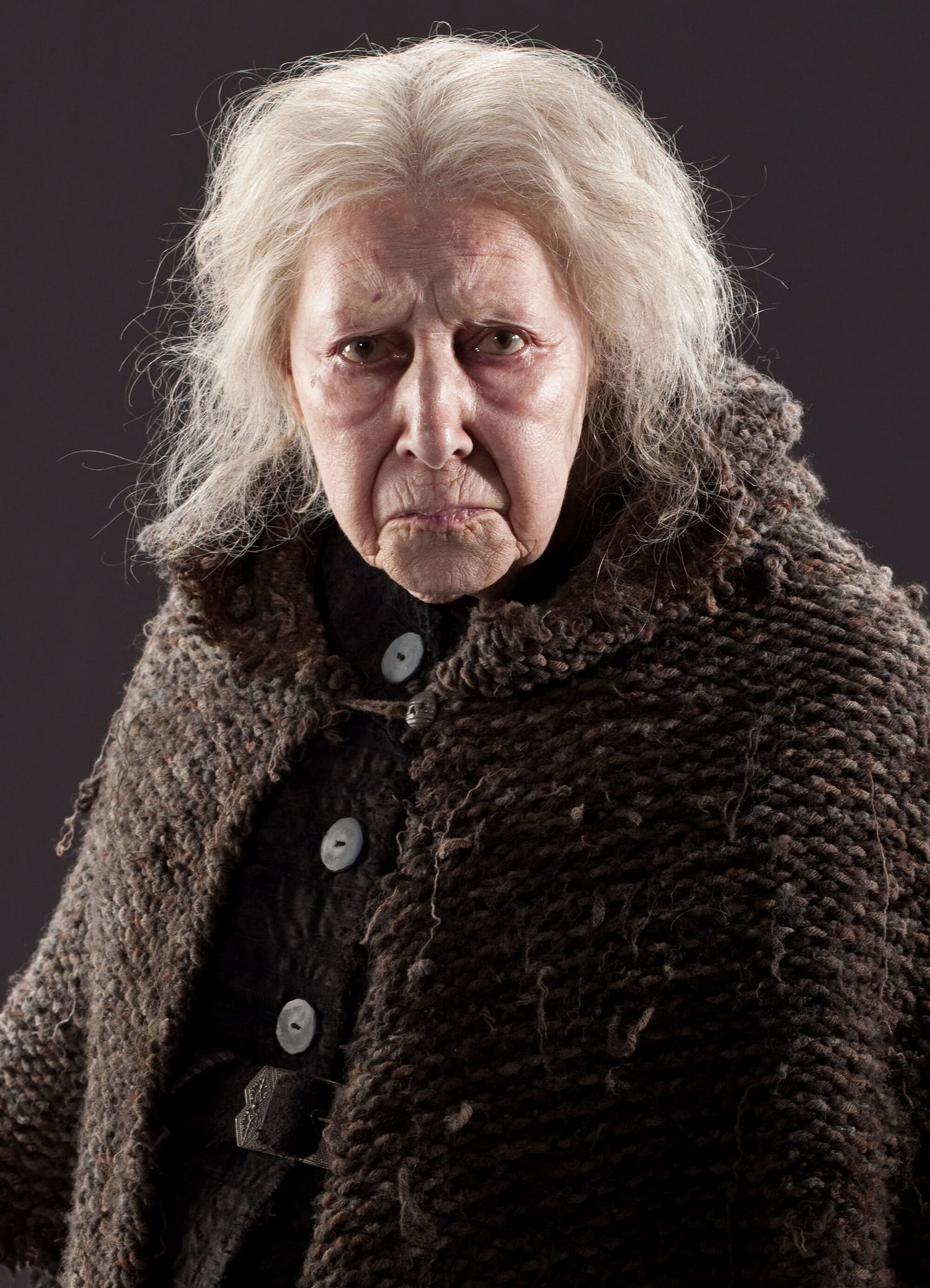
You know that feeling when you're reading a book and you realize, maybe a second too late, that something is horribly, fundamentally wrong? That’s the legacy of Bathilda Bagshot in the Deathly Hallows. It isn't just a plot point. It’s a masterclass in gothic horror tucked inside a fantasy epic. Honestly, for many of us who grew up with Harry Potter, the revelation in Godric’s Hollow remains the most visceral, skin-crawling moment in the entire seven-book run.
Most people remember Bathilda Bagshot as the elderly author of A History of Magic. We spent years seeing her name on a textbook cover. But by the time Harry and Hermione actually meet her in the final book, she isn't really Bathilda anymore. She’s a corpse. A literal skin-suit for Nagini.
It’s dark. It’s incredibly grim. And if you look closely at the text, the clues were there from the moment they stepped into her house.
The Tragedy of the Real Bathilda Bagshot
Before we get into the snake-in-a-sweater horror, we have to talk about who the real Bathilda was. She wasn't just some random historian. She was a powerhouse of magical knowledge and a primary source for some of the most pivotal moments in wizarding history. She lived in Godric’s Hollow for decades, becoming a neighbor to the Potters and, much earlier, the Dumbledores.
Think about her connection to Albus Dumbledore. When the Dumbledore family moved to Godric’s Hollow following Percival’s imprisonment, Bathilda was the only one who really broke through Kendra Dumbledore’s icy exterior. She was the bridge. She’s also the one who introduced Albus to her great-nephew, Gellert Grindelwald.
That one introduction changed the course of the 20th century.
Without Bathilda Bagshot, the "For the Greater Good" era might never have happened. She watched these two brilliant, teenage boys obsess over the Deathly Hallows from her own living room. It's a heavy burden for a historian to carry. By the time The Deathly Hallows timeline rolls around, she’s over a hundred years old, living alone, and unfortunately, she becomes the perfect bait for Lord Voldemort.
Why the Godric's Hollow Trap Worked So Well
Voldemort knew Harry. He knew Harry’s sentimentality would eventually lead him back to his birthplace. He also knew that Bathilda Bagshot was the only living person left who could tell Harry about Dumbledore’s past. It was a calculated, cruel move.
Voldemort murdered her.
He didn't just kill her, though. He used Dark Magic—likely some variation of a possession or a grotesque reanimation—to place Nagini inside her remains. When Harry and Hermione arrive, they see an old woman who doesn't speak, who smells of decay, and who lures them into a dark upstairs room.
The Clues We All Missed
Looking back, the signs were screaming at us. Hermione, usually the brightest witch of her age, was blinded by her own fear and the oppressive atmosphere of the graveyard. Harry was blinded by his need for connection.
- The Lack of Speech: "Bathilda" never speaks in front of Hermione. Why? Because a snake can’t mimic human vocal cords. Nagini could only communicate with Harry through Parseltongue. Because the narrative is from Harry’s perspective, he thinks he's hearing English. He isn't.
- The Smell: Harry notices a "fusty" smell, something like "old laundry" and something else he can't quite place. It’s the smell of a decomposing body.
- The House: It’s a wreck. The real Bathilda was proud; the house Nagini inhabits is a nest.
It’s honestly one of the few times J.K. Rowling leans fully into body horror. The image of Nagini erupting from Bathilda’s neck is the stuff of nightmares. It’s not just a jump scare; it’s the violation of a respected historical figure’s dignity.
The Rita Skeeter Connection
We can’t talk about Bathilda Bagshot in the Deathly Hallows without mentioning Rita Skeeter. That "human vulture" managed to interview Bathilda before her death, using Veritaserum to extract all the juicy, scandalous details for The Life and Lies of Albus Dumbledore.
This is where the E-E-A-T (Experience, Expertise, Authoritativeness, and Trustworthiness) of the character comes into play. Bathilda was the ultimate "reliable source" who was no longer reliable due to age and chemical coercion. It highlights a major theme of the final book: the fragility of memory and the way history is often distorted by those who write it.
Skeeter’s book is what drives Harry to Godric's Hollow in the first place. He’s looking for the truth about the man he thought he knew. Instead, he finds a trap. It’s a bitter irony that the woman who wrote the definitive history of the wizarding world ended up having her own history—and her own body—hijacked by the two most dangerous Dark Wizards of all time.
The Mechanical Reality of the Scene
How did Nagini actually stay inside Bathilda? The book implies a level of Dark Magic that goes beyond a simple Inferius. Inferi are mindless. This was different. Nagini was acting with a level of tactical intelligence, waiting for Harry to be isolated before striking.
Some fans theorize it was a complex "flesh-mask" charm. Others think it was just the sheer size of Nagini (who is depicted as massive, perhaps 20 feet long) coiling within the frame of a small, frail woman. The logistics are terrifying to imagine.
The scene serves a dual purpose. It strips Harry of his last illusions of safety. Godric’s Hollow was supposed to be a homecoming. Instead, it was a slaughterhouse. It also costs Harry his wand. The struggle in Bathilda's house leads to Hermione’s Blasting Curse ricocheting and snapping Harry’s holly and phoenix feather wand.
That loss is huge. It leaves Harry vulnerable and dependent, forcing him to grow in ways he wasn't prepared for.
What This Means for the Deathly Hallows Lore
The presence of Bathilda Bagshot in the Deathly Hallows connects the Peverell brothers to the modern day. She lived in the house that may have been near the original Peverells. She possessed the photographs of Grindelwald. She held the keys to the "Hallows vs. Horcruxes" debate that Dumbledore wanted Harry to figure out on his own.
Without her—even in her tragic death—Harry might never have confirmed that the Mark of the Deathly Hallows was more than just a "Dark Wizard's symbol" as Krum believed.
Moving Past the Horror
If you're revisiting the series or researching the lore, don't just focus on the snake. Look at Bathilda as the ultimate cautionary tale of the wizarding world. She was a woman of immense intellect who became a footnote in the wars of men.
To truly understand her impact, you should:
- Re-read the chapter "Magic is Might" and "Godric's Hollow": Compare how Dumbledore describes her versus how she actually appears.
- Analyze the Parseltongue dialogue: Notice how Nagini/Bathilda only speaks when Hermione is out of the room. It’s a brilliant bit of writing that rewards the observant reader.
- Consider the historical context: Research the real-world historians who lived through wars and how their work was used or misused after their deaths.
Bathilda Bagshot deserved better. She was the keeper of stories, the woman who gave us the framework for understanding the magical world. Her end was gruesome, but her contribution to Harry's journey—and our understanding of Albus Dumbledore—is indispensable.
Next time you see a copy of A History of Magic, remember the woman behind the text. She wasn't just a victim in a house in Godric's Hollow. She was the memory of the wizarding world itself.
Actionable Insights for Lore Fans:
If you're writing your own analysis or just want to dive deeper, check the Fantastic Beasts films for younger versions of these characters to see how the Bathilda/Grindelwald relationship is framed. Also, look into the Wizarding World (formerly Pottermore) archives for the supplemental writing on the Dumbledore-Grindelwald summer; it adds layers to why Bathilda was so willing to talk to Rita Skeeter later in life. Understanding the "why" behind her isolation makes her fate in the seventh book even more impactful.