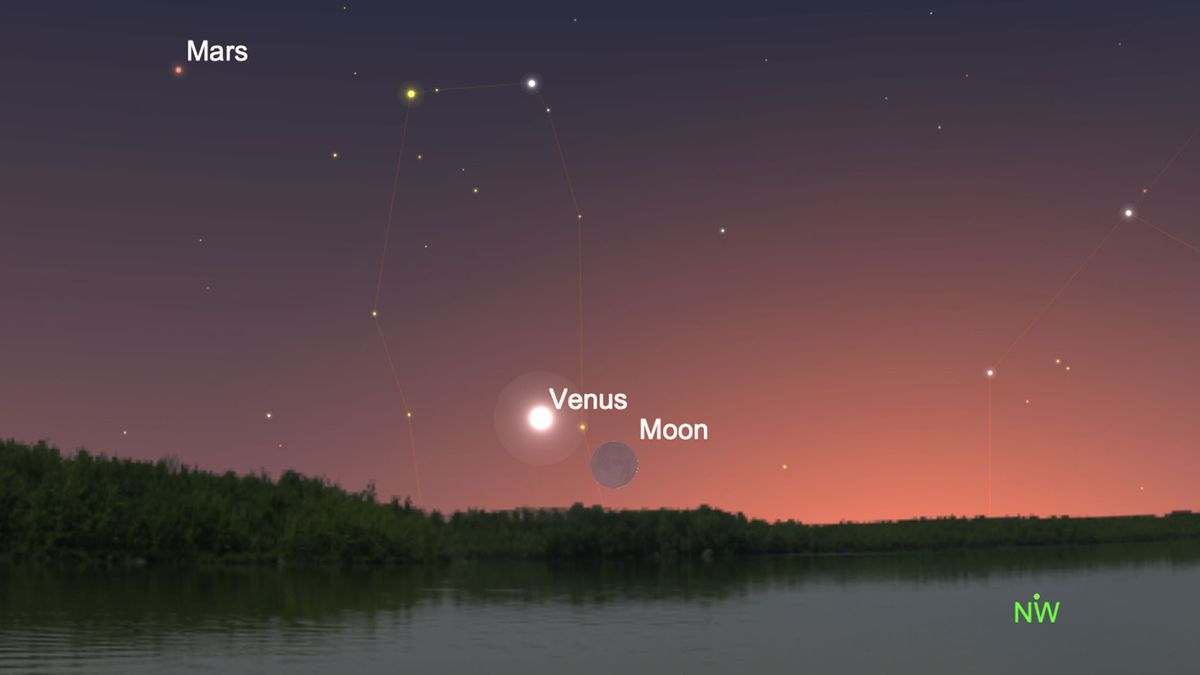
You step outside, look up, and there it is. A weirdly bright light sky tonight that wasn't there yesterday. Or maybe it was, and you just finally noticed it because the clouds cleared out. Honestly, most people freak out a little when they see a non-twinkling, high-intensity beacon hanging over the horizon. Is it a drone? A satellite? Maybe a planet? Usually, it's Venus or Jupiter, but 2026 has been a bit different thanks to the sheer volume of low-earth orbit hardware and some specific solar cycles we're hitting.
It's bright. Really bright.
People often mistake the planet Venus for a "UFO" or a high-altitude surveillance craft because, at its peak, it can actually cast a faint shadow in a true dark-sky area. It doesn't twinkle like a star. It's a steady, unblinking glare. If you're seeing that intense glow in the west right after sunset, that’s your culprit. But if you’re seeing a string of lights moving in a perfect, eerie line, you’re looking at a Starlink satellite train. It's wild how much the night sky has changed in just the last few years.
Why the bright light sky tonight looks so different from five years ago
We have entered a period of peak satellite density. If you feel like the sky is "busier," you aren't imagining things. According to tracking data from CelesTrak and the Union of Concerned Scientists, there are now thousands of active satellites orbiting just a few hundred miles up. When the sun is below the horizon for us on the ground, it can still hit those metal solar panels way up there. This causes a "flare."
Sometimes these flares are accidental. Other times, like with the newer generation of communication satellites, they are persistent.
Then there's the sun itself. We are currently in the midst of Solar Cycle 25. This cycle has been significantly more active than NASA or NOAA originally predicted. When the sun burps—what scientists call a Coronal Mass Ejection (CME)—it flings charged particles at Earth. When those hit our magnetic field, they create the Aurora Borealis. In 2024 and 2025, we saw the Northern Lights as far south as Florida and Texas. If you see a bright, shifting glow that looks like a green or pink curtain, that’s a geomagnetic storm in action. It’s one of the few times a bright light sky tonight is actually caused by natural atmospheric interference rather than a piece of hardware.
The Jupiter Factor and Planetary Alignments
If the light you're seeing is high in the sky and looks slightly yellowish, it's almost certainly Jupiter. Jupiter is massive. It’s so big that its cloud tops reflect an incredible amount of sunlight back at us.
- Check the position: Planets usually follow the "ecliptic," which is the same path the sun takes across the sky.
- Check the "twinkle": Stars twinkle because their light is a tiny point being bounced around by our atmosphere. Planets are a "disk" of light (even if they look like a point to your eye), so their light stays steady.
Basically, if it doesn't flicker, it's a neighbor.
Breaking down the Starlink "Ghost Train" phenomenon
Nothing confuses people more than the Starlink trains. You’ve probably seen the videos on TikTok or Twitter. A line of 20 to 60 bright dots moving in a straight line, perfectly spaced. It looks like a sci-fi invasion.
SpaceX launches these batches regularly. For the first few days after launch, they stay close together in a "train" before they use their ion thrusters to move into their final, higher orbits. While they are low, they catch the sun perfectly. Astronomers, like those at the International Astronomical Union, have actually complained about this because it ruins long-exposure photography of deep space. For the average person in the backyard, it’s just a "what the heck is that" moment.
If you see a bright light sky tonight that is moving slowly but steadily—not blinking like a plane—it’s a satellite. If there are dozens of them? It’s Elon’s internet.
The role of light pollution and "Skyglow"
Sometimes the bright light sky tonight isn't a single object. It’s a hazy, orange or white dome over the horizon. This is "skyglow."
As cities expand, we use more LED lighting. While LEDs are energy-efficient, they often emit more blue light, which scatters more easily in the atmosphere. This creates a permanent haze that washes out the Milky Way. If you're near a stadium, a greenhouse, or a major shipping port, you might see a "bright sky" that looks like a permanent dawn. Greenhouses are actually some of the biggest offenders lately. Some of those industrial indoor farms in places like the Netherlands or the US Midwest use massive purple and yellow lights that reflect off low-hanging clouds, creating an eerie, glowing ceiling that can be seen for 30 miles.
How to identify what you are seeing
You don't need a PhD in astrophysics to figure this out. You just need a couple of tools and a bit of context.
- Download an app: Stellarium or SkyGuide are the gold standards. You just point your phone at the light, and it uses your GPS and gyroscope to tell you exactly what star, planet, or satellite is in that spot.
- Check the ISS tracker: The International Space Station is the brightest man-made object in the sky. It looks like a fast-moving, non-blinking airplane. It can cross the entire sky in about six minutes.
- Look for the "Blink": If you see red and green lights, it’s a plane. Period. Even the most advanced drones usually have FAA-required navigation lights.
The impact of the 2026 Solar Maximum
We are currently hovering around the peak of the solar cycle. This means the sun's magnetic field flips, and during this process, sunspots and flares go crazy.
This matters for your bright light sky tonight because it increases the frequency of SAR arcs (Stable Auroral Red arcs). These aren't quite the Northern Lights, but they look like deep red bands of light across the sky. They used to be rare, but with the current solar intensity, they are popping up more often. People often mistake them for light pollution or distant fires. They are actually a sign that our upper atmosphere is being cooked by solar energy.
It’s a bit humbling, honestly. We think of the sky as this dark, empty void, but it’s actually a very busy, very bright place once you know what to look for.
Why does it look brighter in winter?
Cold air holds less moisture. When the air is crisp and dry, there’s less "gunk" for the light to pass through. This makes stars look sharper and planets look significantly more intense. That's why a "bright light sky tonight" in January usually looks way more impressive than one in the humid haze of July.
Actionable steps for skywatching tonight
If you want to make the most of the glow, stop looking at your phone for ten minutes. Your eyes need "rhodopsin"—a biological pigment in your retina—to build up so you can see in the dark. Every time you look at a white screen, you reset that 20-minute timer.
Find a dark spot. Even moving to the shadow of your house so the streetlights aren't hitting your eyes directly makes a massive difference.
Use averted vision. If you're trying to see a faint glow or a nebula near a bright planet, don't look directly at it. Look slightly to the side. The periphery of your eye is more sensitive to light than the center.
Check the lunar phase. If the moon is more than 50% full, the "bright light" you’re seeing might just be moonlight scattering. The moon is the ultimate light polluter. If you want to see satellites or the Milky Way, you have to wait for the New Moon phase.
Verify the object. If the light is hovering near the horizon and "dancing" or changing colors rapidly, that’s usually "scintillation." It’s caused by the light passing through thick layers of turbulent atmosphere. Sirius, the Dog Star, is famous for this—it flashes rainbow colors when it's low on the horizon.
The night sky is no longer just a static map of ancient stars. It’s a dynamic, evolving display of human technology and solar fury. Next time you see a bright light sky tonight, don't just wonder. Check the movement, check the twinkle, and realize you're looking at a very crowded, very active corner of the solar system.
To get the most accurate viewing times for the ISS or Starlink over your specific zip code, head over to Heavens-Above or the NASA Sight the Station website. They provide down-to-the-second predictions so you aren't just standing in the cold guessing.