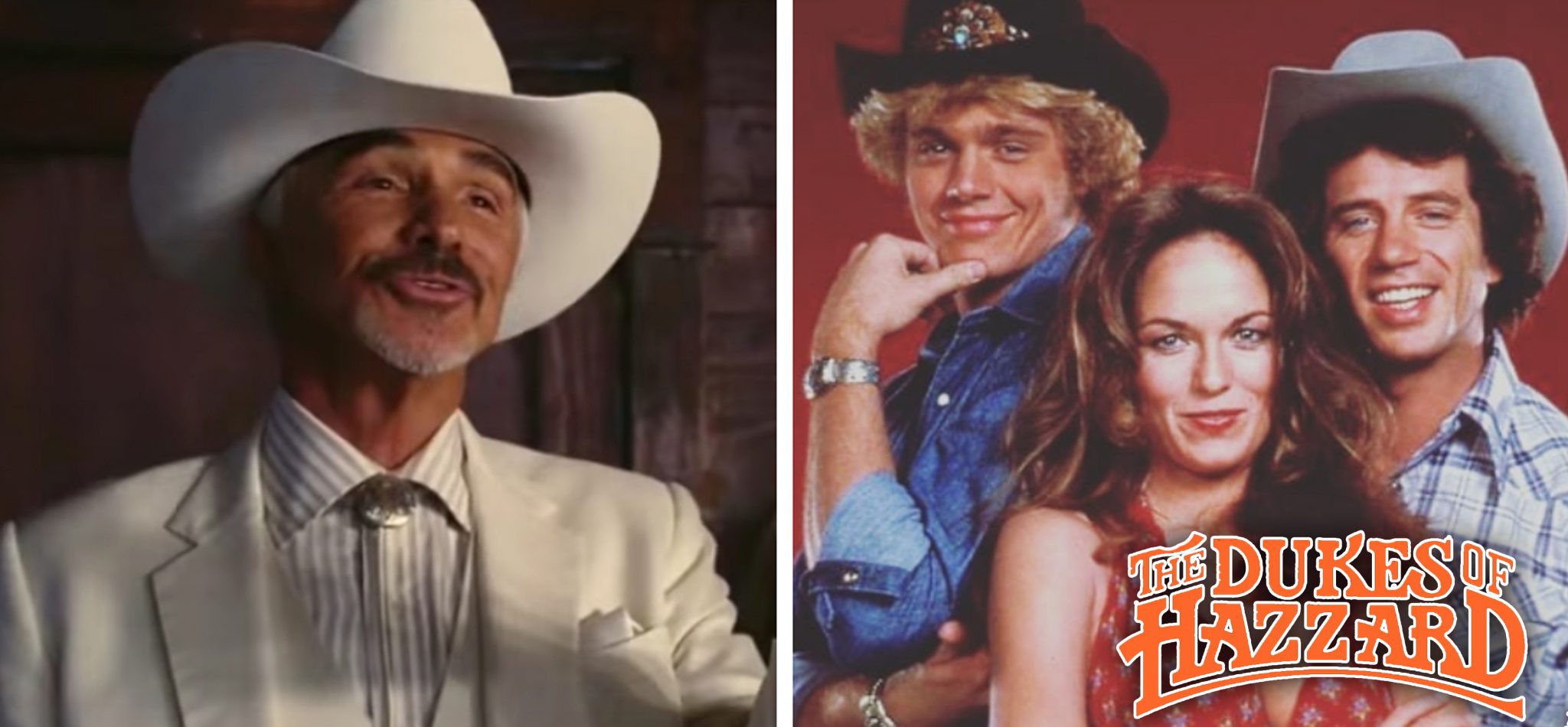
Let’s be real for a second. If you grew up in the late seventies or early eighties, you probably spent a good chunk of your childhood sliding across the hoods of random cars and trying to outrun an imaginary Sheriff Rosco P. Coltrane. The original Dukes of Hazzard wasn't just a TV show; it was a weekly ritual of dirt roads, jumping orange Chargers, and a bumbling, white-suited villain named Boss Hogg.
Then came 2005.
Hollywood decided to give the General Lee a fresh coat of paint and a new engine. But the biggest shock to the system wasn't Seann William Scott’s hair or Johnny Knoxville’s stunts. It was the casting of the legendary Burt Reynolds as Jefferson Davis "Boss" Hogg.
It was a weird choice. Honestly, it was a move that left purists scratching their heads and younger fans wondering why the "Bandit" was suddenly playing the bad guy.
The Bandit Becomes the Boss
To understand why Burt Reynolds Dukes of Hazzard performance was such a massive cultural pivot, you have to look at his history. Burt was the anti-authority hero. In Smokey and the Bandit, he was the guy the Dukes wanted to be. He was the one driving the fast car, laughing at the law, and sporting the most famous mustache in cinematic history.
Seeing him step into the role of Boss Hogg—the very definition of "The Man"—felt like a glitch in the matrix.
In the original series, Sorrell Booke played Boss Hogg as a cartoon. He was short, round, and essentially a human version of a greedy pig. He threw tantrums. He ate raw liver for breakfast. He was ridiculous. Burt Reynolds didn't do any of that. He didn't wear a fat suit. He didn't scream at Rosco until his face turned purple. Instead, he played a version of Boss Hogg that was actually… dangerous?
A Different Kind of Villain
The 2005 film, directed by Jay Chandrasekhar (the guy from Super Troopers), took a hard left turn from the source material. This Boss Hogg wasn't just a greedy local commissioner; he was a calculating, cold-blooded businessman trying to turn Hazzard County into a strip mine.
Burt Reynolds brought a quiet, Southern-fried menace to the role.
- He was sleek. No 62-inch waist here.
- He was smart. This Hogg wasn't being outwitted by every local moonshiner.
- He was menacing. When Burt’s Boss Hogg spoke, it wasn't a comedic shrill; it was a low, gravelly threat.
A lot of fans hated it. They wanted the bumbling fool they grew up with. But looking back at the Burt Reynolds Dukes of Hazzard era, you can see what the filmmakers were trying to do. They were trying to ground the absurdity. By making the villain a serious threat, they tried to raise the stakes for Bo and Luke. Whether it worked is still a heated debate at car shows and dive bars across the South.
Why the Connection Still Matters
There’s a deeper layer to this casting that most people miss. The General Lee itself actually owes a debt to Burt Reynolds.
Think about the iconic "01" on the doors of that 1969 Dodge Charger. It wasn't just a random number. It was a direct tribute to Burt’s character, Bo “Bandit” Darville, from Smokey and the Bandit. The "01" symbolized that same spirit of rebellion. So, when Burt eventually stepped into the 2005 movie, it was a full-circle moment, even if he was playing the guy trying to impound the car this time around.
It’s also worth noting the teacher-student vibe on set. M.C. Gainey, who played Sheriff Rosco in the movie, was stepping into shoes originally filled by James Best. Here’s a piece of trivia for you: James Best actually taught acting to Burt Reynolds decades earlier. The DNA of the original show and the 2005 remake is more intertwined than the credits let on.
The Reality of the 2005 Movie
Let’s talk about the elephant in the room. The movie didn't exactly win Oscars.
It was nominated for MTV Movie Awards for "Best On-Screen Team" and "Sexiest Performance" (shoutout to Jessica Simpson's Daisy Duke), but the critical reception was… let's call it "mixed." Purists felt the soul of the show was lost in a haze of Jackass-style stunts and a plot that felt too heavy for a story about cousins jumping a creek.
But Burt? Burt was professional. He knew exactly what kind of movie he was in. He leaned into the Southern charm, donned the white suit, and gave us a version of corruption that felt a little too real for a PG-13 comedy.
What Most People Get Wrong
The biggest misconception is that Burt was "miscast."
If you view the 2005 film as a direct sequel or a carbon copy of the TV show, then yeah, he doesn't fit. But if you view it as a reimagining—a "What if the South actually had a ruthless kingpin?" scenario—then Burt Reynolds was the only person who could have played it. He had the gravitas. He had the history.
He also knew how to wear the hell out of a white ten-gallon hat.
Takeaways for the True Fan
If you’re revisiting the film or just curious about why the Bandit switched sides, keep these things in mind:
- Watch for the Nuance: Burt isn't playing Sorrell Booke. He’s playing a man who owns the town and knows it. His power doesn't come from shouting; it comes from his bank account.
- Respect the Legacy: The 2005 film was a bridge between the 70s car culture Burt helped create and the modern action-comedy.
- The Wardrobe is Key: Pay attention to the white suit. It’s the one constant between the two versions of the character, signifying a specific type of Southern "Old Money" corruption.
The Burt Reynolds Dukes of Hazzard crossover remains one of the more fascinating footnotes in 2000s cinema. It was the moment the ultimate rebel became the ultimate authority figure. It was weird, it was flashy, and in its own way, it was a tip of the hat to the man who made fast cars and police chases a staple of the American diet.
Next time you see an orange Charger, don't just think about Bo and Luke. Think about the man in the white suit who once taught us how to outrun the law—only to end up becoming the law himself.
To get the full experience of the Reynolds era, track down the behind-the-scenes footage from the 2005 set. You'll see Burt mentoring the younger cast, sharing stories about the "Golden Era" of car stunts, and proving that even as a villain, he was still the coolest guy in the room.