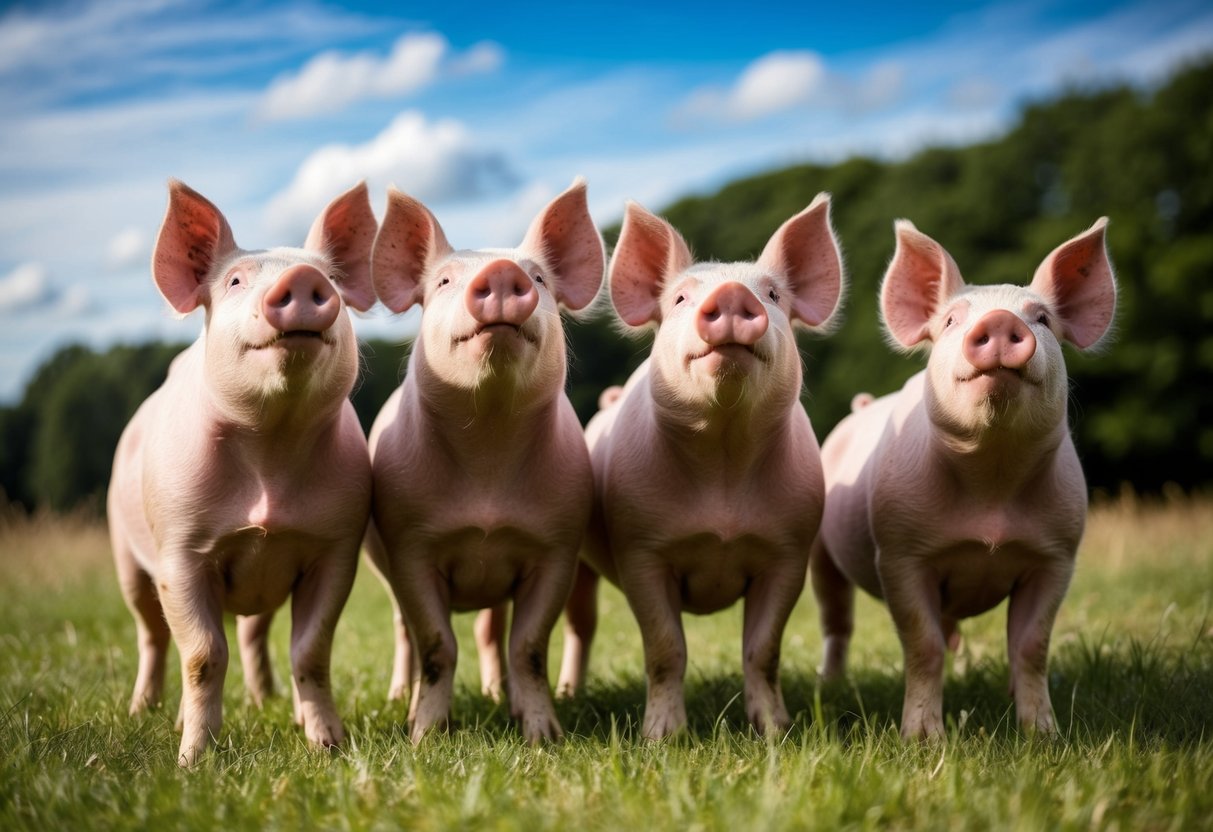
You’ve probably heard the old wives' tale that it’s physically impossible for a pig to look up at the sky. It’s one of those "fun facts" that gets passed around at bars or mentioned in casual conversation to make someone sound smart. But if you've ever spent a significant amount of time around these incredibly intelligent animals, you might start to wonder if that’s actually true. Can pigs look up at the sky, or are they forever doomed to stare at the mud beneath their trotters?
The short answer is: No, they can't—at least not in the way you or I do.
It’s not some weird curse or a lack of curiosity. It’s basic anatomy. Pigs have a spine that is essentially a straight line from their tail to the base of their skull. Their neck muscles are thick, powerful, and designed for one specific job: rooting. If you look at the skeletal structure of a Sus scrofa domesticus, you'll see that the vertebrae in the neck (the cervical vertebrae) don't allow for much upward extension.
Imagine trying to look at the ceiling while wearing a rigid neck brace that’s bolted to your shoulders. That’s the daily reality for a pig. They can look left, they can look right, and they can certainly look down to find a tasty root or a fallen apple. But tilting their head back 90 degrees to watch a passing plane? That’s just not happening.
Why Pig Anatomy Keeps Their Eyes on the Ground
Evolution is rarely accidental. Every weird quirk of an animal's body usually serves a purpose that helped their ancestors survive long enough to have babies. For pigs, looking up wasn't a priority. Looking down was everything.
In the wild, the ancestors of our modern farm pigs spent the vast majority of their lives foraging in the undergrowth of forests. Their food—tubers, fallen nuts, insects, and roots—is all located in the dirt. A pig’s snout is a highly sensitive, muscular tool used for bulldozing through soil. To support that kind of heavy-duty physical labor, they needed a neck that was built like a tank.
The Heavy Lifting of the Neck
If you’ve ever seen a pig "rooting," you know they don't just gently nudge the dirt. They use their entire body weight to heave soil and rocks out of the way. This requires massive, dense muscle attachments along the top of the neck. These muscles, known as the splenius and brachiocephalicus, are so thick that they physically limit the range of motion.
There's also the issue of the fat deposits. Domesticated pigs, especially those bred for meat, have significant fat rolls around their neck and jowls. This "scruff" acts like a physical stopper. Even if their bones could bend further, the sheer mass of their neck tissue prevents them from tilting their head back very far.
Interestingly, Dr. Temple Grandin, a world-renowned expert in animal behavior and livestock handling, often points out that pigs are intensely focused on what is directly in front of and beneath them. Their visual field is wide—about 310 degrees—but it’s oriented horizontally. They are prey animals. They need to see a predator creeping up from the side, but in their natural forest habitat, predators rarely fall from the clouds.
So, Do Pigs Never See the Clouds?
Does this mean a pig lives its entire life without ever catching a glimpse of the blue sky? Not necessarily. Pigs are smart. They’re arguably smarter than dogs, often ranked as the fourth most intelligent animal on Earth. If they want to see something high up, they find a way around their physical limitations.
Here is how a pig actually sees the sky:
- The "Sit and Tilt" Method: Pigs can sit on their haunches like a dog. When they sit back, their entire forebody angles upward. This shift in body position allows them to see much higher than they could while standing on all fours.
- Rolling Over: Pigs love a good mud bath. When a pig rolls onto its side or completely onto its back to scratch an itch or cool down, they get a panoramic view of the heavens.
- Lying Down: Just like humans watching the stars, a pig lying flat on its side can easily see the horizon and the sky above it.
- Using the Terrain: I've seen pigs at sanctuaries lean their front legs up against a fence or a fallen log. By elevating their front end, they change the angle of their neck relative to the horizon.
It’s a bit of a semantic argument, honestly. While they can't "look up" by moving their neck, they can absolutely observe the sky by moving their entire body.
The Science of Pig Vision
To understand what they’re seeing when they do manage to look up, we have to look at the eyes themselves. Pigs have what’s called panoramic vision. Because their eyes are set on the sides of their heads, they have a massive field of view. However, they have a significant blind spot directly in front of their snout and directly behind them.
They are also dichromatic. This means they see color, but not the way we do. They have two types of cones in their eyes, whereas humans (usually) have three. A pig sees blue quite well, but they struggle with greens and reds, which likely appear as shades of grey or yellowish-brown to them.
So, when a pig looks at a bright blue sky, they see a vibrant, clear color. But they lack the "fovea"—the part of the eye that allows for sharp, central focus—that humans have. Their vision is a bit grainier. They are better at detecting motion than fine detail. This is why a pig might bolt if a bird flies low over them; they see the movement instantly, even if they can't quite make out what the bird is.
Debunking the Myths and "Digital Facts"
If you search "can pigs look up" on social media, you’ll find a lot of misinformation. Some people claim that pigs will die if they look up, which is obviously ridiculous. Others say their eyes are fixed in their sockets. That’s also false. Pig eyes can move, though not with the same range as human eyes.
There was a viral TikTok a while back claiming that pigs have a "gravity-locked" ocular system. That’s complete pseudoscience. There is no biological mechanism that prevents a pig’s eyes from perceiving light from above. It’s purely a structural, musculoskeletal limitation of the neck.
Expert Insights from the Farm
I spoke with a local livestock veterinarian who has worked with commercial swine for over twenty years. He told me that in all his time in the barns, he’s never seen a pig look "up" while standing. "They’re just not built for it," he said. "If a pig wants to see what’s happening above it, it’ll usually back up a few steps to increase its angle of view or just wait until the object moves into its horizontal line of sight."
This has practical implications for how we treat them. If you’re building a pig pen or a shelter, putting enrichment toys high up is a waste of time. They won't see them, and if they do, it will cause them physical strain to try and interact with them. Good pig enrichment happens at ground level—rooting boxes, balls they can push with their snouts, and things they can chew on.
Comparing Pigs to Other Livestock
You might wonder why a cow or a horse can look up, but a pig can't. It comes down to the "S" curve in the neck.
Horses and cattle have a much more flexible cervical spine. They are grazers. While they also eat from the ground, they are much more vulnerable to predators in open grasslands. They need to be able to lift their heads high to scan the horizon.
Pigs, being foragers and "tank-like" in their build, traded that flexibility for raw power. A pig’s neck is built to withstand the force of a 200-pound animal throwing its weight into a stubborn root. Flexibility would actually be a weakness in that scenario; a more flexible neck would be more prone to injury under that kind of pressure.
The Cultural Impact of the "Pigs Can't Look Up" Fact
This weird bit of trivia has actually made its way into literature and film. It’s often used as a metaphor for being "grounded" or "stubborn." In some cultures, the idea that a pig cannot see the sky is used to illustrate a lack of spiritual awareness or an inability to see the "bigger picture."
But I think that’s an unfair assessment of the pig. Just because they don't naturally look at the stars doesn't mean they aren't aware of their environment. They are deeply sensitive to changes in light, air pressure, and sound. They know when a storm is coming long before it hits, even without looking at the clouds.
What This Means for You
If you’re a hobby farmer or just a fan of these animals, understanding their physical limitations helps you empathize with them. Don't expect a pig to notice you if you're standing directly over them or waving from a balcony. To get a pig's attention, you need to be in their line of sight—which means getting down on their level.
- Eye Level Matters: If you want to bond with a pig, crouch down. Being at their eye level reduces their stress and makes you a part of their world.
- Enrichment Placement: Always place treats, toys, and water at or slightly below head height.
- Handling: When moving pigs, remember they are looking at the ground. They are easily spooked by shadows or changes in floor texture (like a drain or a shiny piece of metal) because that is where their primary focus lies.
While the physical limitation is real, it doesn't define the animal's experience. A pig's world is rich in scent, sound, and social complexity. They might not be stargazers, but they are masters of the earth they walk on.
To truly understand a pig, stop looking for what they can't do and start watching what they do best. They are built for the ground, for the mud, and for the forest floor. And in that environment, they are perfectly engineered machines.
Actionable Takeaways for Pig Owners or Enthusiasts
If you find yourself interacting with pigs, keep these structural realities in mind to improve your interaction and the animal's well-being:
- Check for overhead stressors: Since pigs can't easily see what's above them, sudden movements from above (like a low-flying drone or a swinging gate) can be terrifying. They hear the noise but can't see the source, triggering a flight response.
- Visual cues at ground level: Use floor markings or low-placed boards if you're trying to guide a pig through a chute or into a trailer.
- Physical comfort: Avoid forcing a pig's head up for photos or medical exams for extended periods. It’s not just uncomfortable; it can actually cause muscle strain or vertebrae issues in older animals.
- Observe the "Roll": Next time you see a pig roll in the grass, realize that might be one of the few times it’s seeing the world from a totally different perspective.
Understanding the anatomy of a pig isn't just about debunking a myth; it's about respecting the specialized evolution of a creature that has lived alongside humans for nearly 10,000 years. They don't need to look at the sky to be one of the most successful species on the planet.