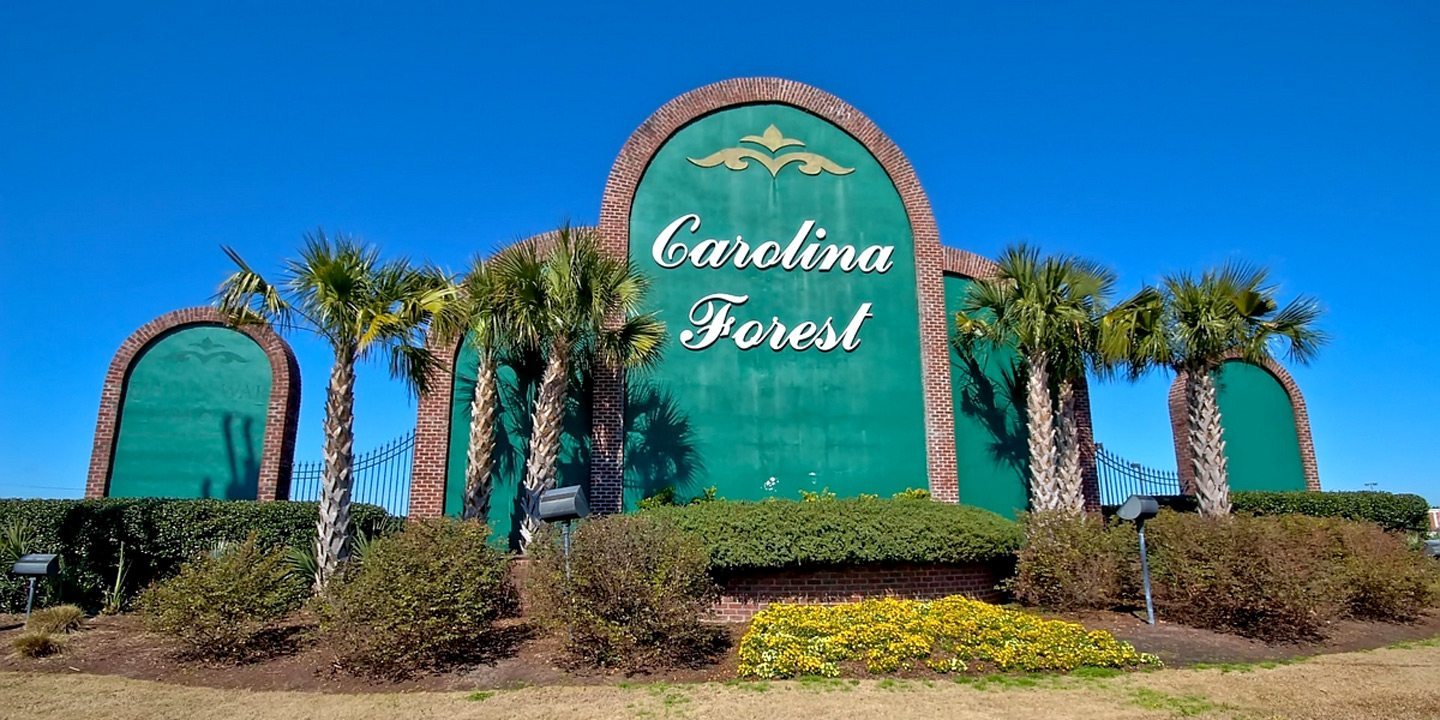
You’ve probably seen the signs. Driving inland from the neon lights of the Myrtle Beach Boardwalk or the high-rises of the Golden Mile, you cross the Intracoastal Waterway and suddenly the scenery shifts. The t-shirt shops vanish. The salt air gets a little thinner. Welcome to Carolina Forest Myrtle Beach, a place that technically isn't even a city, yet it’s the fastest-growing hub in Horry County.
People get confused about this place. They think it’s just a neighborhood. It's not.
Spanning roughly 25 square miles, Carolina Forest is a master-planned behemoth. It sits nestled between Highway 501 and International Drive, acting as the residential backbone for the entire Grand Strand. If the beach is where people play, the Forest is where they actually live, work, and complain about the traffic. It’s a mix of pine barrens, luxury golf courses, and sprawl that has somehow managed to maintain a distinct identity despite being "unincorporated."
The Master Plan That Changed Everything
Back in the early 90s, this area was mostly timberland owned by International Paper. It was quiet. It was rural. Then, a vision for a massive residential development took hold. Unlike the chaotic, piecemeal growth seen in other parts of South Carolina, Carolina Forest was designed with a specific roadmap.
The infrastructure was laid out before the houses arrived. Mostly.
Today, you see the results of that planning in the wide boulevards of Carolina Forest Boulevard and River Oaks Drive. These aren't just roads; they are the arteries of a community that houses over 35,000 people. You have pockets of intense density—think townhomes and apartment complexes—buffered by gated luxury communities like The Farm, Waterway Palms Plantation, and Blackmoor.
What’s wild is the variety. You can find a $250,000 condo right down the street from a $2 million Mediterranean-style estate sitting on the Intracoastal Waterway. It's weirdly democratic in that way. Everyone shares the same grocery stores and the same Post Office, regardless of their zip code’s prestige.
Why Everyone Is Moving Here (And Why Some Regret It)
It’s the schools. Seriously.
If you talk to any local real estate agent, they’ll tell you the Horry County School District’s "Carolina Forest cluster" is the primary driver for property values. Schools like Carolina Forest High and Ocean Bay Elementary consistently rank at the top of state lists. For families fleeing high-tax states in the Northeast, the combination of low property taxes and high-performing schools feels like winning the lottery.
But there’s a catch.
Growth has been so explosive that the infrastructure is perpetually playing catch-up. Traffic on Highway 501 during rush hour is a special kind of purgatory. The county has spent years widening roads and adding turn lanes, but as soon as a new lane opens, another 500-home subdivision gets approved. It’s a cycle.
Then there's the "nature" aspect. It’s called Carolina Forest for a reason, but every year there’s a bit less forest. Local environmental groups have voiced concerns for years about the loss of wetlands. While the community was built around the idea of preserving green space, the reality is often more "manicured lawn" than "untamed wilderness."
Real Talk on the Cost of Living
Living in Carolina Forest Myrtle Beach is cheaper than New Jersey, but it’s not the bargain-basement deal it was in 2015.
- HOA Fees: Almost every neighborhood here has one. They range from $50 a month for basic road maintenance to $300+ for communities with massive pools, fitness centers, and gated security.
- Insurance: Being inland helps with hurricane insurance premiums compared to Ocean Boulevard, but you’re still in a coastal county. Rates are rising.
- Taxes: South Carolina’s 4% primary residence tax rate is a huge draw, but remember that vehicles are taxed annually here. That "surprise" bill in the mail catches a lot of newcomers off guard.
The Golf and Lifestyle Component
You can't talk about this area without mentioning the dirt. Or rather, the grass.
World Tour Golf Links is right in the heart of the Forest. It’s a trip. They literally recreated famous holes from around the world. You can play a version of Augusta’s "Amen Corner" or St. Andrews’ "Road Hole" without a passport. It’s a bit kitschy, but golfers love it.
Beyond the greens, the lifestyle is very "suburban plus." You have the Horry County Memorial Library, which acts as a community nerve center. You have the Lewis Ocean Bay Heritage Preserve nearby, where you can actually see Venus Flytraps in the wild—they’re native to this tiny sliver of the Carolinas and nowhere else on Earth.
Honestly, the "lifestyle" is mostly convenience. You’re 15 minutes from the beach, 10 minutes from the Tanger Outlets, and 5 minutes from a decent craft beer at a local spot like The Grumpy Monk. You get the coastal perks without having to deal with tourists walking across the street in their bathing suits while you’re trying to buy milk.
Understanding the Neighborhood Nuances
Not all "Forest" neighborhoods are created equal. If you’re looking at a map, you need to know the vibes.
Plantation Lakes is the crown jewel for many. It features a massive interconnected lake system where residents can actually boat from house to house. It’s all custom-built homes. Very quiet. Very "established."
On the flip side, you have The Farm at Carolina Forest. It’s huge. It’s bustling. It has a barn-themed clubhouse and two pools that get absolutely packed in July. It’s the quintessential "kids riding bikes in the cul-de-sac" neighborhood.
Then there’s the Waterway Palms area. It’s distinct because of its West Indies-style architecture. White houses, flat roofs, lots of balconies. It looks like it belongs in Florida or the Caribbean, which is a stark contrast to the traditional brick-and-siding homes found elsewhere.
The Future: Where Does the Sprawl End?
The big question for Carolina Forest is where the ceiling is.
The "International Drive" extension was a game-changer. It finally gave residents a back-door route to North Myrtle Beach, bypassing the 501/31 nightmare. Now, development is creeping even further north and west.
There are ongoing debates about incorporation. Some residents want Carolina Forest to become its own city so they can have more control over zoning and police protection. Others hate the idea of another layer of taxes and government. For now, it remains a "Census Designated Place," governed by the county, which keeps things a bit more wild-west than a traditional city.
Environmentalists are keeping a close eye on the Carolina Bays. These are mysterious elliptical depressions in the land that are unique to the Atlantic coast. Carolina Forest is dotted with them. They are vital for local biodiversity, but they also sit on prime real estate. The tension between preservation and the "next big subdivision" isn't going away anytime soon.
Moving to Carolina Forest? Do This First.
If you’re actually considering a move or a long-term stay in Carolina Forest Myrtle Beach, don't just look at the Zillow photos.
- Test the Commute at 8:15 AM: Drive from the back of Carolina Forest Boulevard out to Highway 501. If you can handle that on a Tuesday morning in October, you can handle living here.
- Check the Flood Maps: Even though it’s "inland," certain parts of the Forest have drainage issues during "1,000-year" rain events (which seem to happen every five years now). Look at the FEMA maps, not just the HOA's word.
- Visit the Amenities on a Weekend: See how crowded the pools and tennis courts actually get. Some neighborhoods have outgrown their shared spaces.
- Look Beyond the Gates: Explore the surrounding infrastructure. See how close you are to the fire station and the nearest ER. In a sprawling area like this, those five extra miles can matter.
The reality of Carolina Forest is that it’s a compromise. You give up the walkability of a city and the immediate roar of the ocean for better schools, newer floor plans, and a sense of "normalcy" that’s hard to find in a resort town. It’s a suburban experiment that worked, even if it’s currently bursting at the seams.
Practical Steps for Potential Residents:
- Request a Covenants and Restrictions (CCR) Document: Before buying, read the HOA rules. Some neighborhoods in Carolina Forest are incredibly strict about everything from mailbox color to where you park your work truck.
- Evaluate the "Unincorporated" Status: Understand that you won't have a "City Hall" to go to. Your local representatives are Horry County Council members. Attend a council meeting to see how the area's growth is being managed.
- Verify School Zoning: Boundaries in fast-growing areas change. Never assume a house is zoned for a specific school based on an old listing; check the Horry County Schools website directly for the most current maps.