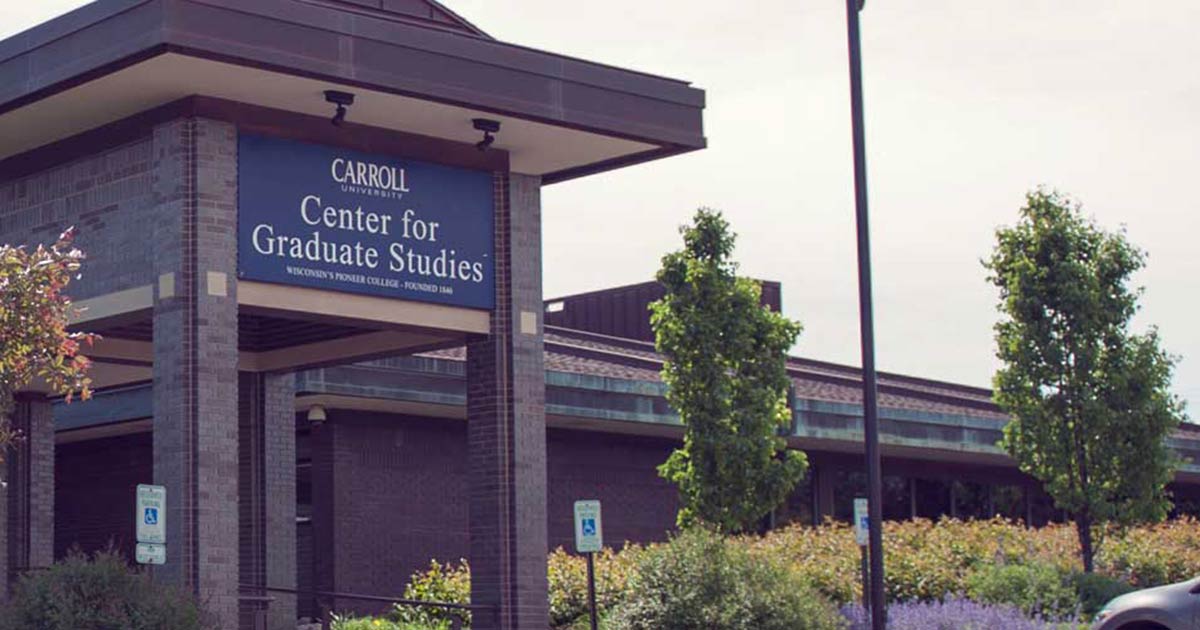
You're driving down Davidson Road in Waukesha, just a few minutes south of I-94, and you see it. It isn't the sprawling, historic stone architecture of the main Carroll campus. Instead, it’s a sleek, focused building that looks more like a high-end medical facility than a traditional college hall. This is the Carroll University Graduate Center, often officially called the Center for Graduate Studies (CGS).
Honestly, it’s the place where the "real work" of modern healthcare education happens in Wisconsin. While the main campus has the charm and the 1846 history, the Graduate Center is where people go when they’re ready to get their hands dirty—literally—in cadaver labs and clinical simulations. It's a specific, intentional environment designed for adult learners who don't have time for the "undergrad" noise.
The Layout of a Specialized Hub
The Center for Graduate Studies isn't just a satellite office. It’s a 55,000-square-foot facility that acts as the nervous system for Carroll’s most intense programs. Located at 2140 Davidson Road, it’s about 20 minutes east of Milwaukee, which makes it a prime spot for working professionals.
Parking is free. That sounds like a small detail, but if you’ve ever tried to park near a major university hospital or a downtown campus, you know it’s actually a massive win. You pull up, you walk in, and you’re immediately in a space that feels more like a professional clinic than a lecture hall.
The building houses the heavy hitters:
- Doctor of Physical Therapy (DPT)
- Master of Occupational Therapy (MOT)
- Master of Science in Physician Assistant Studies (MSPAS)
- Master of Science in Pathologists' Assistant Studies
There’s a certain vibe when you walk through the common areas. You see PA students grabbing coffee with DPT students. This isn't accidental. The Carroll University Graduate Center was built for interprofessional education. In the actual medical world, a physical therapist has to talk to a doctor, who has to talk to a nurse. Carroll forces that collaboration early by putting everyone in the same building.
Inside the Lab: Where Theory Hits the Fan
If you’re squeamish, the Graduate Center might not be your favorite hangout. But for a prospective student, the facilities are the main draw.
One of the standouts is the Human Anatomy Laboratory. We aren’t talking about plastic models here. This is a full cadaver lab. Students in the physical therapy and physician assistant programs spend hundreds of hours here. Understanding how a bicep tendon actually looks—not just how it’s drawn in a textbook—is what separates a "good" provider from a "great" one.
Then there’s the Therapeutic Abilities Clinic. This is basically a mock-up of real-world treatment environments. Occupational therapy students use this space to learn how to help people regain independence. You’ll find adaptive kitchen setups and specialized equipment that mimics what you’d find in a rehab hospital.
The Programs That Actually Live Here
Let's talk about the Physician Assistant (PA) program for a second. It's a 24-month sprint. The first year is a grind of "didactic" learning—basically, you’re in the classroom absorbing everything from pharmacology to clinical medicine. At the Carroll University Graduate Center, this first year includes integrated service-learning. You aren't just sitting in Waukesha; you’re heading out to underserved communities in southeastern Wisconsin.
Then there’s the Master of Occupational Therapy (MOT). It’s an accelerated two-year program. Most people don’t realize that Carroll lets you dive into clinical settings by your second semester. That is fast. You might find yourself working at the university’s on-site Health and Wellness OT clinic or even participating in their annual handwriting camp for kids.
The Doctor of Physical Therapy (DPT) program is perhaps the most famous tenant of the building. Carroll offers a "3+3" track where students can finish their undergrad and their doctorate in six years total. By the time these students hit the Graduate Center for their professional phase, they are locked in. The board exam pass rates for this program are consistently stellar—we're talking 98% to 100% in recent years.
Why Location Matters for Graduate Studies
Waukesha isn't just a random suburb in this context. Because the Carroll University Graduate Center is situated right in the healthcare corridor of SE Wisconsin, students have access to a massive network of clinical placements.
You’ve got ProHealth Care nearby, Aurora, Froedtert, and Children’s Wisconsin. Being at the CGS means you’re physically close to the people who will eventually hire you.
It’s Not All Stress and Scopes
Even though it’s a high-pressure environment, the university tried to make the building livable. It houses pieces from the Jean Stamsta Art Collection, which gives the halls a less "sterile" feel. There are quiet study pods and "hangout" zones where students can decompress.
Is it quiet? Usually. Is it intense? Always.
If you're looking for a traditional "college experience" with football games and dorm life, this isn't it. But if you’re looking to transition from "student" to "provider," the Graduate Center is designed to bridge that gap.
Practical Next Steps if You're Interested
If you're actually thinking about applying or visiting, don't just show up and wander the halls. It's a professional building and some areas (like the labs) are restricted.
- Schedule a "Connect with a Counselor" session: Carroll’s graduate admission team is notoriously fast at responding. They can set up a tour of the Davidson Road facility specifically for your program of interest.
- Check the "Direct Admit" status: If you’re still an undergrad or even a high school senior, look into the 3+3 or direct-entry pathways. It saves a year of tuition and guarantees you a spot at the Graduate Center later.
- Review the prerequisites: For the PA and OT programs, they are very specific about science GPAs and patient care hours (the PA program requires 500 hours).
- Visit on an Open House day: They usually host specific events for the DPT and PA programs in the winter months (like December and January) where you can actually see the labs in action.
The Carroll University Graduate Center represents a shift in how graduate education works. It’s less about the "ivory tower" and more about the clinical floor. For the 500+ graduate students who call this building home every year, it’s the launchpad for careers that literally save lives.