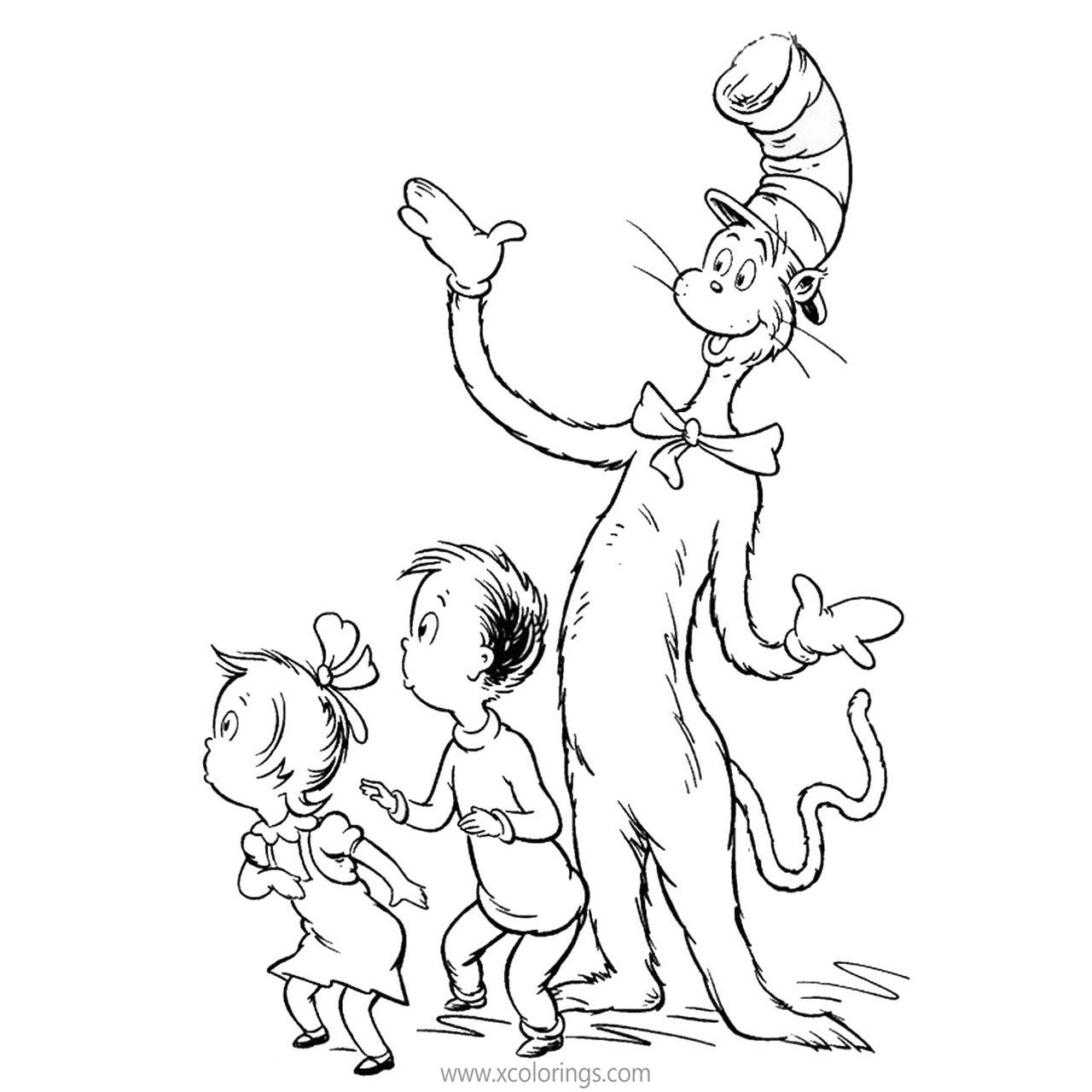
If you grew up with the 1957 Dr. Seuss book, you probably remember the kids as nameless, blank slates. They were just "Boy" and "Sally." They sat by the window. It was cold and wet. They did nothing. Then, in 2003, Universal Pictures decided these two needed names, backstories, and a massive amount of early-2000s angst. That’s how we got Conrad and Sally Cat in the Hat—two kids who, frankly, seemed like they belonged in a completely different movie than the one Mike Myers was starring in.
Honestly, the transition from the page to the screen was messy. While the original book focuses on the chaos of the Cat, the live-action movie tried to turn the siblings into a "dynamic duo" of personality flaws. Conrad is the rule-breaker who can't stop touching things he shouldn't. Sally is the hyper-organized "control freak" who basically acts like a tiny, stressed-out CEO. It's a classic trope, but looking back, it’s wild how much the movie leaned into their psychological baggage.
What Actually Happened to Conrad and Sally?
In the original Dr. Seuss text, the boy is the narrator. He's observant. He’s the one who notices the "cold, cold, wet day." He doesn't have a name because he’s supposed to be you. Sally is just his sister. They are passive observers of the Cat’s madness.
But Hollywood doesn't really do "passive."
When Bo Welch took the director's chair for the 2003 film, the script (penned by Alec Berg, David Mandel, and Jeff Schaffer) gave them distinct identities. Spencer Breslin played Conrad Walden. Dakota Fanning played Sally Walden. Giving them the last name "Walden" was a small touch, but it anchored them in a suburban reality that felt strangely sterile and neon-colored.
Conrad is the engine of the plot. He's the one who opens the "Crate from the Other Dimension." He’s the reason the house gets turned into a literal nightmare landscape. If Conrad doesn't have a "destructive" personality, there is no movie. Sally, on the other hand, is the foil. She’s got a PDA. She’s making to-do lists. She’s played by Fanning with this eerily professional intensity that makes you wonder if the kid ever actually had a childhood.
The Problem with Modernizing Seuss
Why did people have such a hard time with the 2003 versions of Conrad and Sally Cat in the Hat?
Well, it basically comes down to tone. Dr. Seuss wrote about childhood wonder and the fine line between fun and disaster. The movie turned it into a story about a "dysfunctional family." You’ve got a single mom, Joan (played by Kelly Preston), who is terrified of her boss, Mr. Humberfloob. You’ve got the gross neighbor, Larry (Alec Baldwin), who wants to send Conrad to military school.
It’s heavy.
Maybe too heavy for a movie where a guy in a giant cat suit does a "cooking show" parody.
When you look at the 1971 animated special, the kids are still mostly just "the kids." They have a little more personality than in the book, but they aren't the focus. The 2003 film shifted the weight. It tried to make the story about Conrad learning to follow rules and Sally learning to let go. It's a standard character arc, but it felt weirdly forced in a world made of purple foam and CGI goop.
Spencer Breslin and Dakota Fanning: A Weird Career Moment
If you look at the careers of the actors who played Conrad and Sally Cat in the Hat, it’s a fascinating time capsule.
- Spencer Breslin was the go-to "kid" actor of the era. He’d done The Kid with Bruce Willis and The Santa Clause 2. He was great at playing the slightly cynical, slightly messy kid.
- Dakota Fanning was in her "precocious child" era. This was right around I Am Sam and Uptown Girls. She was incredibly talented, which actually made Sally Walden feel even more intense.
The chemistry between them is actually one of the few things that works in the movie. They feel like siblings who genuinely annoy each other. When Conrad says, "I'm not gonna take advice from a girl who keeps a 'To-Do' list for her 'To-Do' lists," it feels real. It’s that specific brand of sibling bickering that anyone with a brother or sister recognizes.
But the movie didn't just want them to be siblings. It wanted them to be the moral center of a chaotic universe. This leads to the infamous "Control/Chaos" dynamic. Conrad is Chaos. Sally is Control. The Cat is... well, the Cat is just Mike Myers doing a voice that sounds suspiciously like a mix between Linda Richman and a blender.
The Lasting Impact (Or Lack Thereof)
Does anyone actually call them Conrad and Sally Cat in the Hat anymore? Not really. Most people just refer to them as "the kids from that creepy Cat in the Hat movie."
The film was a bit of a disaster critically. It currently sits at a pretty grim percentage on Rotten Tomatoes. In fact, Audrey Geisel (Dr. Seuss's widow) reportedly hated the film so much that she banned any further live-action adaptations of her husband's work. That’s why we got animated versions of The Lorax and The Grinch later on.
The legacy of Conrad and Sally is mostly found in "cursed image" memes and nostalgic TikToks. People who watched the movie as toddlers don't see the "tonal inconsistency" or the "failed character arcs." They just remember the giant fish, the "Things," and the absolute terror of the house melting.
The Real Difference Between the Book and Film
Let's get into the weeds for a second. In the book, the Cat arrives, wreaks havoc, and then cleans it all up before Mom gets home. The kids are basically witnesses. They have a moral dilemma at the end: "Should we tell her about it?"
In the movie, the stakes are shifted. If Conrad and Sally don't fix the house, their mom loses her job, Larry marries their mom, and Conrad goes to military school.
It turns a whimsical afternoon into a high-stakes survival horror.
This change forced Conrad and Sally Cat in the Hat to become "action heroes." They have to navigate the "S.L.O.W." (Super Luxurious Omnidirectional Whatchamajigger). They have to fight back against the house's transformation. It’s a lot of pressure for two kids who just wanted something to do on a rainy day.
Why the 2003 Design Still Haunts Us
It wasn't just the writing. The visual design of the kids was... specific.
Sally’s hair was perfectly coiffed, her clothes were stiff and colorful, and she looked like a doll. Conrad looked like he’d been dragged through a hedge backwards. This visual shorthand was effective, sure, but it felt a bit "Disney Channel Original Movie" in a story that was supposed to be surrealist literature.
The house itself—designed by Bo Welch, who did Edward Scissorhands—was a masterpiece of production design. But within that house, Conrad and Sally often felt like they were struggling to find their footing. They were surrounded by props and sets that were more interesting than their own dialogue.
A Lesson in Character Expansion
There is a lesson here about "expanding" simple characters. When you take a 61-page picture book with maybe 200 words and try to turn it into a 82-minute feature film, you have to add "stuff."
The "stuff" added to Conrad and Sally Cat in the Hat was mostly conflict.
- Internal Conflict: Conrad wants to be "cool" but is actually just destructive. Sally wants to be an adult but is actually just a child.
- External Conflict: The threat of military school. The threat of the "Crate."
- Relational Conflict: The kids don't get along at the start, but they have to work together to save their home.
It's Screenwriting 101. But Dr. Seuss wasn't Screenwriting 101. He was about the rhythm of the language and the absurdity of the situation. By grounding the kids in "real-world" problems, the movie lost the magic of the source material.
How to Revisit the Story Today
If you’re looking to introduce someone to these characters, start with the book. It’s a classic for a reason. The ambiguity of the boy and Sally is what makes it work. You can project yourself onto them.
If you must watch the 2003 movie, watch it as a relic of its time. It’s a fascinating look at how the early 2000s tried to "edge up" children's stories. Conrad and Sally aren't just Seuss characters; they are artifacts of a specific era of filmmaking where everything had to be loud, slightly gross, and filled with pop culture references.
What to do if you want to dive deeper:
- Read the original 1957 book and pay attention to how little the kids actually say. It’s a masterclass in visual storytelling.
- Compare the 1971 cartoon to the 2003 film. Notice how the animated kids are allowed to be "plain" while the live-action kids are forced to be "personalities."
- Look up the production design of the 2003 movie. Regardless of how you feel about Conrad and Sally, the world they live in is a stunning piece of practical set building.
Ultimately, Conrad and Sally Walden are the result of Hollywood trying to find a "heart" in a story that was originally about a chaotic cat. Whether they succeeded is up for debate, but they certainly left a lasting impression on a generation of kids who now wonder why their house doesn't have a giant purple slide in the living room.