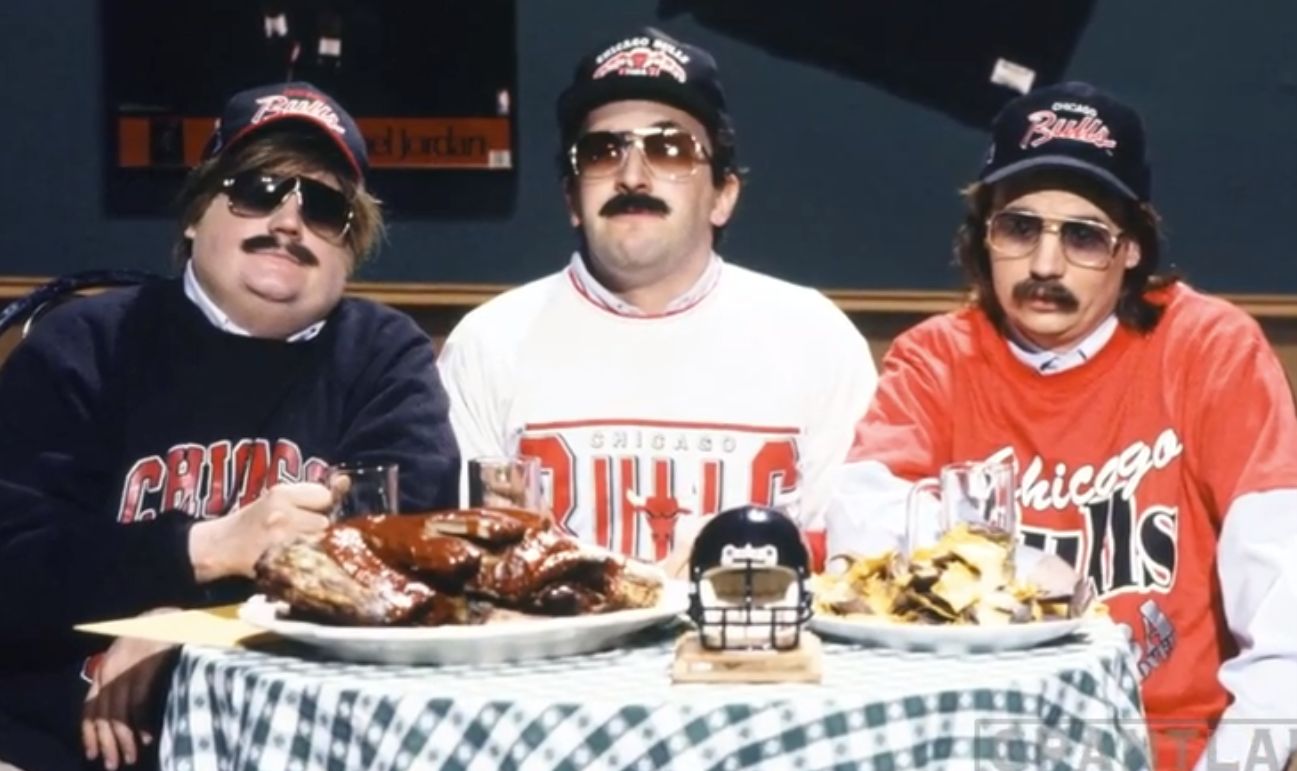
If you’ve ever walked through O’Hare airport or sat in a dive bar on Chicago's North Side, you’ve heard it. That thick, glottal stop. The exaggerated "s" that sounds like a radiator leaking steam. Da Bears. It’s been over thirty years since a group of guys in aviator sunglasses and walrus mustaches first sat around a table on Saturday Night Live to discuss the "gridiron excellence" of Mike Ditka. We remember the heart attacks. We remember the Polish sausage. But honestly, most people forget that the "Bill Swerski’s Superfans" sketches weren't just a joke about football. They were a hyper-specific autopsy of a very particular kind of Midwestern swagger that, for a minute there, took over the entire country.
The Weird, Real-Life Origin of the Mustache
You might think the Superfans were just a parody of Ditka. It's more complicated than that.
The whole thing started with Robert Smigel. In 1982, Smigel moved to Chicago and went to a Cubs game at Wrigley Field. He didn't see fans; he saw a uniform. It was a sea of overweight guys in gold-rimmed sunglasses, Oxford shirts under garish team T-shirts, and those thick, bristly mustaches.
Smigel called it a "badge of virility."
He teamed up with a young Bob Odenkirk (long before he was Saul Goodman) to refine the bit. Odenkirk, a Naperville native, was the one who insisted on the "hiss" at the end of words. It wasn't just "Bears." It was "Bearsss." That tiny phonetic detail turned a generic sports joke into an anthem for an entire region.
They actually tried the characters out first in a live stage revue called Happy Happy Good Show during the 1988 writers' strike. Smigel, Odenkirk, and Dave Reynolds would just sit on lawn chairs and drink beer. Smigel was actually convinced it would never work outside of Illinois. He thought the humor was too "inside baseball."
He was wrong.
Why Da Bears Almost Didn't Happen on SNL
The sketch didn't debut until January 12, 1991. The host was Joe Mantegna, a Chicago legend who played the original Bill Swerski.
Interestingly, Smigel originally wanted Phil Hartman to play one of the fans. But the show's head writer, Jim Downey, stepped in. He told Smigel his own accent was more authentic and forced the writer to get in front of the camera. That’s how we got the core lineup:
- Joe Mantegna (and later George Wendt) as the host.
- Chris Farley as Todd O’Connor (the guy prone to "udder" heart attacks).
- Mike Myers as Pat Arnold.
- Robert Smigel as Carl Wollarski.
When Mantegna couldn't return for every episode, they brought in George Wendt—Norm from Cheers—to play Bill’s "brudder," Bob Swerski. It felt seamless because Wendt was a Chicagoan through and through. He even brought his real-life nephew, Jason Sudeikis, into the fold years later for charity revivals.
The "Heart Attack" Gag and the Ditka Worship
The comedy of the Superfans isn't just in the accent. It's in the absolute, borderline-religious delusion.
They didn't just think the Bears were good. They thought the Bears were invincible. One of the most famous bits involved a debate: Who would win in a fight, a hurricane or Mike Ditka?
The answer? Ditka.
But then came the curveball: "What if the hurricane's name was Hurricane Ditka?"
The table went silent. A theological paradox.
Then there was Chris Farley. His character, Todd O'Connor, was the physical heart of the sketch—literally. He’d get so worked up about "Da Bulls" or a "baker's dozen" of pork chops that he’d clutch his chest and collapse. "It's just a small piece of Polish sausage lodged in the lining of my heart," he'd wheeze.
Farley’s energy made the sketch dangerous. You weren't sure if he was acting or actually about to blow a gasket. That unpredictability is why the sketches still hold up today while other 90s SNL bits feel like museum pieces.
The Cultural Ripple Effect (2026 and Beyond)
It’s 2026, and the "Superfan" archetype is still the blueprint for every "obsessed fan" character in media. From State Farm commercials to local sports radio, the DNA of Bill Swerski is everywhere.
Even the Vatican isn't safe. When Chicago-born Cardinal Robert Prevost was named Pope Leo XIV recently, the city immediately dubbed him "Da Pope." There were literally T-shirts made.
But there’s a nuance people miss. The sketch was parodying The Sports Writers on TV, a real, low-budget show on WFLD-TV where older guys like Bill Gleason sat around a table and argued. Smigel and Odenkirk just replaced the "experts" with guys who ate too many ribs.
It was a commentary on the "fan-as-expert" culture before the internet made everyone a commentator.
What You Should Do Next
If you want to truly appreciate the craft here, don't just watch the Greatest Hits. Go find the 1991 Thanksgiving sketch where Macaulay Culkin guest stars. It shows the group’s dynamic at its peak.
Also, pay attention to the props. The hats they wore—with the bills on both the front and the back—were a subtle joke about the fans being so drunk or disoriented they didn't know which way they were facing.
Next Steps for the Superfan Obsessive:
- Watch the "Remastered" YouTube clips: NBC has been upscaling these to 4K. The detail on Farley's mustache is honestly terrifying.
- Listen to "The Sportswriters" archives: Find the old WGN radio clips to hear the real voices that inspired the characters.
- Visit Ditka’s: If you’re ever in Chicago, go to the actual Mike Ditka’s restaurant. It’s less of a steakhouse and more of a cathedral to the era this sketch immortalized.
The Superfans worked because they weren't mean-spirited. Smigel loved those guys. He was one of them. That's why, even when the Bears are having a losing season, you can still find someone in a bar shouting "79 to zero" with a straight face. It’s not about the score; it’s about the "swagger."