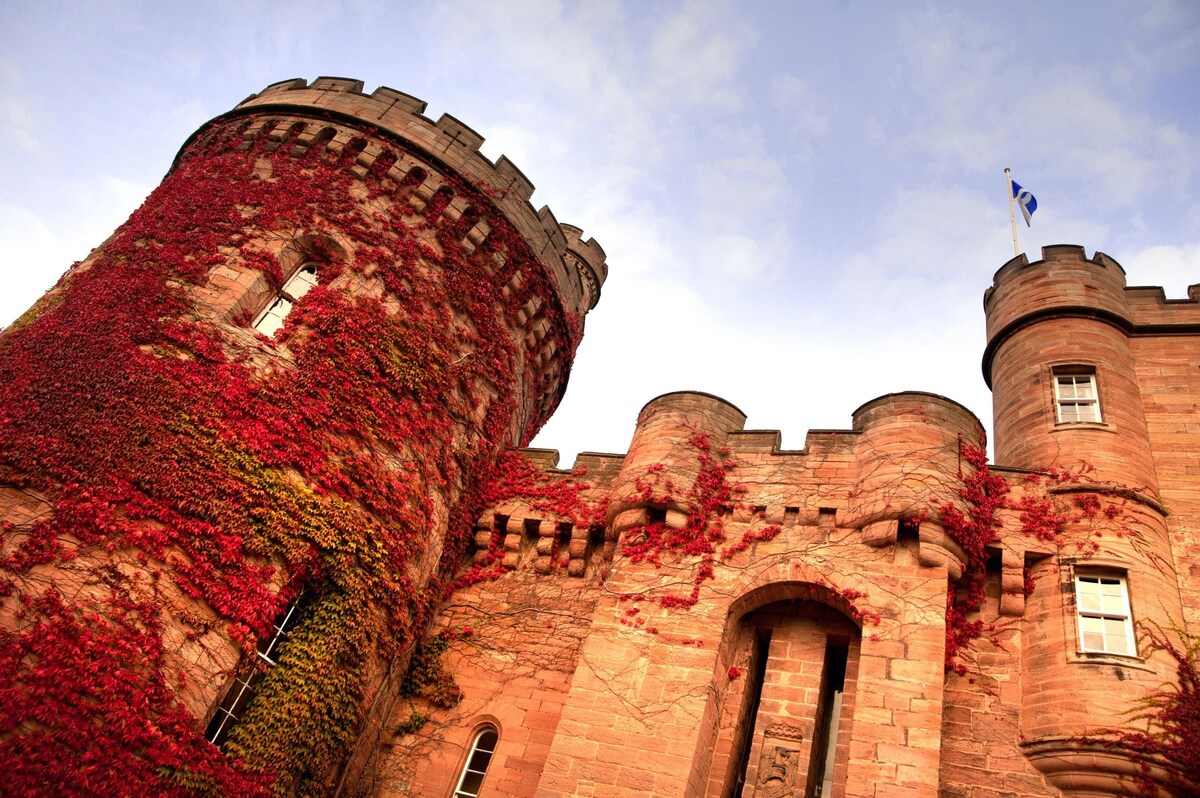
Scotland is basically littered with old stones and drafty rooms. You can’t throw a haggis without hitting a "historic" site, but Dalhousie Castle Hotel and Spa is different. It’s the oldest inhabited castle in Scotland. That’s not just a marketing line; it’s a heavy, 13th-century reality you feel the second you pull up the driveway toward the red sandstone walls.
Most people heading to Edinburgh stay in the city. They deal with the noise of the Royal Mile and the overpriced hotels. Honestly? They’re missing out. Just eight miles south, in Bonnyrigg, this place sits on the banks of the River Esk, surrounded by thick woods. It feels like you’ve accidentally slipped through a crack in time.
The Reality of Staying in a 13th-Century Fortress
Let’s get one thing straight: if you want ultra-modern, glass-and-steel minimalism, look elsewhere. This is a fortress. The walls are massive. Some of them are 11 feet thick. It was the ancestral seat of the Earls of Dalhousie, the Clan Ramsay, and they didn’t build it for "vibes"—they built it to keep people out.
The history here is dense. King Edward I stayed here on his way to fight William Wallace at the Battle of Falkirk in 1298. Mary Queen of Scots spent a night in 1563. When you’re walking down the corridors, you aren't just walking on carpet; you’re retracing the steps of people who literally shaped Scottish and British history. It’s kinda surreal.
The rooms are a mix. You’ve got the "Castle" rooms, which are inside the main keep. These are the ones people fight over. They have the four-poster beds, the heavy drapes, and the period furniture that makes you feel like royalty—or at least a very well-off knight. Then there are the "Edinburgh" rooms in the lodge, which are a bit more contemporary but still carry that Scottish country house feel.
Pro tip: if you’re staying in the castle, don't expect a lightning-fast elevator. There isn't one. You’ll be climbing stone spiral staircases. It’s authentic, sure, but it’s a workout after a three-course dinner.
Dining Beneath the Waterline in the Dungeon
Eating at the Dalhousie Castle Hotel and Spa is an event, specifically if you get a table in the Dungeon Restaurant. It’s located in the former—you guessed it—dungeon.
It’s dark. It’s atmospheric. There are suits of armor standing guard in the corners. They’ve won 2 AA Rosettes for the food here, which is impressive given they’re cooking in a space that used to hold prisoners. The menu leans heavily into local provenance. You’re looking at things like:
- Seared West Coast scallops that taste like they were in the ocean three hours ago.
- Scottish venison served with rich, earthy sauces that match the environment.
- A selection of cheeses that could probably sustain a small village.
It isn't cheap. But you aren't just paying for the calories; you’re paying for the fact that you’re eating fine dining in a room where people were once chained to the walls. It’s a bit macabre, but undeniably cool. If you want something lighter, the Orangery offers a view of the estate and a more relaxed menu, but the Dungeon is the "bucket list" experience.
The Residents Who Never Left
We have to talk about the ghosts. Dalhousie Castle Hotel and Spa is widely considered one of the most haunted buildings in Scotland. The most famous resident is Lady Catherine, the "Grey Lady."
The story goes that she was a teenager in the 16th century who fell in love with the wrong person. Her parents weren't thrilled, so they locked her in the castle turret, where she eventually died of a broken heart (or starvation, depending on which historian you ask). People see her all the time. She’s usually spotted around the staircases or the turrets.
Then there’s Sir Alexander Ramsay. Back in 1342, he was starved to death in the dungeon by William Douglas. Guests often report weird noises or the feeling of being watched in the lower levels. Whether you believe in ghosts or not, the atmosphere at 2:00 AM in a stone castle is enough to make anyone a bit jumpy.
Falconry and the Aqueous Spa
One of the coolest things about Dalhousie is the multi-sensory contrast. On one hand, you have the Aqueous Spa. It’s modern. It’s got a hydrotherapy pool, a laconium, and a Turkish steam room. After a day of hiking around Midlothian, sitting in a hot tub surrounded by ancient stone is peak relaxation.
On the other hand, you have the falconry.
The castle has its own dedicated mews. You can go out with an expert and have a Harris hawk or an owl land on your leather-gloved hand. It’s one of the few places where this ancient sport feels entirely natural. Seeing a hawk fly through the Scots pine trees against the backdrop of the castle walls is a core memory kind of moment. They offer "hawk walks" which are much better than just standing in a field watching a demonstration. You’re actually part of the process.
What Most Travelers Get Wrong About the Location
People see "Edinburgh" in the descriptions and think they can just pop into the city center for a quick coffee.
Technically, you can. It’s a 20-minute drive if the traffic behaves. But the A7 can be a nightmare during rush hour. If you’re planning on doing the Edinburgh Fringe or seeing the Castle, don’t rely solely on Uber. The local train station at Eskbank is a better bet—it’s a short taxi ride from the hotel and gets you into Waverley Station in about 18 minutes.
But honestly? Most people who check into Dalhousie find they don't actually want to leave the grounds. There are miles of walks along the River Esk. You can spend hours just poking around the library, which has a secret door (seriously) and a massive collection of old books.
Is It Worth the Price Tag?
Dalhousie isn't a budget stay. You’re looking at anywhere from £200 to over £500 a night depending on the season and the room type.
If you just want a bed, go to a Premier Inn. If you want to feel the weight of eight centuries of history, hear the wind howl against stone walls that have survived sieges, and eat dinner in a literal dungeon, then yes, it’s worth every penny. It’s a specific kind of luxury—it’s not polished and "perfect" in the way a Four Seasons is. It’s authentic. It’s creaky. It’s old. And that’s exactly why it works.
Actionable Steps for Your Visit
- Book the Dungeon Early: The restaurant fills up weeks in advance, especially on weekends. Don't assume you can just "walk in" because you're a guest.
- Request a Castle Room: If you're staying in the lodge, you're basically in a nice hotel. If you're in the castle, you're in a fortress. Specify this during booking.
- Check the Wedding Calendar: Dalhousie is a massive wedding venue. If you want peace and quiet, try to stay on a Tuesday or Wednesday. Saturday nights can get loud with ceilidh music and bagpipes.
- Visit Rosslyn Chapel: It’s only about a 10-minute drive away. If you’re a fan of The Da Vinci Code or just incredible stonework, it’s a non-negotiable side trip.
- Pack for the Weather: Even in July, Scotland is unpredictable. The castle can be drafty. Bring a solid sweater (or "jumper" as the locals say) even for indoors.
- Talk to the Falconers: They are a wealth of knowledge and usually happy to chat about the birds even if you aren't doing a full session.
The real magic of Dalhousie isn't in the spa treatments or the fancy linens. It’s the fact that at 11:00 PM, when the day guests have left and the fire is dying down in the library, you realize you're just the latest in a very long line of people who have sought shelter within these red walls. You're part of the story, even if only for a weekend.