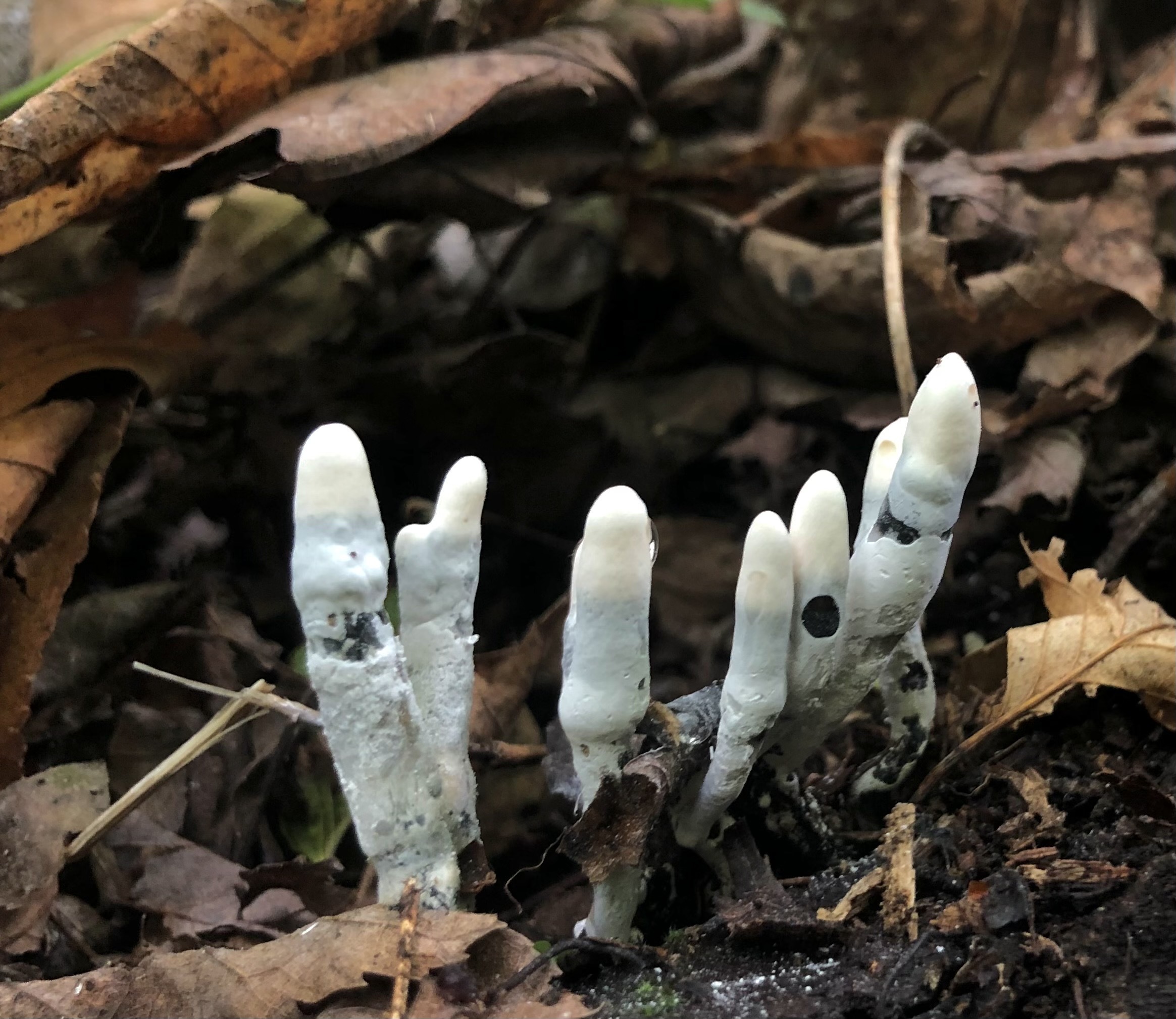
Walking through a damp forest in late autumn can be a bit surreal. You’re looking at the changing leaves, maybe sniffing the crisp air, and then you see it. Poking out from the base of a rotting tree stump is what looks exactly like a decaying human hand reaching up from the grave. It’s terrifying. Honestly, the first time I saw dead man’s fingers, I nearly jumped out of my skin. But once you get past the initial "is there a body buried here?" panic, you realize you're looking at one of the most fascinating organisms in the fungal kingdom.
Xylaria polymorpha. That’s the scientific name. It literally translates to "many-shaped wood lover," which is a lot less metal than the common name but way more accurate.
These things don't look like your typical grocery store button mushrooms. They’re club-shaped, hard, and usually appear in clusters of three to six "fingers." When they’re young, they might have a pale, bluish-white dust on them—those are the asexual spores. But as they mature, they turn a charred, crusty black. They look burnt. Or like something that’s been underground for a few months too long.
What’s Actually Going On With Dead Man’s Fingers?
Most people assume that if a fungus looks this gross, it must be "bad." That’s not how nature works. Dead man’s fingers are saprobic. Basically, they eat dead stuff. They are the cleanup crew of the forest floor. They specialize in breaking down the polysaccharides in wood—things like glucan and cellulose.
Think about it. If these fungi didn't exist, the woods would be piled twenty feet high with dead logs that never rot. They turn stubborn wood back into nutrient-rich soil. It’s a slow process. It’s gritty.
But there’s a catch. Sometimes they aren't just eating the dead; they’re a bit more aggressive. While they mostly live on decaying logs, they can be facultative parasites. If they find a stressed apple or maple tree, they might start eating the roots before the tree is even dead. If you see them growing at the base of a tree in your yard, it’s usually bad news. It means the heartwood or the root system is already rotting away from the inside out. You’ve got a structural problem on your hands.
Identifying the "Fingers" Without Losing Your Mind
You’ll find them year-round, but they really "bloom" (if you can call it that) in the summer and fall. They love deciduous forests. Beech, oak, hickory—that’s their favorite menu.
- Look for the texture. It’s not soft. If you poke a dead man's finger, it feels like wood or charcoal.
- Look for the "nail." Sometimes the tips stay white or pale longer than the rest of the body, giving it a creepy fingernail appearance.
- Check the inside. If you were brave enough to snap one in half (don't worry, they aren't poisonous to touch), you’d see a stark white interior. It’s a weird contrast. Pure white flesh inside a charred, black "skin."
People often confuse them with Xylaria longipes, which is "Dead Moll's Fingers." Those are usually thinner and grow on fallen branches rather than large stumps. There’s also Xylaria hypoxylon, known as the "Candlesnuff Fungus," which is much smaller and looks like tiny, branched deer antlers covered in flour.
The Chemistry of Decay: Why Mycology Experts Care
In the world of mycology, dead man's fingers are respected for their persistence. While a puffball or a morel might pop up and disappear in three days, Xylaria polymorpha hangs around for months. Sometimes years. They are incredibly tough.
Researchers have been looking into the secondary metabolites produced by these fungi. They contain compounds like xylocandin, which has shown some antifungal properties against other types of rot. It’s a chemical war down there in the dirt. These fungi produce "bio-control" agents to stop other organisms from stealing their food source.
Also, they’re famous in the world of woodworking. Have you ever seen "spalted" wood? It’s that beautiful lumber with dark, winding lines through the grain. That’s often caused by Xylaria species. They create "zone lines" as they defend their territory from other fungi. People pay a premium for that "dead man" aesthetic in their coffee tables.
Can You Eat Them? (Spoiler: No)
Don’t. Just don't.
Technically, they aren't listed as "deadly toxic" in the same way an Amanita is, but they are completely inedible. They’re tough. They’re woody. They taste like nothing, or maybe bitter dirt. More importantly, there isn't enough research on the long-term effects of consuming their specific alkaloids.
Mushrooms are either food, medicine, or "don't touch that." This one is firmly in the third category.
Why You Should Stop Freaking Out About Them
If you find dead man’s fingers in your garden or a local park, don't rush to get the bleach. They are a sign of a functioning ecosystem. They mean the soil is active.
The only time to worry is when they are touching a tree you actually care about. If they’re growing on a prized ornamental maple, that tree is likely on its way out. The fungus is just the messenger. It’s telling you the tree is already failing.
Nature is weird. It’s often ugly. But Xylaria polymorpha is doing the heavy lifting that keeps our forests green. It's the ultimate recycler.
Actionable Next Steps for Homeowners and Hikers
If you’ve spotted this fungus and aren't sure what to do, follow these steps:
- Check the host. If the fungus is on a loose log or an old stump, leave it alone. It’s doing its job.
- Inspect your trees. If it's growing on the "flare" (the base) of a living tree, call an arborist. The tree might be a falling hazard because the roots are likely decaying.
- Don't kick them. Spreading the spores around your yard might lead to more growth on other wood debris or mulch.
- Appreciate the Spalting. If you have to cut down a tree that was infected, look at the wood grain. You might find some incredible patterns that are highly sought after by woodturners.
- Wash your hands. It’s just good practice after handling any wild fungi, even though these won't hurt you through skin contact.
Dead man’s fingers might look like a prop from a low-budget horror movie, but they’re just another part of the forest's life cycle. They aren't evil. They’re just busy eating.