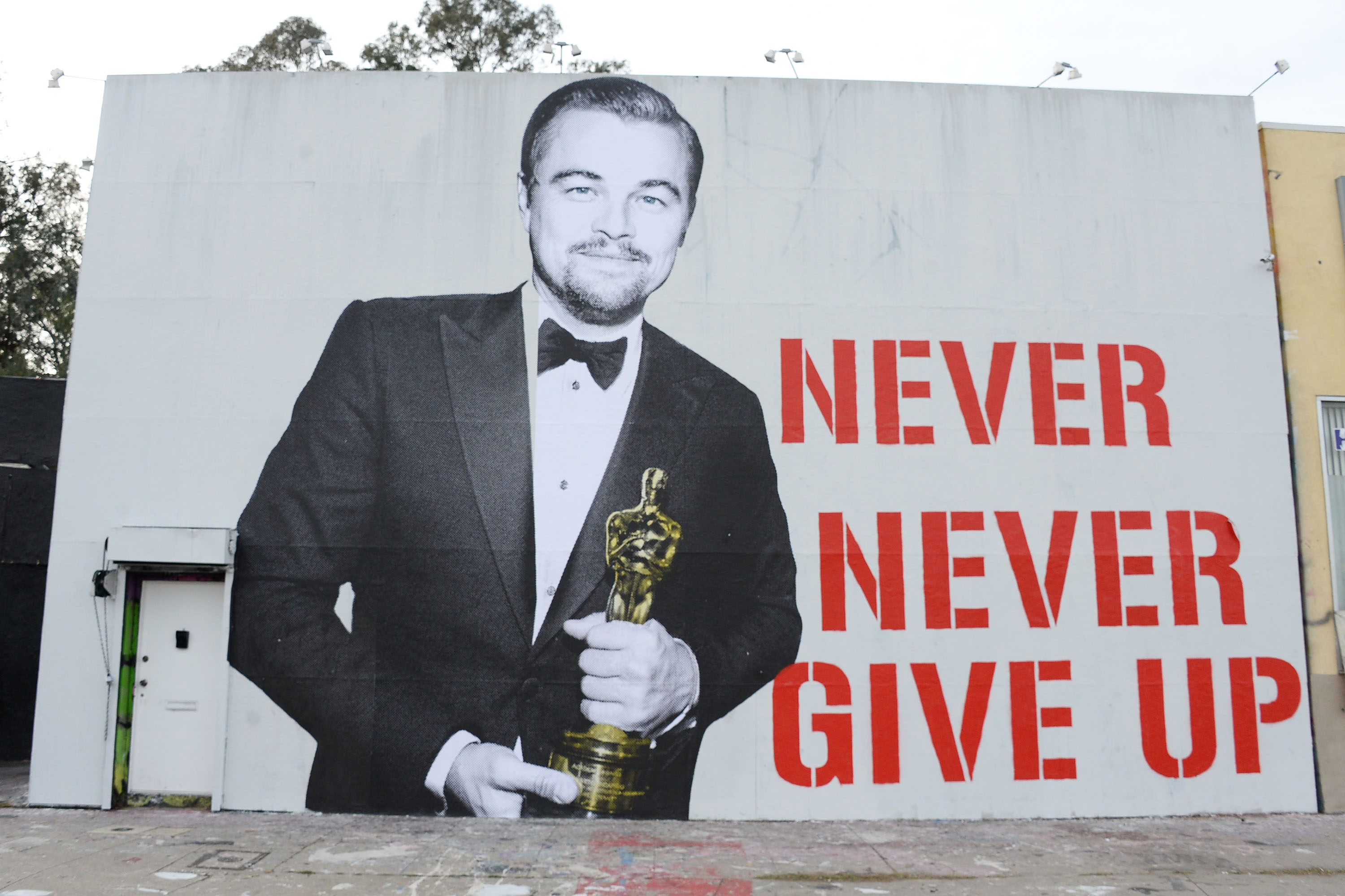
It was the meme that defined an entire era of the internet. You remember them—the GIFs of a weeping Leo reaching for a gold statue, the photoshopped images of him crying behind a velvet rope, and the collective digital anxiety every time late February rolled around. For years, the question did Leonardo DiCaprio win Oscar glory was the punchline to a very long, very public joke. It felt like a glitch in the Matrix. How could the guy from Titanic, The Departed, and Inception have a shelf full of empty space where an Academy Award should be?
He finally did it.
In 2016, the drought ended. But the story of how he got there—and why it took so long—is actually way more interesting than the win itself. It wasn't just about one movie. It was about a decade of "snubs" that turned a movie star into a cultural underdog.
The night the internet broke: The 88th Academy Awards
When Julianne Moore opened that envelope on February 28, 2016, the world collectively held its breath. Honestly, if he hadn't won for The Revenant, there might have been a riot in the Dolby Theatre. When she said his name, the standing ovation lasted forever. It wasn't just the industry clapping; it was a release of nearly two decades of tension.
Leo’s speech was classic Leo. He didn't gloat. He didn't make it about the "about time" narrative. Instead, he pivoted immediately to climate change. He talked about the difficulty of finding snow for the film and the urgent need to protect the planet. It was a pro move. He took the biggest personal moment of his career and made it about something bigger, which sort of silenced the critics who thought he was too desperate for the win.
But why did we care so much?
People felt a weirdly personal connection to his struggle. We grew up with him. From the scrawny kid in What’s Eating Gilbert Grape to the king of the world in Titanic, DiCaprio was our generation's leading man. Seeing him lose year after year felt like a personal slight to our own taste.
The long road of "almosts"
To understand why people kept asking did Leonardo DiCaprio win Oscar trophies for so long, you have to look at the sheer quality of the work he was putting out while being ignored by the Academy.
His first nomination came way back in 1994. He was just 19. He played Arnie Grape, a boy with a developmental disability, and he was so convincing that many people who saw the film actually thought the production had cast a non-actor. He lost to Tommy Lee Jones for The Fugitive. Fair enough. Tommy Lee Jones was a titan.
Then came the Titanic snub. The movie won basically everything—eleven Oscars—but Leo wasn't even nominated. That's where the "Academy vs. Leo" narrative really started to bake.
He stayed busy, though. He stopped doing heartthrob roles and started chasing "prestige" cinema. He became Martin Scorsese's muse. Think about this run:
- The Aviator (2004): He played Howard Hughes. He was obsessive, manic, and brilliant. He lost to Jamie Foxx, who did an untouchable Ray Charles impression.
- Blood Diamond (2006): He mastered a Rhodesian accent and went full action-prestige. He lost to Forest Whitaker in The Last King of Scotland.
- The Wolf of Wall Street (2013): This was the one that hurt. His Jordan Belfort was a comedic tour de force. The Quaalude scene alone is legendary. But Matthew McConaughey had the "McConaissance" momentum for Dallas Buyers Club.
Each time he lost, the memes got louder. The internet started treating the Oscars like a cruel reality show where the main character was being tortured for our amusement.
Why The Revenant was the tipping point
By the time 2015 rolled around, the narrative was "What does this man have to do?"
Alejandro G. Iñárritu gave him the answer: suffer.
The production of The Revenant was famously miserable. They shot in sub-zero temperatures using only natural light. DiCaprio, a longtime vegetarian, ate a raw bison liver on camera because a fake one "didn't look right." He slept in animal carcasses. He caught hypothermia multiple times.
The Academy loves a "suffering" narrative. They love it when a beautiful person makes themselves look haggard for the craft. It felt less like he was being rewarded for his acting—though he was great—and more like he was being given a Purple Heart for surviving the shoot.
Critics like Mark Kermode and Wesley Morris have pointed out that while it might not even be his best performance (many argue for The Wolf of Wall Street or Django Unchained), it was the most "undeniable." You couldn't look at that footage and say he wasn't working harder than anyone else in Hollywood.
The "Snub" that wasn't: Why he kept losing
If you look at the stats, Leo wasn't actually "snubbed" as much as people think. He was just a victim of bad timing.
The Oscars are a political game. It’s about the "narrative." In 2005, Jamie Foxx had the narrative. In 2014, McConaughey had the narrative. Leo was always the bridesmaid because he was consistently great, and the Academy often prefers a "comeback" or a "transformation" over consistent excellence.
There’s also the "Pretty Boy" tax. For a long time, the older members of the Academy viewed him as the teen idol from Titanic. It takes a long time to wash that image off in the eyes of 70-year-old voters.
The movies he wasn't even nominated for
Interestingly, some of his best work didn't even get him to the ceremony.
- The Departed: He was the emotional core of the movie, but the Academy focused on Mark Wahlberg’s supporting role.
- Django Unchained: His Calvin Candie was terrifying. He literally cut his hand open on a glass during a scene and kept acting through the blood. No nomination.
- Revolutionary Road: A brutal, nuanced look at a collapsing marriage. Ignored.
What changed after the win?
Once the question did Leonardo DiCaprio win Oscar recognition was finally answered with a "Yes," something shifted in his career. The pressure was off.
He took a break. He didn't rush into another grueling production. When he came back for Quentin Tarantino’s Once Upon a Time in Hollywood, he looked like he was having fun again. He played Rick Dalton, a fading actor, and he was hilarious. He got another nomination, but the desperate "give it to him" energy from the fans was gone. We could just enjoy the performance.
He's since moved into a phase of his career where he’s picking projects based on his personal interests—mainly environmentalism and working with masters of the craft. Films like Don’t Look Up and Killers of the Flower Moon show a man who isn't hunting trophies anymore. He's just building a legacy.
Common misconceptions about Leo's Oscar history
There’s a lot of fake news floating around about his awards record. Let's clear some of it up.
"He has won multiple Oscars."
Actually, no. As of 2026, he has only won one Academy Award for acting. He has been nominated seven times (six for acting, one as a producer for The Wolf of Wall Street), but only the bison-liver-eating expedition brought home the gold.
"He was nominated for Titanic."
Nope. This is one of the biggest Mandela Effects in cinema. Titanic won 11 Oscars, and Kate Winslet was nominated, but Leo was left out of the Best Actor category entirely.
"The Academy hates him."
Probably not. They’ve nominated him more times than most actors will ever dream of. It’s just a very crowded field every year.
Actionable insights: How to track his next run
If you're following his career now, the game has changed. He isn't the "underdog" anymore. He's the veteran.
- Watch for the Scorsese collaborations: Whenever Leo and Marty team up (like for the upcoming The Wager), an Oscar nomination is almost a statistical certainty.
- Look at the "Physicality" of the role: If he's transforming physically or undergoing intense training, the Academy will take notice.
- Follow the trades: Sites like Variety and The Hollywood Reporter start their "Oscar Buzz" columns as early as September. If his name is at the top of the list by November, he’s in the running.
The 2016 win wasn't just a trophy for a movie about a fur trapper. It was a career achievement award given in the middle of a career. It validated a generation of fans who had cheered for him since the 90s.
What to do next
To really appreciate the win, you should do a "Comparison Marathon." Watch The Wolf of Wall Street and then The Revenant. You’ll see the two sides of his talent: the high-energy, verbal gymnast and the quiet, physical survivalist.
If you're tracking current awards cycles, pay attention to the "narrative" of the frontrunners. You'll notice that the same patterns that kept Leo waiting for 22 years—the "it's their turn" factor or the "transformation" factor—are still deciding who wins today. Check the current betting odds on platforms like GoldDerby to see who the "Leo" of the current year might be. There's always someone the internet is rooting for a little bit too hard.