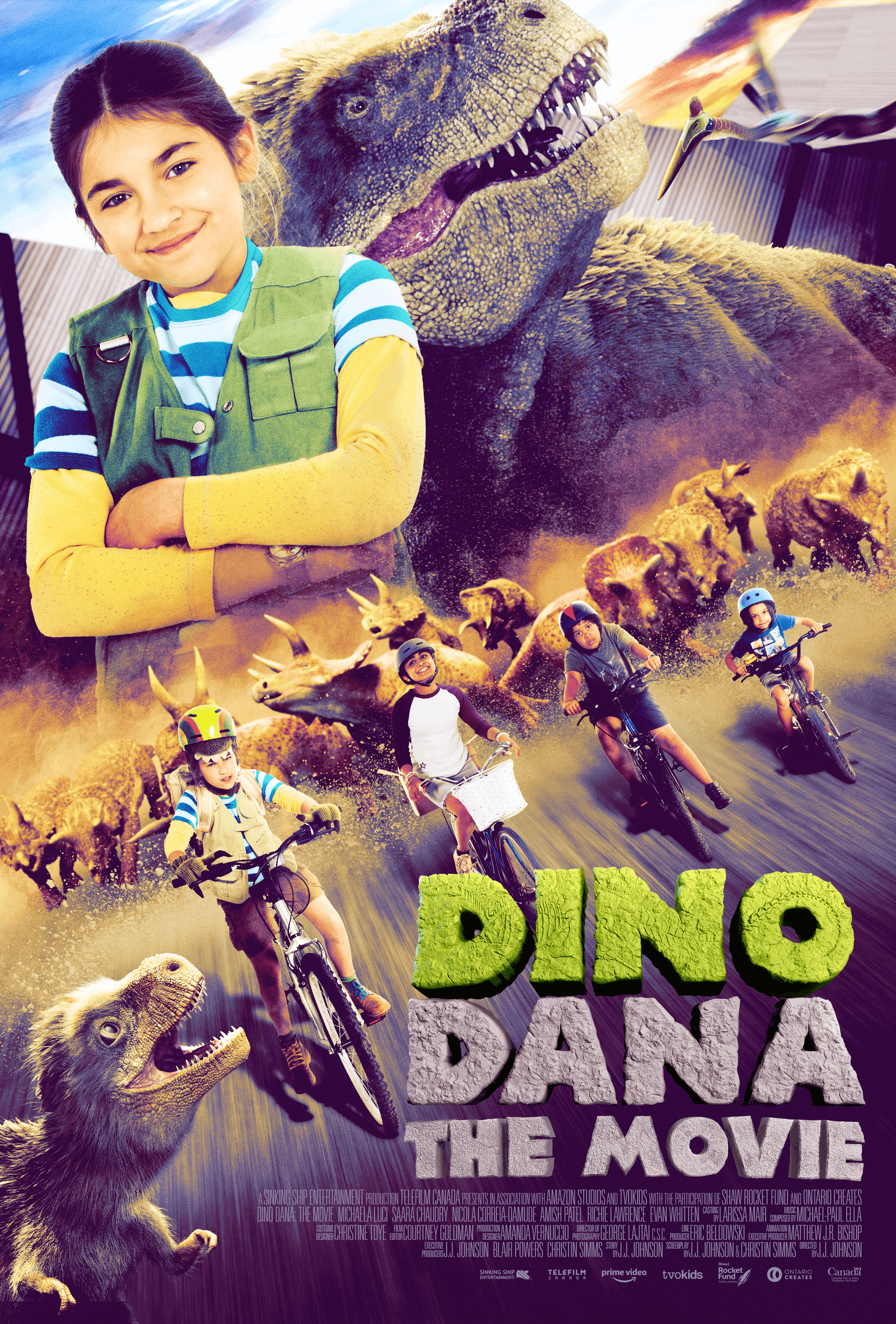
Honestly, if you've got a kid who can recite the difference between a Microraptor and a Troodon, you probably already know Dana Jain. She’s the kid who sees dinosaurs in her backyard. It started as a TV show on TVOKids and Amazon Prime, but when dino dana the movie dropped, it actually managed to do something most spin-offs fail at: it stayed grounded while getting much, much bigger. It didn't lose the heart.
Ever wondered why some kids' movies feel like a chore to sit through while others actually keep you engaged? It’s the "Dino Field Guide" logic.
Produced by Sinking Ship Entertainment, this film isn't just a long episode. It’s a full-on cinematic experiment. Michela Luci returns as Dana, and her energy is basically the engine of the whole franchise. She’s not just an actress playing a part; she’s become a bit of an icon for girls in STEM. That matters.
What actually happens in Dino Dana The Movie?
The plot is pretty straightforward but carries some emotional weight. Dana is ten now. She's dealing with a new neighbor, Mateo, who is skeptical about her "dino vision." Then there’s the whole subplot with her older sister, Saara, played by Saara Chaudry. They’re visiting an aquarium, and Dana gets distracted by a prehistoric mystery.
A Nanotyrannus is hunting a baby Triceratops.
That’s the hook. Dana sees this unfold, but nobody else can. She has to figure out why the "Triceratops kids" are being targeted. It sounds simple, but the way director J.J. Johnson weaves the real-world sibling rivalry with the prehistoric survival story is actually pretty clever.
The movie explores "Dino Experiment 901." Dana wants to know where all the kid dinosaurs went. To find out, she has to go on a journey that involves a lot of CGI creatures and some genuine tense moments. It’s not Jurassic Park scary, but it’s got enough stakes to keep a seven-year-old on the edge of their seat.
The Science and the "Magic"
One thing people get wrong about this franchise is thinking it’s just fantasy. It’s not.
The team at Sinking Ship works closely with paleontologists. They update the models. If a new paper comes out saying a certain raptor had feathers on its tail, they try to reflect that. In dino dana the movie, the visual effects are surprisingly high-quality for a Canadian indie production. The feathers look soft. The skin looks leathery. The lighting on the dinosaurs usually matches the real-world environment, which helps with the immersion.
- Nanotyrannus vs. T-Rex: There is a huge debate in the scientific community about whether Nanotyrannus is a separate species or just a juvenile T-Rex. The movie leans into the predator-prey dynamic without getting bogged down in the academic bickering.
- Pterosaurs: You see some incredible flying reptiles.
- The Brachiosaurus: A classic. It’s used for scale and wonder.
The "Dino Vision" is the central gimmick. It’s how Dana sees them. She has this backpack and a field guide left to her by Trek (the protagonist of the previous Dino Dan series). It’s a legacy thing. It teaches kids that observation is the first step of the scientific method. Look. Hypothesize. Test.
Why it didn't just disappear after 2020
The movie came out right as the world was shifting. It had a weird release schedule because of the pandemic, hitting some theaters but mostly finding its home on streaming platforms. Yet, it stayed relevant. Why?
Because it respects kids' intelligence.
It doesn't talk down to them. It uses big words like "Cretaceous" and "Paleogene" without stopping to explain them every five seconds. Kids like to be experts. They love knowing something their parents don't. When a kid watches dino dana the movie, they feel like they’re part of a secret club of scientists.
Also, the family dynamic is refreshing. The parents (played by Nicola Correia-Damude and Amish Patel) aren't bumbling idiots. They’re supportive. They’re tired. They’re real. It makes the "magic" of the dinosaurs feel more like a part of their daily life rather than a weird anomaly.
The Mateo Factor: A New Perspective
Mateo is an interesting addition. He’s the "new kid." He represents the audience members who might be aging out of the dinosaur phase or who never got into it. His skepticism provides a foil for Dana’s obsession.
Through Mateo, the movie explores the idea of shared imagination. Is Dana actually seeing these things? Is it a shared hallucination? The film never explicitly says "this is real magic" or "this is just her brain." It lets it exist in that middle space. That’s a sophisticated move for a family film.
Technical Details You Might Care About
The runtime is a crisp 75 minutes. That is the "sweet spot" for children's attention spans.
The cinematography by George Lajtai captures the lushness of the outdoor scenes. They filmed a lot of it in and around Toronto, but they make it look like a sprawling prehistoric wilderness when the dinosaurs show up. The score is bouncy and adventurous.
- Production: Sinking Ship Entertainment
- Cast: Michela Luci, Saara Chaudry, Richie Lawrence, Evan Whitten
- Release Year: 2020 (Global rollout continued through 2021)
What Most People Get Wrong
People often confuse Dino Dana with its predecessor Dino Dan. While they share the same universe, the movie is the culmination of Dana's specific journey. It’s her "final exam" in a way.
Some critics argued it felt like a TV special. I disagree. The scale of the dinosaur encounters—especially the climax involving a stampede—is much larger than what the TV budget allowed. There’s a sense of "widescreen" wonder here that the 22-minute episodes couldn't quite capture.
Actionable Insights for Parents and Fans
If you're planning a movie night, here is how to get the most out of it:
- Get the Field Guide. There are actual physical books that tie into the show and movie. Having the book while watching the movie allows kids to "follow along" with Dana’s experiments.
- Discuss the "Experiment." After the movie, ask what "Experiment 901" was. It encourages active listening.
- Check out the AR App. There’s a Dino Dana World app. It uses the same assets from the movie. You can basically do "dino vision" in your own living room.
- Watch the credits. There’s usually some fun behind-the-scenes stuff or little stings that show how the CGI was integrated with the live-action footage.
Dino dana the movie isn't just a distraction. It’s a bridge between play and learning. It’s one of those rare instances where a brand stays true to its educational roots while actually delivering a fun, popcorn-munching experience for the whole family. If you haven't seen it yet, or if it's been sitting in your "Watch Later" list, give it a shot. It’s genuinely charming.
To dive deeper into the world of prehistoric education, look into the actual paleontological findings regarding the Nanotyrannus. Comparing the movie's depiction to real-world fossil records is a great way to turn a screen-time session into a genuine learning moment about how science evolves as new evidence is discovered.