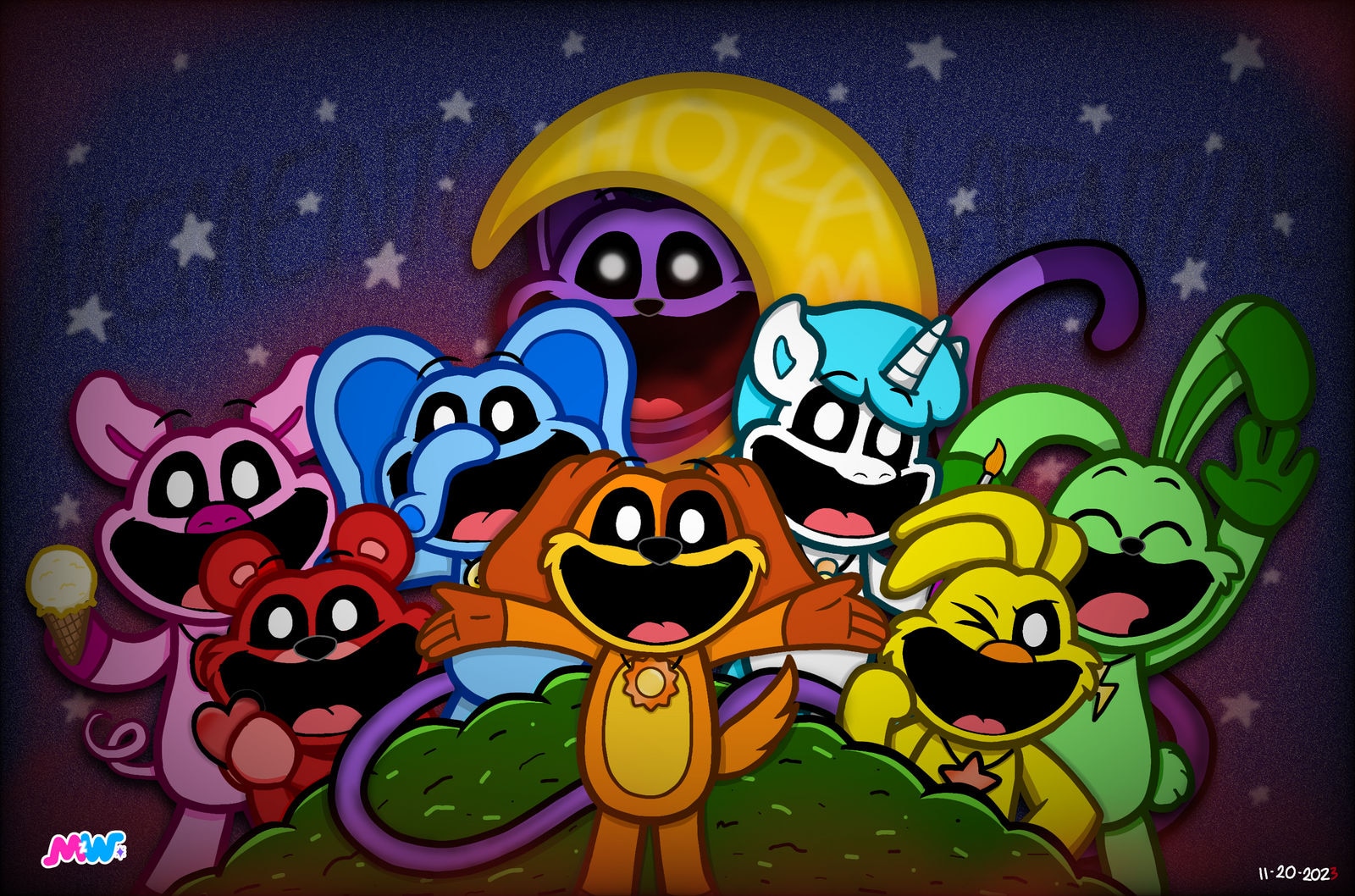
You've seen the sun pendant. You've probably seen that wide, unblinking grin plastered across social media or in the dark corners of the Playtime Co. factory. DogDay, the sun-themed leader of the Smiling Critters, is a fascinating case study in how modern horror subverts the things we used to find comforting. It's weird, right? We take a plush toy meant for toddlers—something designed to smell like vanilla and radiate sunshine—and turn it into a symbol of absolute, soul-crushing despair. That is the core of what makes the Poppy Playtime Chapter 3 experience stick in your brain long after you've closed the game.
DogDay isn't just another monster jumping out of a locker. He's a tragedy.
Most people get it wrong. They think he's just another villain because of that unsettling smile. But if you actually dig into the lore provided by Mob Entertainment, you realize DogDay is the only one who tried to keep things together when the "Hour of Joy" turned the factory into a slaughterhouse. He’s the fallen hero of the Smiling Critters lineup. He’s the one who stood up to CatNap and paid a price so gruesome it honestly pushed the boundaries of what we expect from "mascot horror."
The Real Story Behind the Leader of the Smiling Critters
Let’s look at the facts. In the universe of Poppy Playtime, the Smiling Critters were a massive commercial success for Playtime Co. before everything went south. Each character had a specific scent and a "personality" meant to help kids deal with various emotional needs. DogDay was the glue. He was the determined leader, the one who looked out for everyone else.
His design is intentionally bright. Orange fur. A sun-shaped charm. A smell that's supposed to be warm and inviting.
But then there's the Prototype.
When the Prototype (Experiment 1006) began exerting influence over the toys in the factory, the Smiling Critters split. CatNap became a religious zealot, a herald for the Prototype. DogDay didn't. He refused to worship the "God" of the factory. Because of that, he was imprisoned, tortured, and eventually used as a literal meat suit for the smaller, starving "mini-critters." When you find him in the jail cell during Deep Sleep, he isn't trying to kill you out of malice. He's a husk. He's being piloted by the very creatures he was supposed to protect.
It’s a heavy narrative choice. It shifts the fear from "this thing wants to eat me" to "this thing is suffering, and I am watching its final moments of agony."
Why We Can’t Look Away from That Smile
There is a psychological term for why DogDay and the rest of the Smiling Critters work so well: Anatidaephobia—or more accurately, the "Uncanny Valley" effect applied to childhood nostalgia.
Think about it.
The smile is static. It’s a physical part of the toy's face. In a normal world, a smile is a fleeting expression of joy. When it’s permanent—especially in a dark, blood-stained hallway—it becomes a mask. It suggests that whatever is happening behind the eyes doesn't match what’s happening on the mouth.
Poppy Playtime thrives on this. The game designers at Mob Entertainment, including founders Seth and Zach Belanger, have openly discussed how they wanted to create characters that felt "marketable" in the real world. They didn't want to just make monsters; they wanted to make toys that people would actually want to buy, which makes their eventual corruption feel more personal. It’s why the DogDay plushies (the real ones you can buy) are so popular. There is a weird tension in owning a physical version of a character you watched get torn apart in a basement.
The CatNap vs. DogDay Dynamic
You can't talk about DogDay without talking about CatNap. They are two sides of the same coin.
- CatNap represents the moon, sleep, and the influence of the Prototype.
- DogDay represents the sun, wakefulness, and the last remnants of the factory's "human" morality.
In the lore, CatNap was originally Theodore Grambell, a kid who had a close relationship with the Prototype. DogDay’s human identity is less explicitly detailed in the tapes, but his behavior suggests a personality that remained remarkably resilient against the Prototype's "religion."
The conflict between them isn't just a playground spat. It’s an ideological war. CatNap views the Prototype as a savior who freed the toys from their human captors. DogDay, even in his final moments, sees the Prototype as the monster it truly is. When DogDay tells the player to "leave this place" and that he is the "last of the Smiling Critters," he isn't just giving a spooky monologue. He is acknowledging that the hope his group once represented is officially dead.
The "Mini-Critters" Horror Factor
The scene in the play area where the small versions of the critters start crawling out of DogDay’s mouth and eye sockets? Yeah. That's the stuff of nightmares.
It’s biologically repulsive.
But it’s also a clever bit of storytelling. These mini-critters are starving. The factory hasn't had "food" (which we later learn is just the bodies of others) in a long time. They are parasitic. By turning DogDay—the strongest, most protective member of the group—into a food source and a puppet, the game shows that in this world, kindness is a weakness that gets exploited.
It's grim. Really grim.
Misconceptions People Have About DogDay
I see this a lot on Reddit and in YouTube theories. People think DogDay is "evil" because he chases the player.
Honestly? He’s not.
If you listen to his voice lines (voiced by the incredibly talented Baldwin Williams Jr.), he is lucid and terrified. He warns you. He explains that the others are already gone. When his lower half is gone—yes, he is literally half a dog—and the mini-critters take over, his movements become jerky and animalistic. That’s not DogDay. That’s a corpse being driven by a swarm of hungry rats in colorful costumes.
Another common mistake is thinking the Smiling Critters were always meant to be monsters.
The Playtime Co. orientation videos show they were intended to be helpful. They were part of a "get healthy" and "stay positive" campaign for kids. The horror comes from the subversion. It’s the same reason clowns are scary to some people; the disconnect between the "job" (making kids laugh) and the "reality" (a predatory entity) creates a cognitive dissonance that our brains interpret as danger.
The Technical Brilliance of the Character Design
From a technical standpoint in Poppy Playtime Chapter 3, the animation for DogDay is a step up from previous chapters. The way his fabric stretches, the way the "fur" looks matted and dirty, and the physics of his movement all contribute to the realism.
The sound design is where it really gets you, though.
The clinking of his chain. The heavy breathing. The muffled screams of the mini-critters inside him. It’s a sensory overload designed to make you feel claustrophobic. The developers didn't just want you to see a monster; they wanted you to feel the weight of his presence in that cramped, dark cell.
Where Does DogDay Go From Here?
Is he dead?
Probably. In the world of Poppy Playtime, "death" is a bit fluid since most characters are experiments with human brains or souls attached to plastic and stuffing. But DogDay's physical body was pretty much destroyed by the end of Chapter 3. However, his influence remains. He serves as the moral compass for the player's journey through Playcare. He provides the context needed to understand why CatNap is so dangerous.
Without DogDay, CatNap is just a scary cat. With DogDay, CatNap is a traitor and a tyrant.
Actionable Takeaways for Fans and Theorists
If you're trying to piece together the full story of the Smiling Critters, don't just look at the jumpscares. There is a lot of environmental storytelling that people miss.
- Check the Vibe of the Cells: Look at the drawings on the walls in the area where DogDay is kept. They tell a story of a rebellion that failed.
- Listen to the VHS Tapes: The "Bigger Bodies Initiative" tapes explain how the transition from toy to living nightmare happened. DogDay was likely one of the later conversions, which might be why he kept his sanity longer.
- Analyze the Scent: Each critter has a scent. DogDay is vanilla. CatNap is lavender (used to induce sleep/gas). Think about how those scents would interact in a real-world scenario. One is meant to comfort, the other is used to subdue.
- Watch the Cartoon Intro: The 2D animated intro for the Smiling Critters isn't just "flavor text." It establishes the hierarchy and the roles. Pay attention to how the others look to DogDay for direction. It makes his eventual fall even more impactful.
The tragedy of DogDay is what gives Poppy Playtime its emotional weight. It’s easy to make something scary. It’s much harder to make something that people feel sorry for while they are running away from it in total terror.
To fully understand the lore, your next step is to revisit the "Hour of Joy" tape. Look specifically for any footage of the Smiling Critters during the massacre. You’ll notice that while CatNap is actively hunting, some of the others—potentially including DogDay—are conspicuously absent or showing signs of hesitation. This is the key to understanding the upcoming chapters and the eventual confrontation with the Prototype. The resistance didn't start with you, the player; it started with a dog who refused to stop smiling, even when his world was ending.