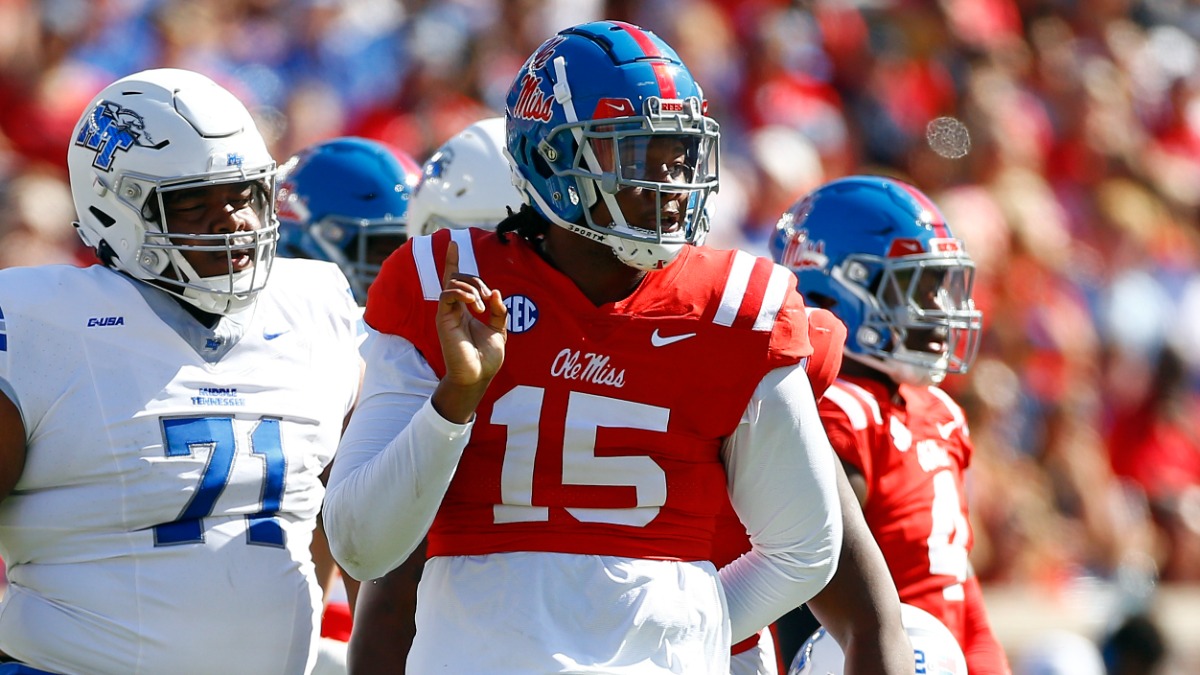
You see a guy walking through the tunnel who stands 6-foot-6 and weighs nearly 280 pounds, and you immediately think "first-rounder." That is the edge Jared Ivey effect. During his time with Ole Miss, Ivey wasn't just another body on the defensive line; he was a problem. A massive, long-limbed, versatile problem that Lane Kiffin leaned on heavily to transform the Rebels' defense from a liability into a legitimate SEC powerhouse.
But football is rarely just about the measurables.
Honestly, the conversation around Ivey is kinda complicated right now. If you look at the raw production from the 2024 season—42 tackles, 7 sacks, and 11 tackles for loss—you’d assume he was a lock for the early rounds of the 2025 NFL Draft. Instead, he went undrafted. It was a shocker for Rebels fans who watched him earn the defensive MVP of the Peach Bowl just a year prior. Now, as we look at his trajectory heading into 2026, there is a lot to unpack regarding what happened and why his "boom-or-bust" profile is still being debated in scouting circles.
The Versatility Trap: Is He an Edge or a 3-Tech?
One of the biggest hurdles for edge Jared Ivey at Ole Miss was actually his greatest strength: he could do everything. In 2023, he spent a significant amount of time kicking inside. He played the three-technique, using that 82-inch wingspan to swallow up interior lanes. Then, in 2024, the Rebels coaching staff moved him primarily back to the edge, where he played about 72% of his snaps.
Scouts are picky. They love a "chess piece," but they hate "tweeners."
Basically, Ivey is too big to be a traditional speed rusher and maybe just a hair too light to be a full-time interior mauler in a 3-4 system. When he’s on, he’s unstoppable. His hands are active. He has this lethal club-swim move that leaves SEC tackles lunging at air. But when his pad level gets high—which happens a lot because he’s so tall—he loses that leverage.
- Height: 6'5" (6057)
- Weight: 274–285 lbs (varied by season)
- Arms: 33.5 inches
- Key Stat: 17.5 career sacks across Georgia Tech and Ole Miss.
The tape against Oklahoma in 2024 is the perfect example of the "Ivey Experience." He was everywhere. He showed closing speed that shouldn't exist for a man that size. Then, on the very next drive, he’d get washed out on an outside run because he got too focused on the interior gap. It’s that inconsistency that led some analysts, like the crew at WalterFootball, to label him with the "lazy" tag—a harsh word that has followed him since his Pro Day.
Why the 2025 Draft Ignored Him
It wasn't just the tape. Reports started leaking before the draft about "character concerns" and a lack of motor. Whether that’s fair or just pre-draft smoke is hard to say. You’ve got to remember that Ivey played nearly 2,300 college snaps. That is a massive workload. Some people think he was just gassed; others think he was "business making" or saving himself for the next level.
Regardless, the Seattle Seahawks didn't care about the rumors. They signed him as a priority undrafted free agent.
Seattle is a fascinating spot for him. John Schneider has a history of finding gems in the UDFA market—think Doug Baldwin or Riq Woolen. Ivey joined a room with veterans like Leonard Williams and Boye Mafe. In that environment, you either sink or you swim. He spent most of the 2025 season fighting for oxygen on the practice squad and getting into late-season games, but the talent is undeniably there.
Decoding the Jared Ivey Scouting Report
If you’re trying to figure out why edge Jared Ivey didn't dominate the draft process despite his Ole Miss pedigree, you have to look at the "get-off." His first step is... fine. It's adequate. But in the NFL, "adequate" gets you blocked by a backup tight end.
He wins with length.
When Ivey uses his 33-inch arms to keep a lineman's hands off his chest, he wins 90% of the time. He’s surprisingly slippery for a guy who looks like a literal door frame. He uses an upper-body swivel to "shapeshift" (as NFL.com's Lance Zierlein put it) around blocks. He doesn't always go through you; he goes around you in a way that’s really awkward for blockers to handle.
The Medical Red Flag
We can't talk about Ivey without mentioning the Wake Forest game in 2024. He was dominating—two sacks and two tackles for loss in just over two quarters. Then, the cart came out.
It was a "bad" left ankle sprain. He missed time, and even when he came back, that twitchy burst seemed slightly dampened. For a player whose stock depended on proving he was an elite athlete at 280 pounds, that ankle injury was a massive blow. It likely contributed to the "poor" testing numbers that scouts harped on during the spring.
What’s Next for the Former Rebel?
So, where does he go from here? Jared Ivey is currently a developmental piece in the NFL. He’s no longer the big fish in the Oxford pond. To stick, he has to prove that the "motor" concerns were nonsense.
If you're a fan or a collector following his career, keep an eye on his weight. If he bulks up to 295, he’s a starting 3-4 defensive end. If he trims down to 265, he’s a rotational edge. The versatility that made him a star at Ole Miss is now the thing he has to resolve to find a permanent home in the pros.
Actionable Insights for Following Ivey's Career:
- Watch the Seahawks' 2026 Active Roster: His status during the preseason will tell you everything you need to know about his "new" motor and conditioning.
- Check his Alignment: If he’s playing more 5-technique (over the tackle), it means the coaches trust his strength more than his speed.
- Ignore the Sack Total: For a player like Ivey, "pressures" and "batted passes" are better indicators of his impact than just raw sacks. He had 5 pass deflections in college for a reason—he’s a nightmare in the passing lanes.
Jared Ivey's journey from a 4-star recruit in Georgia to a dominant SEC force and now an NFL underdog is a reminder that the path to the pros isn't always a straight line. Sometimes, you have to be the "mystery" before you become the solution.