March 1960 was a weird time for music. Rock and roll was supposedly "dying" because its biggest stars were either in jail, in scandal, or in the army. Then, a plane landed at McGuire Air Force Base in New Jersey. Out stepped a thinner, more polished Sergeant Elvis Presley. He’d been gone for two years. Two years is an eternity in pop music. People honestly thought he was done. But within weeks, he recorded Elvis Presley Stuck on You, and the world realized the King wasn't going anywhere.
It wasn't just a hit. It was a statement.
If you look at the charts from that era, the vibe was shifting toward "teen idols" and softer sounds. Elvis knew he had to pivot. He couldn't just scream "Hound Dog" anymore; he needed to show he’d grown up in Germany. "Stuck on You" was the bridge between the raw, 1950s rebel and the 1960s global entertainer. It's got that infectious, mid-tempo bounce that feels like a finger snap in a cool basement club.
The Midnight Session at RCA Studio B
The recording of Elvis Presley Stuck on You is the stuff of legend. Imagine this: Elvis gets discharged on March 5th. By March 20th, he’s in Nashville at the famous RCA Studio B. He didn't waste a second. He was nervous. He actually told his drummer, D.J. Fontana, that he wasn't sure if the fans still wanted him.
The session started late—around 8:00 PM. They worked through the night. "Stuck on You" was actually the first song they finished. It only took a few takes. Elvis was backed by the "A-Team" of Nashville session players: Scotty Moore on guitar, D.J. Fontana on drums, and the Jordanaires providing those silky smooth background vocals.
The chemistry was still there. It’s funny because if you listen closely to the original recording, you can hear the looseness. It isn’t over-produced. It has this "first-take" energy where the bassline just carries the whole melody. Bob Moore’s bass playing on this track is basically a masterclass in how to drive a song without being loud.
Why This Track Hit Different in 1960
A lot of critics at the time were ready to bury Elvis. They called him a "flash in the pan." When the needle hit the wax on "Stuck on You," those critics had to eat their words. The song hit Number 1 on the Billboard Hot 100 in just three weeks. That was unheard of back then. It stayed at the top for four weeks.
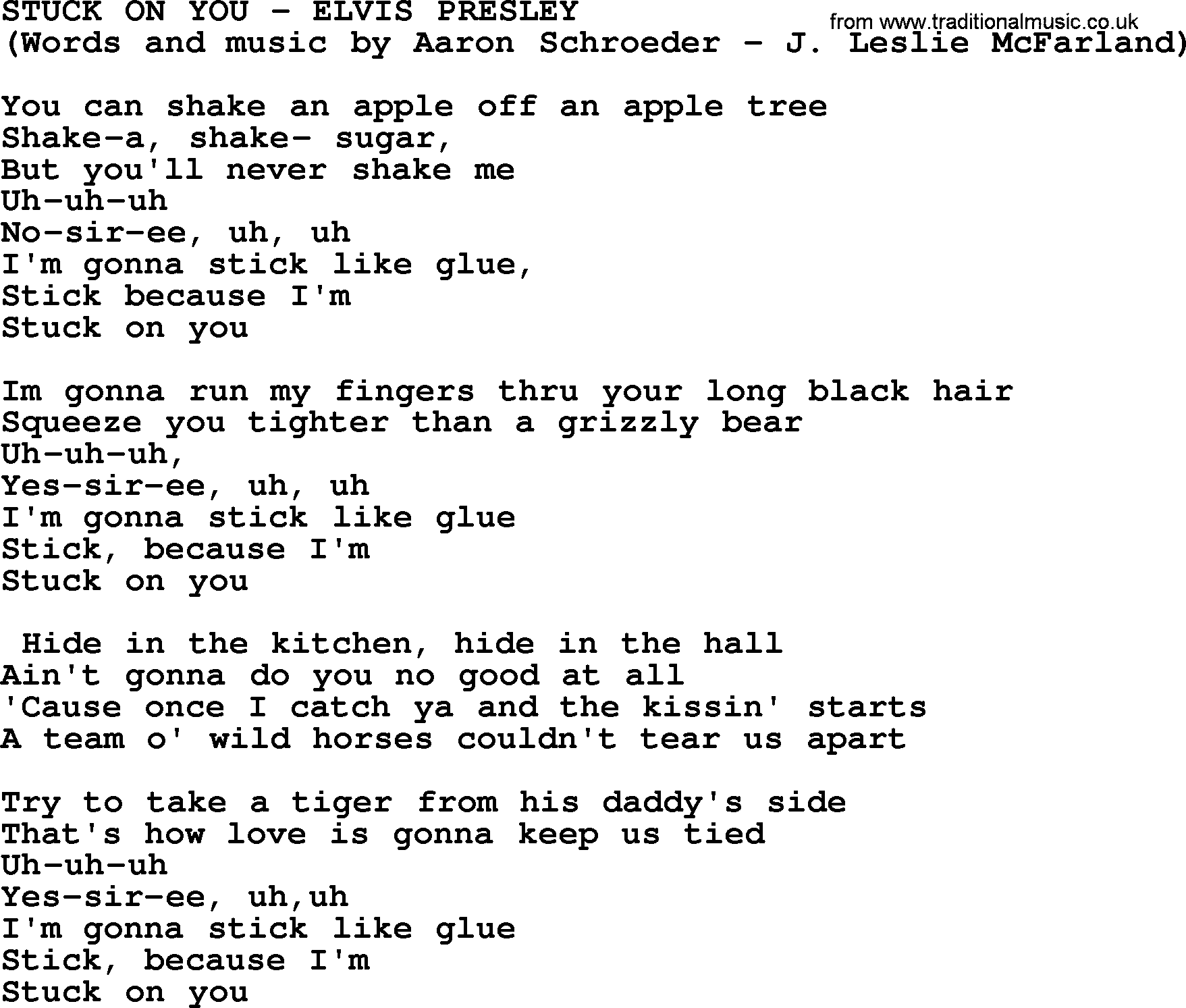
The lyrics are simple. "I'm gonna stick like glue, stick because I'm stuck on you." It's not Shakespeare. But the way Elvis delivers it? That’s the magic. He uses this playful, almost teasing growl. He wasn't trying to be a dangerous hoodlum anymore. He was being a charmer.
Interestingly, the song was written by Aaron Schroeder and J. Leslie McFarland. Schroeder was a hit machine for Elvis, eventually writing or co-writing 17 songs for him. He understood that Elvis needed a specific type of syncopation—a rhythm that allowed him to move his hips but also let his voice shine.
Breaking Down the Sound: More Than Just Pop
You’ve probably heard people call this a "comeback" song. That’s technically true, but musically, it’s a transition. It’s not quite rockabilly, and it’s definitely not a ballad. It’s something else.
- The Rhythm: It’s a shuffle. That 2/4 beat makes you want to walk down the street in time with it.
- The Vocal Range: Elvis stays in a comfortable mid-range here. He doesn't go for the operatic high notes he’d later use in "It's Now or Never." It’s conversational.
- The Guitar Work: Scotty Moore kept it subtle. There’s no screaming solo. It’s all about the "chug" of the rhythm guitar.
People forget that when this came out, the B-side was "Fame and Fortune." That was a slow ballad. By putting Elvis Presley Stuck on You on the A-side, RCA was betting that the public wanted the upbeat Elvis back first. They were right. The single sold over a million copies almost instantly.
The "New" Elvis vs. The "Old" Elvis
There is a major debate among Elvis fans (and trust me, these debates get heated) about whether the post-army Elvis was "better" than the 1950s version. "Stuck on You" is usually the focal point of that argument.
Purists think he lost his edge. They miss the distorted Sun Records sound. But if you look at his vocal control on this track, it's objectively superior to his early stuff. He had more breath control. He was listening to his own recordings more critically. He was becoming a producer in all but name.
During the Germany years, Elvis listened to a lot of different music. He was obsessed with Mario Lanza and Dean Martin. You can hear that influence creeping in. "Stuck on You" has a bit of that "crooner" DNA mixed with a Memphis backbeat. It’s a hybrid. It’s the sound of a man who realized he didn't just want to be a singer—he wanted to be an icon.
Misconceptions About the Recording Process
One thing that gets repeated a lot is that Elvis was "rusty" during this session. That is total nonsense.
The Nashville sessions in March 1960 were some of the most productive in his entire career. In just a few days, they recorded enough material for the album Elvis Is Back! and several hit singles. If he was rusty, he hid it incredibly well.
Another myth is that he didn't like the song. While it’s true that Elvis often preferred ballads and gospel, he knew exactly what a "hit" sounded like. He had an internal radar for commercial success. He chose "Stuck on You" as the lead single because he knew it was the perfect "welcome home" gift to the fans.
The Legacy of the "Glue" Metaphor
It sounds cheesy today, right? "Stick like glue." But in 1960, this was the language of young love. It was relatable. It also served as a metaphor for his relationship with his fans. They had "stuck" by him while he was away in the army, and he was "stuck" on them.
The song has been covered dozens of times, but nobody quite catches that specific swagger. It’s a deceptively hard song to sing because if you do it too fast, it sounds like a nursery rhyme. If you do it too slow, it loses the "stuck" energy. Elvis found the pocket.
How to Appreciate the Song Today
To really "get" why this song mattered, you have to stop listening to it as a "Golden Oldie" on a supermarket playlist.
Try this: put on a pair of good headphones. Turn up the volume. Listen specifically to the bass guitar and the way Elvis "pushes" his voice against the beat. He’s slightly behind the beat, which creates this feeling of relaxed confidence.
He wasn't rushing. He knew he was the King. He knew the song was a hit before the session was even over.
Practical Takeaways for Elvis Collectors
If you are looking to own a piece of this history, don't just grab any old compilation CD. Look for the original 45rpm pressings with the "Living Stereo" or "New Orthophonic" labels. The mono mix of Elvis Presley Stuck on You is actually punchier than the stereo version.
In the early 60s, stereo was still a bit of a gimmick for pop singles. The mono mix was where the real "oomph" lived. If you can find a copy with the original picture sleeve—which features Elvis in his army uniform—hang onto it. Those are becoming increasingly rare and are a massive part of the song's visual history.
What to Listen for in the Mix:
- The "Pop" of the Snare: D.J. Fontana used a very tight snare sound here.
- The Jordanaires' "Oohs": Notice how they act as a second instrument, not just backup singers.
- The Fade Out: It’s a classic 60s fade, leaving you wanting just one more chorus.
Final Thoughts on a Classic
Ultimately, this track wasn't just a song; it was a cultural reset. It proved that rock and roll could age gracefully. It showed that a star could go away for two years and come back even bigger.
The next time you hear that opening bass line, remember that it represents a pivotal moment in music history. It was the moment the 1950s officially ended and the 1960s—the decade of the superstar—truly began.
Your next steps for exploring the King’s 1960s era:
- Listen to the full Elvis Is Back! album to hear the range he developed in the army.
- Compare the mono vs. stereo mixes of "Stuck on You" to hear the difference in vocal presence.
- Watch the 1960 Frank Sinatra "Welcome Home Elvis" TV special to see him perform his new hits for the first time.
The song remains a masterpiece of pop construction. It's short, it's sweet, and it's impossible to get out of your head. Which, I guess, is exactly the point. It sticks to you.