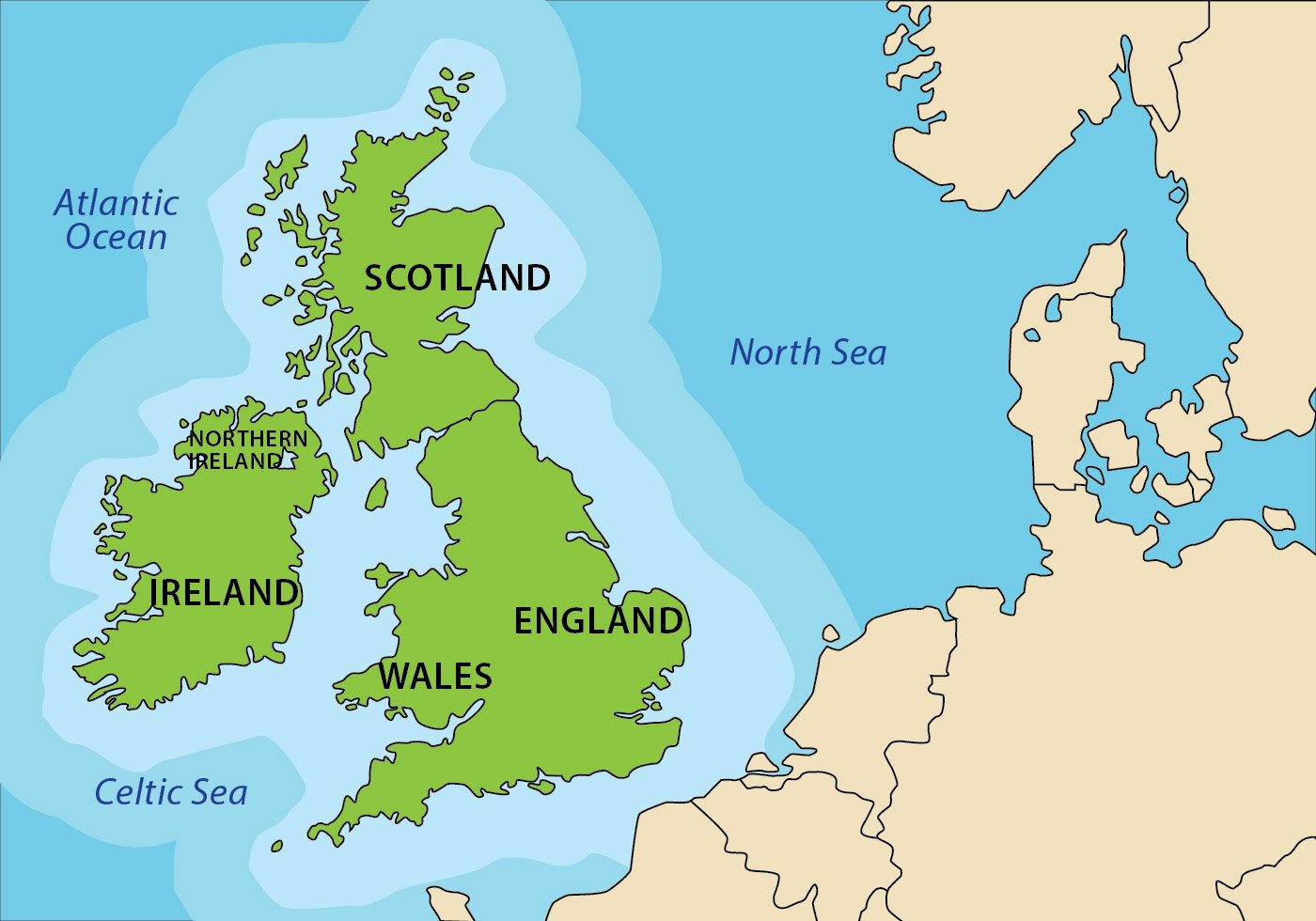
Honestly, if you’ve ever found yourself staring at a map of the North Atlantic and feeling a bit dim because you can’t quite explain where England UK and Great Britain begin and end, you’re in good company. People get this wrong constantly. Even folks who live there sometimes muddle the terminology when they’re talking to tourists. It's kinda like a nesting doll situation, but with more rain and significantly more historical baggage.
You’re not just looking at different names for the same place.
If you call someone from Glasgow "English," you’re going to have a very short and potentially loud conversation. If you say Northern Ireland is in Great Britain, you’re factually incorrect. It’s a mess of geography, politics, and "who conquered whom" that goes back centuries. Let’s actually break this down so you never have to second-guess your passport or your dinner party facts again.
The Simple Breakdown: Island vs. Country
Basically, the biggest mistake is treating these terms as synonyms. They aren't.
Great Britain is an island. That’s it. It’s a piece of rock in the ocean. It is the largest island in the British Isles and contains three specific countries: England, Scotland, and Wales. If you are standing on the physical ground in London, Edinburgh, or Cardiff, you are in Great Britain.
The United Kingdom (or the UK) is the political entity. This is the "sovereign state" that has a seat at the UN. The UK includes everything on the island of Great Britain plus Northern Ireland. That’s why the full, slightly exhausting official name is the United Kingdom of Great Britain and Northern Ireland.
Then you have England. England is just one country within that union. It’s the biggest one by population and landmass, which is why people often (wrongly) use "England" as a shorthand for the whole thing. Imagine if people called the entire United States "Texas" because it was the loudest part. That’s essentially what’s happening here.
Why Does This Distinction Even Exist?
It wasn't a choice made for simplicity's sake. It was a slow, often violent process of stitching pieces together.
- 1707: This was the big one. The Acts of Union joined the Kingdom of England (which already included Wales) with the Kingdom of Scotland. This created a single kingdom called "Great Britain."
- 1801: Another Act of Union brought the Kingdom of Ireland into the mix. Now we had the "United Kingdom of Great Britain and Ireland."
- 1922: Most of Ireland broke away to become the Republic of Ireland (an independent country). The northern bit stayed. Hence, the name change to "United Kingdom of Great Britain and Northern Ireland."
The "British" Identity Crisis
If you live in the UK, what is your nationality? This is where it gets weirdly personal.
Legally, everyone from these places holds a "British" passport. However, ask a local and you’ll get a different answer. Someone from Cardiff will likely tell you they are Welsh first, British second. In Scotland, the "Scottish" identity is incredibly strong, especially with ongoing debates about independence.
In Northern Ireland, it’s even more complex. Depending on their political and cultural background, someone there might identify as British, Irish, or Northern Irish—or all three.
A Quick Cheat Sheet for Not Offending People:
- English: Only people from England.
- Scottish: Only people from Scotland.
- Welsh: Only people from Wales.
- British: Anyone from the UK (England, Scotland, Wales, Northern Ireland).
- Irish: People from the Republic of Ireland (not in the UK) or Northern Ireland (depending on their preference).
Common Myths That Just Won't Die
You've probably heard that the Queen (now the King) "rules" all these places. While King Charles III is the head of state, he doesn't actually make the laws.
The UK Parliament in Westminster (London) handles big stuff like defense and foreign policy for everyone. But Scotland, Wales, and Northern Ireland have their own "devolved" governments. They make their own rules on things like education, health, and transport. England, strangely enough, is the only one without its own dedicated parliament; it’s managed directly by the UK-wide government.
Another classic: The British Isles. This is a purely geographical term. It includes the island of Great Britain, the island of Ireland, and over 6,000 smaller islands like the Isle of Wight or the Hebrides. Using this term in the Republic of Ireland can be a bit controversial because it sounds like a claim of ownership, so "these islands" is often the safer, more polite way to put it.
The Passport and Border Reality in 2026
If you’re traveling to England UK and Great Britain today, you’ll notice a few quirks.
Since the UK left the European Union, the border between the Republic of Ireland and Northern Ireland is a major talking point. In practice, for a traveler, there is no "hard" border you’ll have to stop at when driving from Dublin to Belfast. This is thanks to the Common Travel Area. However, the rules for goods and trade are a different story entirely, involving a complicated setup called the Windsor Framework.
And no, you can't use your Euros in London. England, Scotland, and Wales use the Pound Sterling (£). Interestingly, Scottish and Northern Irish banks print their own versions of pound notes. They look totally different but are technically legal tender in England—though you might get a suspicious look from a London shopkeeper who’s never seen one before.
What You Should Actually Do With This Info
If you’re planning a trip or just trying to sound smart in a meeting, focus on the geography first.
Don't book a flight to "Great Britain" if you actually mean "Dublin"—you'll end up in the wrong country. If you're visiting Edinburgh, don't tell the locals how much you love "English history." They’ll politely (or not so politely) remind you that Scottish history is quite distinct.
Check your entry requirements based on the United Kingdom, not just England. If you have a visa for the UK, it covers London, Belfast, Edinburgh, and Cardiff. It does not cover the Republic of Ireland.
To keep it straight, just remember:
- UK = The political club (4 members).
- Great Britain = The big island (3 members).
- England = The biggest member of the club.
Next time you see a Union Jack, look closely. It’s actually a mash-up of the flags of England (St. George’s Cross), Scotland (St. Andrew’s Cross), and the old St. Patrick’s Cross for Ireland. Wales isn't even on there because, back when the flag was designed, it was legally considered part of England. Yeah, history is messy.
When you're packing your bags, remember that while the political borders are firm, the cultural ones are fluid. You can drive for two hours and hear a completely different accent, see different architecture, and find different laws on the books. That's the real charm of the place—it's a lot of different worlds crammed into one small, confusingly named corner of the map.
Actionable Steps for Travelers:
- Verify your Currency: While Scottish and Northern Irish notes are legal, they are sometimes rejected by automated machines in England. Swap them for "Bank of England" notes if you're heading south.
- Check Visa Reciprocity: If you’re a non-EU citizen, remember that a UK visa does not grant entry to the Republic of Ireland, and vice versa, unless you fall under specific waiver programs like the British-Irish Visa Scheme (BIVS).
- Update your GPS: If you're driving, remember that speed limits are in miles per hour (MPH) throughout the UK, but once you cross the border into the Republic of Ireland, they switch to kilometers (KMH).