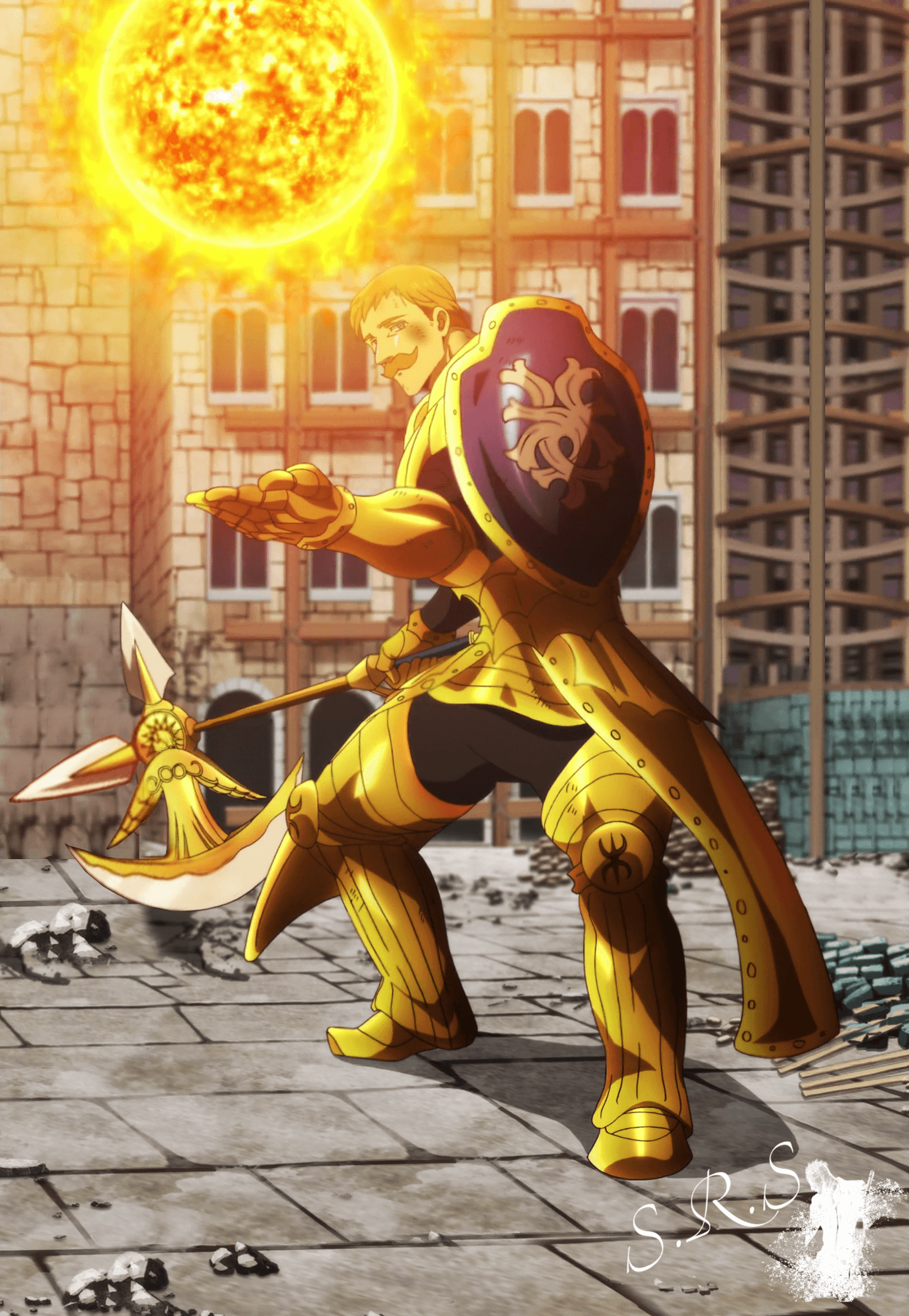
He shows up late. Honestly, that’s the first thing you notice about Escanor in the Seven Deadly Sins manga and anime. While the rest of the Sins are established early on, Nakaba Suzuki made us wait years—actual years—to see the Lion's Sin of Pride in the flesh. It was worth it. When he finally walked out of that cave to face Galand of the Ten Commandments, the entire power dynamic of the series shifted. It wasn't just about a big guy with a big axe. It was about a character who fundamentally broke the rules of shonen power scaling while remaining deeply, tragically human.
You’ve probably seen the memes. "Who decided that?" is basically the unofficial anthem for anyone who likes their heroes a little bit arrogant. But looking at Escanor Seven Deadly Sins fans realize there's a weird duality there. By day, he’s a god-tier warrior who looks down on demons as if they're literal ants. By night? He’s a scrawny, stuttering bartender who can barely carry a tray of drinks. It’s a Jekyll and Hyde trope, sure, but executed with such flair that it became the emotional heartbeat of the final arcs.
The Sunshine Grace and the Curse of Midday
Escanor doesn't have magic in the traditional sense. He has a Grace. Specifically, the "Sunshine" Grace that originally belonged to Mael of the Four Archangels. This is where things get complicated. Because Escanor is a human, his body was never meant to hold the power of a literal deity. It’s why he’s always burning up. It’s why his presence alone can melt stone armor or evaporate a lake just by standing near it.
His power level is tied directly to the sun. At midnight, he’s a power level of 5. That is pathetic. Even a low-level red demon could poke him and he’d crumble. But as the sun rises, he hits 20,000, 50,000, and eventually climbs into numbers that make the other Sins look like sidekicks.
Then there’s "The One."
For sixty seconds at high noon, Escanor becomes the "Invincible Incarnation of Power." He’s the peak of existence. During his fight with Meliodas—the Assault Mode version that terrified everyone else—Escanor basically brushed off a 1,000-slash combo like it was a light breeze. He then proceeded to nearly chop the future Demon King in half with a hand swipe. It’s ridiculous. It’s over the top. And that is exactly why it works.
Why Escanor Seven Deadly Sins Content Still Trends
People love a winner who doesn't apologize for winning. Escanor doesn't feel "lucky" to be strong. He feels it is the natural order of the universe. When he fought Estarossa, the Commandment of Love, he wasn't affected by the curse that freezes anyone with hatred in their heart. Why? Because you can’t hate someone you only feel pity for. That’s the peak of Escanor's character. He doesn't hate his enemies; he just feels sorry that they have to exist in the same world as him.
But there is a sadness to the Escanor Seven Deadly Sins legacy.
His body was a ticking time bomb. Every time he used Rhitta—his giant, one-handed Divine Axe—he was stressing a human frame that was essentially melting from the inside out. The tragedy of Escanor is that his greatest strength was also his cause of death. He knew it. He chose to burn out brightly rather than fade away in the shadows of the night. His love for Merlin, which was largely unrequited in the way he wanted, added a layer of "nice guy" tragedy that felt earned because he never let it turn him bitter. He just wanted to be a man worthy of standing beside her.
The Fight with the Demon King
The final battle is where we see the true limit of a human using a god's power. Escanor didn't just fight; he offered up his life force to keep the flame going. He entered a state called "The One Ultimate."
In this form, he was literally burning his own soul to maintain his peak power past the one-minute mark at noon. He was punching the Demon King—a literal god—and holding his own. It’s a sequence that makes your skin crawl because you know he’s dying with every swing. He wasn't fighting for glory or because he was proud; he was fighting because his friends were in trouble. The "Lion's Sin of Pride" died as the most selfless member of the team.
Breaking Down the Divine Axe Rhitta
Let's talk about that axe. It's named after a sun maiden loved by the sun, or something like that. It’s heavy. So heavy that Meliodas, who has insane physical strength, complained about dragging it along the ground.
- It stores heat.
- It releases that heat in a massive "Charge and Fire" burst.
- It allows Escanor to use his power at night, albeit at a much lower level.
- It’s functionally a giant battery for solar energy.
The design is iconic. The golden, crescent-moon blade and the intricate engravings make it one of the most recognizable weapons in anime history. But Escanor's real weapon wasn't the axe. It was his absolute, unshakable belief that no matter who stood in front of him, they were beneath him.
What Most People Miss About His Connection to the Other Sins
Most fans focus on his rivalry with Meliodas or his crush on Merlin. But his relationship with Ban and Gowther is actually pretty nuanced. Ban is the only one who really talks to "Night Escanor" like a regular guy. They share drinks. They talk about the burden of immortality versus the burden of a dying body.
And then there's the irony. Escanor represents Pride, yet he is the only Sin who is genuinely humble for 12 hours of every day. He apologizes for existing. He writes poetry. He’s a soft soul trapped in a body that occasionally turns into a thermonuclear reactor.
The Reality of the "Power Level" Debate
In the world of Escanor Seven Deadly Sins lore, power levels became a bit of a joke toward the end. They kept going up and up until they didn't mean anything. However, Escanor was the only one whose power level felt justified by the narrative cost. When Meliodas got stronger, he just "unlocked" his old power. When King got stronger, he just grew wings. When Escanor got stronger, he died.
That stakes-driven power is why his victory over the Commandments felt so satisfying. It wasn't unearned. It was a loan from the sun that he knew he’d have to pay back with interest.
Critical Insights for Fans and Collectors
If you're looking into the series now, especially with the Four Knights of the Apocalypse sequel out, Escanor’s shadow loams large. Even though he’s gone, his influence on the "Grace" system and the way humans are viewed in that world changed everything.
Here are the hard truths about his character:
- He was never the strongest Sin "on average." Ban and Meliodas have more consistent output.
- His "Pride" was a defense mechanism for his nighttime insecurity.
- The anime’s animation in Season 3 (Studio Deen/Marvy Jack) unfortunately did his biggest moments a huge disservice. If you want the real experience, read the manga chapters 180 through 190. The art is vastly superior.
Moving Forward With The Seven Deadly Sins
If you've finished the main series and you're missing that Escanor energy, you should probably check out the Seven Deadly Sins: Grudge of Edinburgh movies or dive straight into the Four Knights of the Apocalypse manga. While the Lion's Sin isn't there, the legacy of the Graces continues to evolve.
You should also look into the side stories (Gaiden) that Nakaba Suzuki wrote. There is a specific one about Escanor’s past—how he was a prince who was cast out because his parents were terrified of his power. It explains a lot about why he clings to the Sins as a family. They weren't scared of him; they were just annoyed by his ego, which, for a guy who was hunted by his own kingdom, probably felt like a warm hug.
To really appreciate the character, stop looking at him as a "power level" machine. Look at him as a guy who was given a gift he didn't want, used it to protect people who didn't always appreciate him, and died with a smile on his face because he finally felt like he belonged. That's the real story. And honestly? It's way better than just watching a guy swing a big axe.
Next Steps for Deep Diving into Escanor Lore:
- Read Manga Chapter 182: This is the "Galand vs. Escanor" fight. It is the gold standard for character introductions.
- Analyze the "Sunshine" Grace in Four Knights of the Apocalypse: No spoilers, but the power doesn't just disappear after the final battle.
- Compare the Arthurian Legend: The real-world Sir Escanor of the Large was said to be a knight whose strength grew and faded with the sun. Suzuki stayed surprisingly true to the source material here.
- Watch the "Prisoners of the Sky" Movie: While non-canon, it gives some great "Prime Escanor" moments that the later seasons of the anime failed to deliver visually.