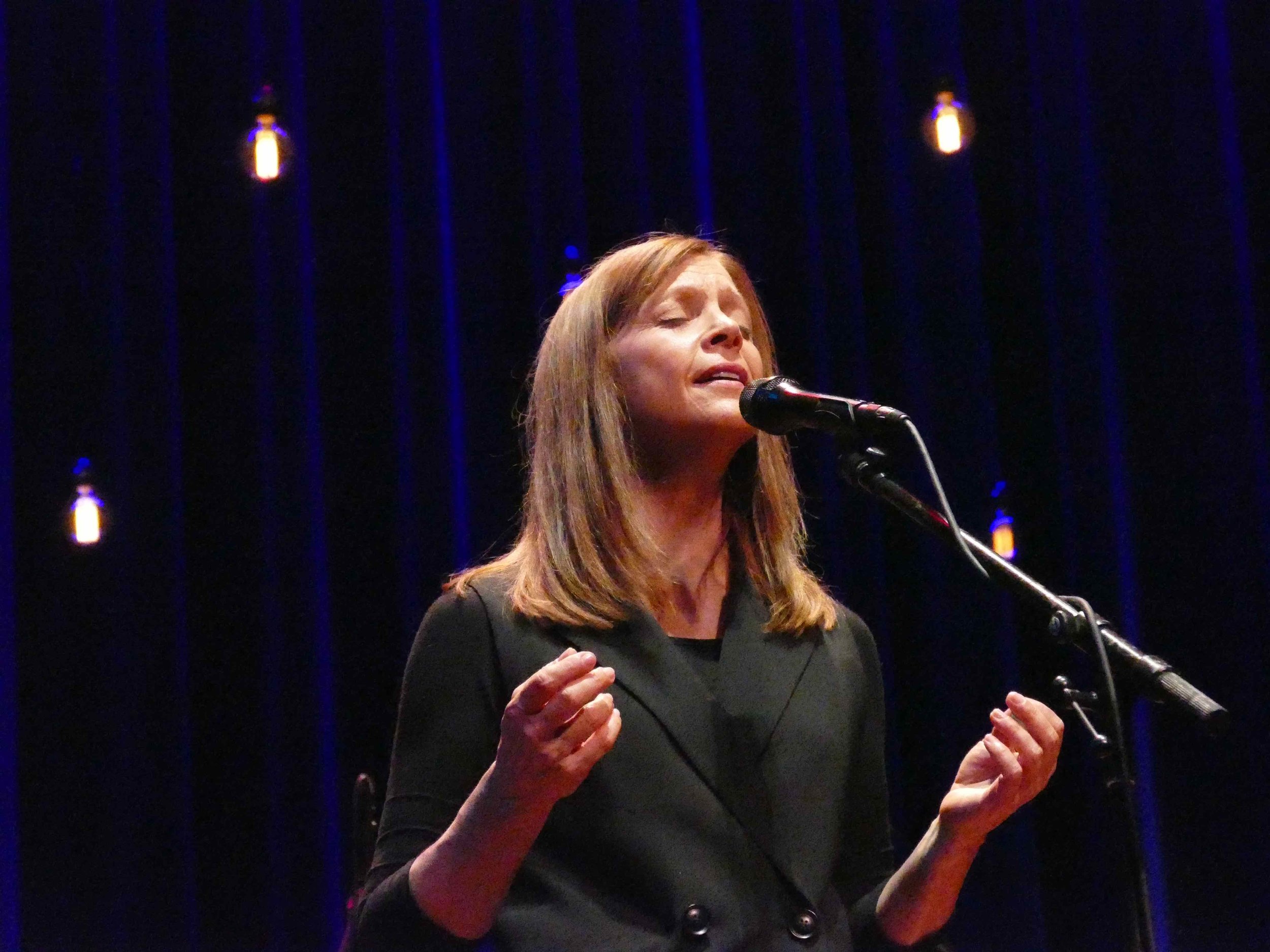
We’re all running a bit too fast. Honestly, look at your screen time or that low-grade buzz of anxiety in your chest when the news cycle hits a particularly jagged peak. It’s exhausting. And that’s exactly why Sanctuary by Carrie Newcomer feels less like a collection of folk songs and more like a literal deep breath. It isn’t just music. It’s an intervention for the soul.
Newcomer has been called a "prairie mystic" for a reason. She doesn’t scream for your attention. Instead, she whispers, and in a world that won't stop shouting, that’s a radical act. Released in 2014, this album didn't just come and go; it carved out a permanent space for people who are tired of the noise. It’s about the thin places. You know, those moments where the line between the physical world and something deeper—call it the divine, call it peace, call it whatever you want—gets blurry.
The Quiet Power of Sanctuary by Carrie Newcomer
When you first put on the title track, "Sanctuary," you’ll notice her voice right away. It’s a rich, earthy alto. It sounds like woodsmoke and old libraries. There’s a specific line in that song that hits like a ton of bricks: "It’s a long way from the hope to the heart."
That’s the core of the whole project.
Carrie isn't interested in toxic positivity. She knows life is messy. She knows the world is breaking in a dozen different ways at any given moment. But the album argues that we can’t fix anything if we’re running on empty. We need a "sanctuary" to regroup. For some, that’s a church. For others, it’s a kitchen table at 5:00 AM before the kids wake up, or a walk through a park where the trees don't care about your emails.
What Makes This Album Different?
Most folk music focuses on the "protest" or the "story." Carrie does both, but she adds a layer of Quaker-influenced spirituality that is incredibly grounding. She’s a practitioner of silence. In an interview with On Being's Krista Tippett, Newcomer talked about how she writes from the "living room" of her life. She isn't performing a character. She’s just telling you what she saw in the woods or what she felt while washing the dishes.
The instrumentation is sparse but intentional. You’ve got acoustic guitars, some subtle piano, and maybe a fiddle that weeps in just the right places. It feels organic. You can almost hear the fingers sliding across the strings. It’s "human-scale" music. It doesn't use digital tricks to make things sound perfect because perfection isn't the point. Connection is.
Beyond the Title Track: The Deep Cuts
If you only listen to the lead song, you’re missing the architecture of the whole experience. Take "The Glass Now Empty." It’s a song about transition, about that hollow feeling when one thing has ended but the next thing hasn't started yet. It’s uncomfortable. Most of us try to fill that emptiness with scrolling or snacks. Newcomer suggests we just sit in it for a minute.
Then there’s "The Wind Does Not Need a Passport."
Think about that title.
It’s a subtle, beautiful nod to our shared humanity and the artificial borders we draw between ourselves. It’s political without being a polemic. It’s a reminder that the natural world doesn't recognize our fences.
And "Abide."
Man, that song.
It’s a prayer for presence. "Abide with me, the evening shadows fall." It’s a classic sentiment, but she makes it feel modern and urgent. She’s asking us to stay. Just stay. Don't run to the next thing. Don't check your phone. Just be in the room.
The Quaker Influence and the "Thin Places"
To really get what’s happening in Sanctuary by Carrie Newcomer, you have to understand her background. She’s a Quaker. That means she values silence, community, and the "inner light." This isn't just trivia; it’s the DNA of the music.
Quakerism is about waiting. You sit in a circle and wait for the spirit to move. That sense of "waiting" is baked into the tempo of these songs. They aren't in a rush to get to the chorus. They breathe.
She often references "thin places," a concept from Celtic spirituality. These are locations or moments where the veil between heaven and earth is paper-thin. In this album, she suggests that sanctuary is a thin place we carry inside us. We don't have to go to a cathedral in France to find it. We can find it in the "ordinary rituals" of a Monday morning.
Why We Are Still Talking About This in 2026
You’d think a folk album from over a decade ago would be a relic. But it’s actually more relevant now than when it was released. We are more polarized. We are more distracted. We are more "online" than ever before.
Sanctuary by Carrie Newcomer serves as a counter-weight. It’s the "slow food movement" of the music world.
Critics at the time, and listeners today, often point out that Newcomer’s work bridges the gap between the secular and the sacred. You don't have to be religious to feel the weight of these songs. You just have to be a person who feels the weight of the world. She’s writing for the exhausted. She’s writing for the person who feels like they’re losing their grip on what matters.
Technical Brilliance in Simplicity
Let’s talk about the production for a second. It was produced by Gary Walters, who has worked with Carrie for years. The chemistry is obvious. He knows exactly when to let a note hang in the air and when to add a bit of percussive texture.
The recording quality is crystalline. If you listen on a good pair of headphones, it feels like she’s sitting about three feet away from you. This intimacy is vital. If the production were too "slick," the message of authenticity would fall flat. It has to sound like a wooden room. It has to sound like a conversation.
Misconceptions About "Spiritual" Folk
People hear "spiritual folk" and they think it’s going to be preachy or "woo-woo." That’s a mistake here.
Carrie Newcomer is incredibly grounded in the physical world. She sings about "The Work of Christmas" and "The Bread of Life" in ways that feel like dirt and flour, not clouds and harps. She’s a poet of the mundane. She finds the holy in the grocery store line or the way the light hits a kitchen sink.
It’s not about escaping reality. It’s about seeing reality more clearly.
If you think this album is just "nice" background music, you aren't listening. There’s a quiet steel in these songs. There’s a demand for justice and a call for deep, radical kindness. That isn't "nice." It’s difficult. It’s hard work.
How to Actually Listen to This Album
Don't shuffle it. Seriously.
Don't put it on while you’re doing the dishes or answering emails.
Give it forty minutes of your undivided attention. Sit in a chair. Turn off your notifications. Let the songs flow into one another as they were intended. You’ll find that by the end of the title track, your heart rate has actually slowed down. That’s the "Newcomer Effect."
- Start with "Sanctuary" to set the tone.
- Move into "The Work of Christmas" to understand her philosophy of action.
- Finish with "Abide" to ground yourself in the present moment.
Real Insights for the Weary
The brilliance of Sanctuary by Carrie Newcomer is that it doesn't give you a "to-do" list. It gives you a "to-be" list.
In a culture that measures your worth by your productivity, Newcomer measures it by your presence. This album is a reminder that you are allowed to stop. You are allowed to be quiet. You are allowed to seek sanctuary.
It’s a brave album because it refuses to be cynical. In a world where sarcasm is the default language, being this sincere is a risk. But it’s a risk that pays off for the listener who is craving something real.
Actionable Ways to Integrate "Sanctuary" Into Your Life
Listening to the album is just the first step. To truly benefit from the themes Carrie Newcomer explores, consider these practical applications:
- Create a Physical Space: Designate one corner of your home—even just a specific chair—as your "sanctuary." No phones, no work, no stress allowed in that square footage.
- The Three-Minute Pause: Use the length of the song "Sanctuary" (roughly 4 minutes) as a daily meditation timer. Sit in silence until the track ends.
- Practice "Ordinary Rituals": Choose one mundane task this week—like brewing coffee or folding laundry—and perform it with total focus and gratitude, as if it were a sacred rite.
- Audit Your Noise: Identify one source of "cacophony" in your life (a specific news app, a toxic social feed) and replace it with a period of intentional quiet or acoustic music.
- Engage with the "Thin Places": Spend twenty minutes outside today without a goal. Don't track your steps or listen to a podcast. Just notice where the "veil" feels thin for you.