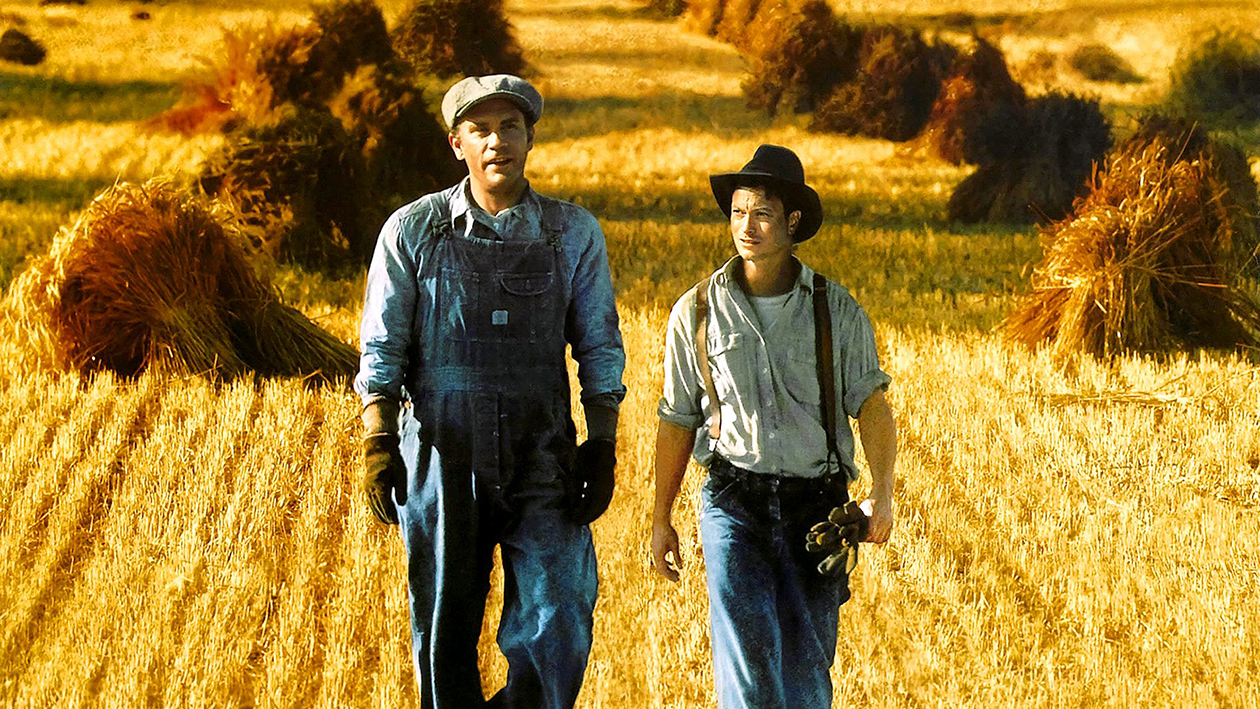
You’ve probably seen it. Maybe it was a grainy black-and-white still in a high school textbook or a glossy movie poster featuring John Malkovich. That one picture of Of Mice and Men—the image of George and Lennie standing by the Salinas River—is basically burned into the collective consciousness of anyone who ever had to read John Steinbeck. It’s more than just a promotional shot. It’s a visual shorthand for the American Dream going sideways.
Honestly, when people go looking for a picture of Of Mice and Men, they aren't usually just looking for a random book cover. They’re looking for that specific feeling of 1930s grit. They want to see the dust, the canvas bindles, and the contrast between George’s small, sharp features and Lennie’s hulking, confused presence.
Steinbeck was a master of "word pictures." He didn't need a camera. He described the "horizontal arms of the brush" and the "willows fresh and green" so well that every film adaptation has had a massive job trying to live up to the mental images readers already have.
The Evolution of the Visual Legacy
The first time the world really got a "real" picture of Of Mice and Men was in 1937. The book was a hit, but the stage play and the 1939 film directed by Lewis Milestone truly defined the aesthetic. Burgess Meredith played George, and Lon Chaney Jr. played Lennie. If you look at those old production stills, they’re incredibly dark. The shadows are long. It feels like a noir film before noir was even a thing.
Chaney Jr. brought a specific look to Lennie that influenced every actor afterward. He had this blankness in his eyes. It’s a specific kind of visual storytelling where the body language does all the heavy lifting. You see a photo of them together and you immediately get the power dynamic. One is the brain, one is the muscle, and both are completely lost.
Then you have the 1992 version. This is the one most people think of now. Gary Sinise directed it and played George, while John Malkovich took on Lennie. The cinematography by Kenneth MacMillan changed the "picture" of the story. Instead of the stark, moody shadows of the thirties, we got golden wheat fields. It looks beautiful, which actually makes the ending much more brutal. It’s that contrast between a gorgeous landscape and a miserable reality.
Why the Cover Art Matters So Much
If you walk into a used bookstore, you’ll see twenty different versions of this book. Each picture of Of Mice and Men on those covers tells a different story about how we view the Great Depression.
Some covers focus purely on the landscape. They show the hills of Soledad. These covers suggest the story is about man’s relationship with the earth. Others focus on the hands. Just two hands, one small and one large, reaching for something. It’s a bit on the nose, sure, but it works.
Then there are the modern, minimalist covers. They might just show a dead puppy or a single piece of hay. These are for the readers who already know the plot. They don't need to see the characters; they just need a visual trigger for the tragedy.
The Problem with Modern Interpretations
People sometimes get it wrong. They try to make a picture of Of Mice and Men look too polished. If the clothes look like they came from a costume shop and not a labor camp, the immersion breaks. Steinbeck spent time in these camps. He lived with "bindle stiffs." He knew that their clothes weren't just dirty—they were falling apart.
When we look at historical photos from the Farm Security Administration (FSA), like those taken by Dorothea Lange, we see the real people Steinbeck was writing about. A photo like "Migrant Mother" is, in many ways, the ultimate picture of Of Mice and Men era reality. When you compare those real-life photos to the movie stills, you see where the Hollywood versions sometimes blink. The real men were thinner. Their skin was tougher.
The Symbolism of the Salinas River
The opening and closing scenes take place in a very specific spot. When photographers or cinematographers try to capture this, they’re looking for a sanctuary. In the book, the river represents a temporary escape from the harshness of the ranch.
If a picture of Of Mice and Men doesn't capture that specific "hollow" by the river correctly, it loses the symmetry of the story. The story begins there in peace and ends there in a different kind of peace—the permanent kind.
Behind the Scenes of the Most Famous Shots
In the 1992 film, there’s a famous shot of George and Lennie sitting on the tailgate of a truck. It’s used on posters everywhere. It’s iconic because it captures the "traveling" aspect of their lives. They are never home. They are always between places.
Gary Sinise has talked about how they wanted the film to feel like a "living painting." They waited for "golden hour" light for many of the exterior shots. That’s why those images feel so warm and nostalgic, even though the subject matter is anything but. It’s a trick. It makes the audience lean in, making the final "mercy killing" feel like a violation of that beautiful space.
On the other hand, the 1939 film used much more "theatrical" lighting. It felt like a play. The picture of Of Mice and Men from that era is much more claustrophobic. You feel the walls of the bunkhouse closing in. It’s less about the beauty of California and more about the trap of poverty.
Curley’s Wife and the Visual Trap
One of the most debated visual elements is how to depict Curley’s wife. In the text, she’s described through the eyes of men who don't trust her. She wears red. She has "sausage curls."
When you look at a picture of Of Mice and Men featuring her, it’s usually a study in isolation. She’s often framed in doorways. This isn't an accident. She is literally and figuratively "blocked" out of the men's world. If an artist or photographer makes her look like a simple villain, they’ve missed the point. She’s just as trapped as Lennie is.
How to Use These Visuals for Education
If you’re a teacher or a student looking for a picture of Of Mice and Men to help understand the text, don't just look at the actors. Look at the primary sources from the 1930s.
- Check the Library of Congress archives for "California migrant camps."
- Look for photos of the Salinas Valley from 1930 to 1936.
- Compare the bunkhouse descriptions in Chapter 2 to real photos of labor quarters.
Seeing the "black grease" and the "Western magazines" on the shelves in a real photo makes the book feel less like a "classic" and more like a documentary. It grounds the tragedy in a way that a stylized movie poster can't always do.
The Enduring Power of the Image
Why do we still care about a picture of Of Mice and Men nearly a century later? It’s because the themes haven't aged. We still see the "little guy" getting crushed by systems he can't control. We still see the power of friendship in the face of total loneliness.
The image of George holding the Luger to the back of Lennie's head is perhaps the most painful picture of Of Mice and Men possible. It’s the visual representation of the death of hope. George is killing his friend, but he’s also killing his own future—the dream of the little house and the rabbits.
When you see that scene played out, whether it's on stage or on screen, the visual silence is what hits you. No music. Just the sound of the wind and the river.
What to Look for in a High-Quality Visual Reference
If you are sourcing images for a project or just trying to visualize the story better, focus on these details:
The scale is everything. Lennie should dwarf George, but George should always seem to occupy more "mental" space in the frame. The lighting should feel heavy. Even in the outdoor shots, there should be a sense that the sun is beating them down, not warming them up.
Most importantly, look at the eyes. In any good picture of Of Mice and Men, George’s eyes should look tired. Not just "sleepy" tired, but "soul-weary" tired. He’s been carrying Lennie for a long time, and you should be able to see that weight in a single still frame.
Actionable Steps for Exploring the Visuals Further
To truly understand the visual world Steinbeck created, take these steps:
- Compare the 1939 and 1992 film versions of the "dream" speech. Note how the camera moves—or doesn't move—during this scene.
- Search for "Dust Bowl migration" in the National Archives. Seeing the real faces of the people who inspired George and Lennie changes how you read their dialogue.
- Look at the illustrations in the 1937 first edition or early reprints. These were the first visual interpretations authorized (or at least seen) by the author himself.
- Visit or virtually tour the National Steinbeck Center in Salinas, California. They have incredible exhibits that put the book into a visual, historical context that explains why the "picture" of this era looks the way it does.
By looking past the "movie star" versions and into the historical and symbolic grit of the story, you get a much deeper appreciation for why this book remains a staple of American culture. It’s not just a story; it’s a snapshot of a moment where the American dream was, for many, a total nightmare.