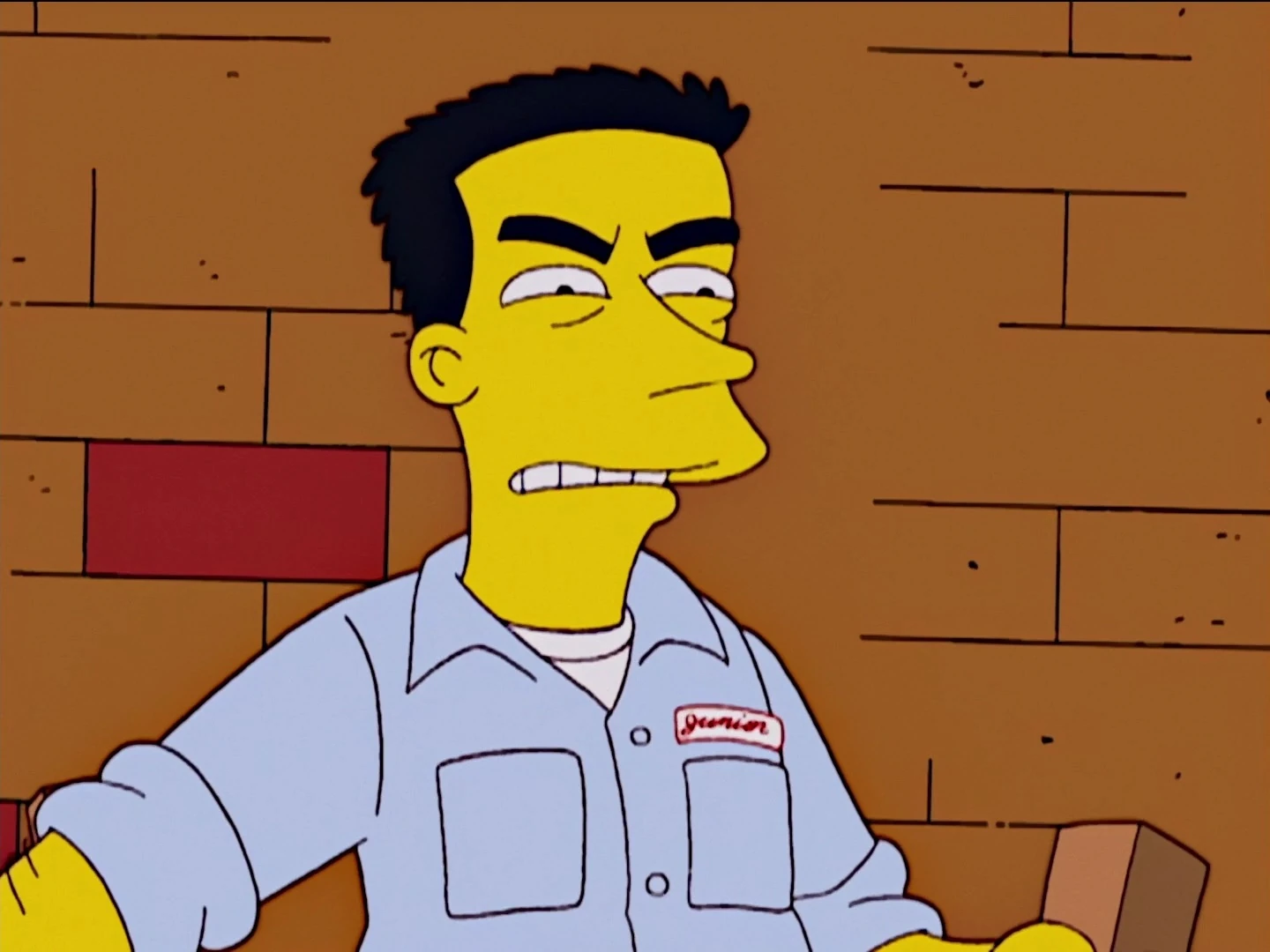
You probably remember Frank Grimes. He was the "Grimey" of Season 8, the man who lived in a bowling alley above another bowling alley and below another bowling alley. He died because he couldn't handle the sheer, unadulterated luck of Homer Simpson. But people often forget that his legacy didn't end with a funeral where Homer fell asleep. It actually continued years later through his son, Frank Grimes Jr., a character who embodies one of the show's most dedicated—and perhaps weirdest—attempts at long-term continuity.
Frank Grimes Jr. isn't a recurring staple like Ned Flanders or Moe. He showed up, caused absolute chaos, and then vanished back into the ether of Springfield's criminal justice system.
Honestly, the way he was introduced was kind of brilliant. It happened in the Season 14 episode "The Great Louse Detective." This was 2002. The show was transitioning into its "Scully-to-Jean" era, and the writers were looking for ways to bridge the gap between classic era lore and new-school antics. Someone decided it was time for Homer to face the consequences of his past. Or, more accurately, the offspring of those consequences.
Who is Frank Grimes Jr. anyway?
The kid is a mechanic. Well, he was. He showed up in Springfield with a singular, burning desire: to kill Homer Simpson. Not just prank him or make him lose his job, but actually end him. Why? Because his father, Frank Grimes, was driven to a literal, electrical-current-induced death by Homer’s existence.
It’s a dark premise.
When you think about the physics of The Simpsons, characters rarely stay dead, and their relatives rarely show up to settle scores. Frank Grimes Jr. changed that. He didn't look exactly like his dad—he had a bit more of a rugged, grease-monkey vibe—but the resentment was identical. He blamed Homer for the "misery" of his father's life, ignoring the fact that his father's misery was largely a product of his own inability to ignore Homer's stupidity.
The episode plays out like a parody of The Silence of the Lambs. Homer starts getting targeted by a mysterious assassin. Someone tries to crush him with a parade float. Someone tries to shoot him. The police are useless, as usual. So, they do the only logical thing: they recruit Sideshow Bob to help find the killer.
The Motive and the Madness
What makes Frank Grimes Jr. interesting is that he represents the "Real World" crashing into "Springfield World" again. His father was the original outsider who couldn't understand how a man like Homer could have a beautiful wife, three kids, a mansion, and a lobster dinner while being a complete moron.
Junior takes that frustration and turns it into a physical threat.
He's not a genius. He's not a mastermind like Bob. He’s just a guy with a wrench and a grudge. When he’s finally unmasked at the end of the episode, he basically rants about how Homer "killed" his father. It’s a moment of high drama that the show plays for both laughs and a weirdly grounded sense of tragedy.
Homer’s response? He basically doesn't remember who Frank Grimes was. Or he barely does. That’s the real kick in the teeth. For the Grimes family, Homer is the villain of their life story. For Homer, the Grimes family is a footnote he forgot while eating a donut.
Why the Fans Are Still Divided on Junior
Some fans hate him. They think it cheapened the masterpiece that was "Homer's Enemy" (the original Frank Grimes episode). That episode was a perfect, self-contained tragedy about a man who couldn't exist in a cartoon universe. By bringing in Frank Grimes Jr., the writers turned a philosophical point into a standard "villain of the week" trope.
But there's another side to it.
The appearance of Junior allowed the show to acknowledge its own history. By the early 2000s, The Simpsons had been on the air for over a decade. It was starting to feel like nothing mattered. Bringing back the Grimes name was a way of saying, "Yeah, we remember what happened in 1997."
It also gave us some of the best Sideshow Bob interactions in years. Watching Bob try to "reform" while helping Homer find a killer who is arguably less evil than Bob himself is a great dynamic.
- Junior represents the second generation of Simpson-haters.
- He is one of the few characters to actually try and murder Homer for a legitimate (in his mind) reason.
- His presence forced Homer to actually look back at his life, even if only for a second.
The Mechanical Details of the Attack
If you watch "The Great Louse Detective" closely, Junior’s methods are actually pretty clever for a mechanic. He uses his knowledge of machinery and the town’s infrastructure. He isn't using elaborate deathtraps or poison gas. He's using heavy objects and gravity.
He almost wins, too. If it weren't for Sideshow Bob's ego and his strange, burgeoning respect for Homer, Frank Grimes Jr. might have actually succeeded where so many others failed. He caught Homer at his most vulnerable: during a celebration of his own ego.
Is he still in jail?
Presumably, yes. In the world of Springfield, characters who go to "The Slammer" usually stay there unless they are Sideshow Bob or Snake. Junior hasn't been seen in a major role since. He’s a relic of an era where the show was experimenting with its own legacy.
Interestingly, the show has made other references to the Grimes lineage. In later seasons, we see the gravestone of Frank Grimes multiple times. It has become a visual shorthand for "Homer's path of destruction." But the son? He’s the forgotten man.
Maybe that’s fitting. The father was a man who wanted to be remembered for his hard work but was remembered for his breakdown. The son wanted to be remembered for his revenge but was remembered as a plot device for a Sideshow Bob episode.
How to Appreciate the Grimes Legacy Today
If you want to understand the impact of Frank Grimes Jr., you have to go back and watch the original Season 8 episode first. You need to feel the tension that Frank Sr. felt. You need to see the "palace" that Homer lives in through the eyes of someone who lives in a single room with a hot plate.
Then, watch the Season 14 sequel.
Notice the difference in tone. The show had become more surreal by then. The Stakes were higher, but the emotional weight was lighter. Junior is a fun character, but he lacks the existential dread of his father. He’s a "bad guy," whereas his father was a "protagonist in the wrong show."
- Check out Season 8, Episode 23: "Homer's Enemy" (The Origin).
- Check out Season 14, Episode 6: "The Great Louse Detective" (The Revenge).
- Look for the Easter eggs: In various episodes, keep an eye on the Springfield Cemetery. The Grimes plot is a recurring background gag.
The story of the Grimes family is essentially the story of what happens when the real world tries to sue a cartoon for damages. The cartoon always wins because the cartoon doesn't have to follow the rules of logic or fairness. Frank Grimes Jr. learned that the hard way. He tried to bring a wrench to a magic fight, and he ended up in the back of a police cruiser while Homer went back to his couch.
To really dive into the lore, start by comparing the two episodes back-to-back. You’ll see how the writing style of The Simpsons shifted from character-driven satire to plot-driven absurdity. It’s a masterclass in television evolution, for better or worse. Keep an eye out for Junior in the massive crowd scenes of later seasons or the movies; though he hasn't had a speaking line in years, the animators love to hide these one-off characters in the background of town hall meetings or riots. Check the Reddit threads dedicated to "Simpsons Continuity" to see if anyone has spotted his latest cameo in the high-definition era.