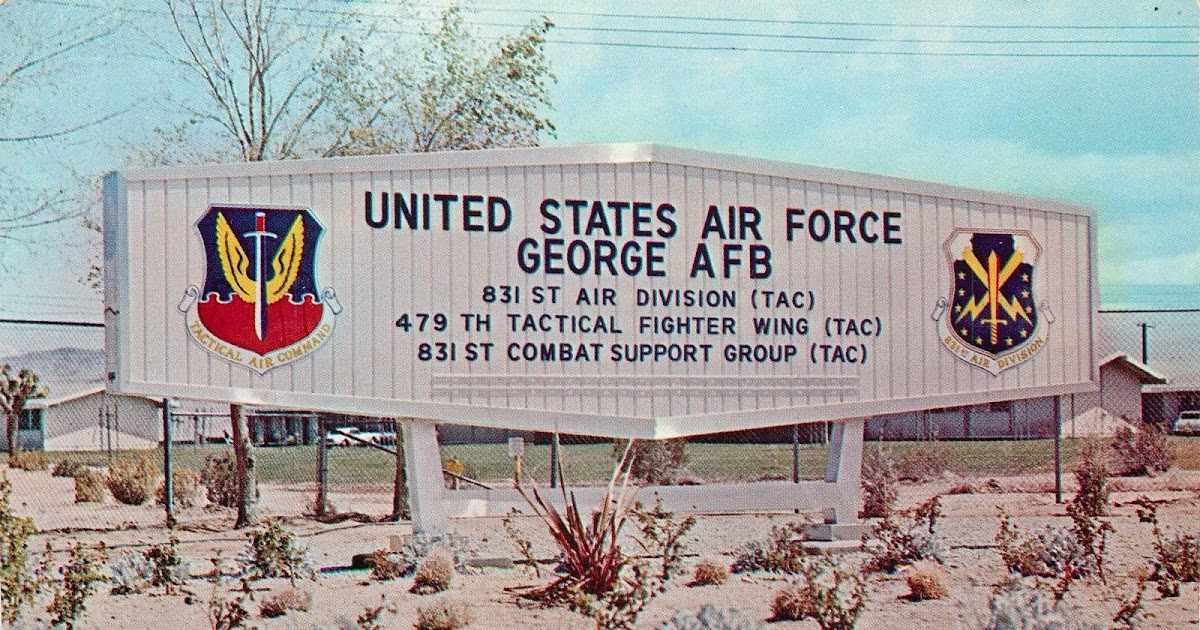
If you drive through the High Desert of California today, specifically the north end of Victorville, you’ll see something that looks like a post-apocalyptic movie set. Rows of abandoned houses. Empty hangars. Runways that seem to stretch into nothingness. This is the former George Air Force Base, or as locals usually call it, the Victorville air force base. It’s a place defined by two very different eras: the thunder of F-4 Phantoms during the Cold War and the eerie silence of a Superfund site today.
Actually, it isn't totally silent. Parts of it are now the Southern California Logistics Airport (SCLA). But the "ghost" part of the base? That’s where the real story lives. People often assume these bases just close because of budget cuts and that’s the end of it. With George, the closure was just the beginning of a massive environmental and legal headache that still hasn't been fully resolved decades later.
Why the Victorville Air Force Base Actually Closed
The base officially shut its gates in 1992. It was part of the Base Realignment and Closure (BRAC) process. Basically, the Cold War was ending, the Soviet Union had collapsed, and the Pentagon realized it didn't need a massive fighter wing training facility in the middle of the Mojave anymore.
It was a huge blow to the local economy. Victorville, Adelanto, and Apple Valley were built around those paychecks. When the 35th Fighter Wing packed up and moved to Mountain Home AFB in Idaho, they didn't just take the planes; they took the soul of the town. But they left something behind. Something much worse than empty storefronts.
The Toxic Legacy Most People Ignore
You can't talk about the Victorville air force base without talking about the contamination. It's a heavy topic, but you can't skip it. For years, the base was a hub for industrial activity. We're talking jet fuel, solvents like trichloroethylene (TCE), and firefighting foams. Back then, environmental standards were... let's say "loose."
Spills happened. Disposal was often just dumping stuff into unlined pits. Consequently, a massive plume of contaminated groundwater began migrating toward the Mojave River. According to the EPA, which listed the site on the National Priorities List in 1990, the primary concerns are VOCs (volatile organic compounds) and pesticides.
The military has spent hundreds of millions of dollars trying to pump and treat this water. It’s a slow process. If you talk to some of the veterans who were stationed there, or the families who lived in the base housing, you’ll hear stories of weird clusters of illnesses. There are entire Facebook groups dedicated to "George AFB survivors." It’s a grim reminder that military power often comes with a localized human cost.
From Fighter Jets to Fedex: The SCLA Pivot
So, what do you do with a giant abandoned airbase? You turn it into a "Logistics Airport." It sounds boring, but it’s actually a genius use of space. Because the runways at the old Victorville air force base are incredibly long—one is 15,050 feet—it can handle the largest aircraft in the world.
If you fly over it today, you won’t see fighter jets. You’ll see "boneyards."
The Famous Airplane Graveyard
This is probably what George is most famous for now. Because the desert air is so dry, it prevents rust and corrosion. Airlines from all over the world send their retired or "hibernating" planes here. During the 2020 pandemic, the runways were literally choked with hundreds of grounded jets from Southwest, Delta, and Qantas. It looked like a parking lot for giants.
- Storage: Planes are sealed up, engines are covered in "Mylar," and they wait for better economic times.
- Scrapping: If a plane is too old, it gets picked apart. Electronics go first. Engines are worth millions. The aluminum shell is eventually crushed.
- Maintenance: Companies like ComAv Technical Services operate out of the old hangars, doing heavy maintenance that can't be done at smaller municipal airports.
The "Ghost Town" of Base Housing
West of the runways lies the most haunting part of the property. The residential areas. For a long time, these were just left to rot. Broken windows, peeling lead paint, and desert weeds taking over the playgrounds. It became a magnet for urban explorers and vandals.
The city of Victorville and the military have had a tug-of-war over what to do with this land for thirty years. You can't just sell it to a developer because the soil is contaminated. You can't just tear it all down because of asbestos. So, it sits. It’s often used for military and SWAT training now. If you hear explosions or gunfire coming from the old base housing, don't worry—it's usually just the Army's Fort Irwin personnel or local police practicing "MOUT" (Military Operations in Urban Terrain).
Is it Safe to Visit?
Mostly. The Southern California Logistics Airport is a secure, working facility. You can't just wander onto the runways to take selfies with a Boeing 747. However, the surrounding roads offer some of the best views of the aircraft boneyard you’ll find anywhere in the country. Phantom West and Air Base Road are the spots where photographers hang out.
Just stay out of the fenced-off housing areas. Seriously. Not only is it trespassing, but the physical hazards—rusted metal, collapsing floors, and whatever chemicals are still lingering in the dust—aren't worth the Instagram photo.
What Most People Get Wrong About George AFB
A common myth is that the base is "secretly active." You'll see conspiracy theories online about underground bunkers or UFO reverse-engineering. Honestly? It's much more mundane. The "activity" people see is usually just cargo flights or the occasional military transport stopping for fuel.
Another misconception is that the city of Victorville owns the whole thing. It’s actually a complex patchwork. The Air Force Civil Engineer Center (AFCEC) still manages the environmental cleanup. The Southern California International Airport Authority (SCIAA) manages the business side. It’s a bureaucracy-heavy zone.
The Future of the Site
The long-term goal for the old Victorville air force base is total industrial conversion. They want more warehouses. More distribution centers. With the proximity to I-15 and the rail lines, it’s prime real estate for the "Amazon-ification" of the world.
But the shadow of the past is long. Until the groundwater is 100% clean—which experts suggest could take decades more—the base will always be a split personality. Half-thriving logistics hub, half-toxic memory.
Actionable Insights for Visiting or Researching George AFB
If you’re planning to check out the site or are researching its history, keep these practical points in mind:
- Spotting Planes: Use flight tracking apps like FlightRadar24 while standing near the perimeter. You’ll see some "heavy" traffic that you won't see at LAX, including massive Russian-built Antonov cargo planes that occasionally drop in.
- Environmental Records: If you lived there and are concerned about health, the Air Force maintains an Administrative Record (AR) online. You can search for "George AFB" to find thousands of pages of soil and water test results.
- Photography: The best light for the boneyard is "Golden Hour"—the hour before sunset. The sun hits the tails of the parked planes and makes for incredible shots from the public fence line.
- Local History: Visit the Victor Valley Museum in Apple Valley. They have specific exhibits on the 35th Fighter Wing that give you a sense of what the base looked like when it was the pride of the Mojave, not just a cleanup project.
The story of the Victorville air force base isn't over. It’s just transitioned from a story about national defense to a story about environmental reclamation and global logistics. It’s a weird, dusty, fascinating piece of California history that deserves more than a drive-by glance.