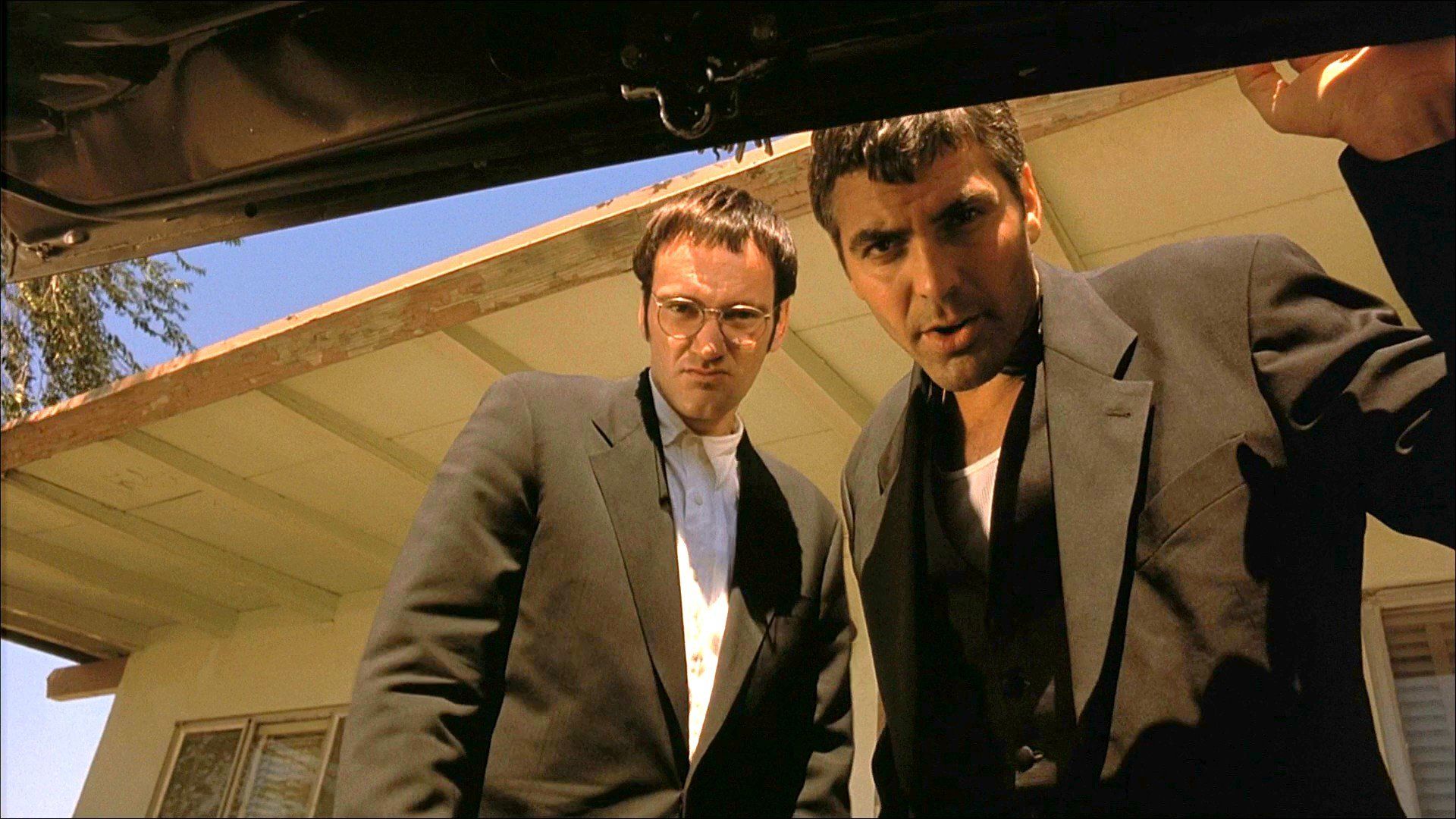
George Clooney wasn't always the silver-fox statesman of Hollywood. Before he was the guy winning Oscars and selling high-end tequila, he was a TV doctor struggling to break into the big leagues. Then came 1996. Then came Seth Gecko. If you look back at From Dusk Till Dawn Clooney is the absolute anchor of a movie that, by all accounts, should have been a complete disaster. It's half gritty crime thriller, half schlocky vampire flick.
It worked.
The film didn't just succeed because of Quentin Tarantino’s snappy dialogue or Robert Rodriguez’s kinetic directing. It worked because Clooney possessed an effortless, dangerous cool that nobody knew he had. Up until that point, he was Doug Ross on ER. He was the guy in the scrubs. Suddenly, he was a tattooed kidnapper with a glare that could melt steel.
The Seth Gecko Transformation
Let's be real: transitioning from television to film in the mid-90s was notoriously difficult. It wasn't like today where A-listers jump between HBO and Marvel movies without blinking. Back then, if you were a "TV actor," you stayed in your lane. Clooney needed a sledgehammer to break that glass ceiling.
Seth Gecko was that sledgehammer.
Seth is a fascinating character because he’s a professional. He isn’t a mindless killer; he’s a man with a plan who happens to have a psychotic brother, Richie (played by Tarantino). Clooney plays Seth with a simmering, controlled rage. He’s the "cool" to Richie’s "chaos." When Seth tells a room full of hostages to "be cool," you believe him because Clooney is radiating an intensity we hadn’t seen on the small screen.
There’s a specific nuance to his performance. He manages to make a kidnapper and thief somewhat likable—or at least, someone you’d rather have on your side when the literal monsters show up. He brought a "leading man" gravitas to a B-movie premise. Without that grounded performance, the second-half pivot into vampire carnage would have felt silly. Instead, it felt like a desperate survival story.
Why the Titty Twister Pivot Still Works
Critics at the time were split down the middle. Some loved the genre-bending audacity. Others felt like they had been tricked into watching two different movies. But honestly? That’s why people are still talking about From Dusk Till Dawn Clooney thirty years later.
The movie starts as a hostage drama. The Gecko brothers are fleeing to Mexico after a bloody bank heist. They kidnap a preacher (Harvey Keitel) and his kids. It’s tense. It’s sweaty. It’s classic Tarantino-penned grit. Then, they arrive at a trucker bar called the Titty Twister.
Everything changes.
The moment Salma Hayek finishes her iconic dance and the band starts playing "After Dark" by Tito & Tarantula, the movie descends into a neon-soaked bloodbath. It’s a jarring shift. Most actors would have looked lost in the chaos. Clooney, however, just leans into it. His delivery of the line, "Are they brothers? No, they're vampires. Vampires don't settle small scores only big ones," is peak 90s cinema. He says it with the same conviction he’d use to diagnose a patient on ER.
That’s the secret sauce. Clooney didn't wink at the camera. He didn't treat the vampires like a joke. He treated them like a problem that needed solving with a shotgun and a stake.
The Impact on Clooney's Career
If this movie flops, Clooney might have stayed on TV for another decade. Instead, it proved he could carry a feature film. It’s a weird calling card, but it worked. Shortly after, he landed Batman & Robin. We don't need to talk about the nipples on the batsuit, but the point is that he became an "it" guy because of the grit he showed in the desert.
He proved he had range. He wasn't just the handsome guy. He could be mean. He could be funny. He could be an action star.
- The Look: That flame tattoo crawling up his neck became iconic.
- The Voice: Clooney used a lower register, a gravelly tone that commanded authority.
- The Chemistry: His dynamic with Harvey Keitel—a legit "serious" actor—showed he could hold his own with the best in the business.
The Production Reality
Rodriguez and Tarantino were a match made in heaven (or hell). They shot the movie on a relatively modest budget of $15 million. It was a fast, dirty shoot. Clooney has often spoken about how different it was from the controlled environment of a TV set. On ER, everything was timed to the second. On a Rodriguez set, they were inventing ways to make green vampire blood look disgusting enough to bypass the censors.
They used green blood, by the way, specifically to get an R-rating instead of an NC-17. Apparently, the MPAA didn't mind a massacre as long as the liquid wasn't red. It’s these kinds of weird, practical solutions that give the film its soul.
Clooney also had to deal with Tarantino’s unique acting style. Tarantino is a brilliant writer, but as an actor, he’s... an acquired taste. Clooney had to play the straight man to Tarantino’s twitchy, unsettling Richie Gecko. It’s a testament to Clooney’s talent that he made that sibling bond feel authentic, even when Richie was seeing hallucinations in the cereal.
Common Misconceptions About the Film
Some people think this was a Tarantino-directed film. It wasn't. Tarantino wrote the screenplay (based on a story by Robert Kurtzman), but Robert Rodriguez directed it. You can see the "Mexico Trilogy" DNA all over the camera movements and the editing.
Another big one: people forget how much of a risk this was for Clooney’s image. He was the "sexiest man alive" type. Taking a role where he kills people and fights rubber monsters was a massive gamble.
The film also spawned a franchise, including two direct-to-video sequels and a TV series. But let’s be honest: none of them captured the magic of the original. Without the specific chemistry of the 1996 cast, the "vampire crime" gimmick loses its teeth. You need the weight of an actor who can ground the absurdity.
Actionable Takeaways for Cinephiles
If you’re revisiting From Dusk Till Dawn Clooney is the best lens through which to view it. Don't just watch the explosions. Watch his eyes. Watch how he reacts to the supernatural shift.
- Watch the Transition: Pay attention to the exact moment the genre flips. It’s about 60 minutes in. Note how Clooney’s body language changes from "predator" to "prey" and then back to "survivor."
- Contextualize the Era: Watch an episode of ER from 1995 and then watch this movie. The contrast is staggering. It’s one of the best examples of "rebranding" an actor in history.
- Look for the Subtle Writing: Tarantino’s dialogue is famous for its pop culture references, but in this movie, Seth Gecko’s lines are surprisingly lean. He doesn't ramble. He’s all business. This was a deliberate choice to differentiate him from the usual Tarantino protagonist.
The movie stands as a monument to a specific time in Hollywood—a time when you could take a $15 million budget, throw a TV star and some vampires in a bar, and create a cult classic that still looks great on 4K today. It’s messy, it’s loud, and it’s unapologetically violent. And at the center of it all is a man who would eventually become one of the most powerful people in the industry, proving that sometimes, you have to fight some vampires to get to the top.
The best way to appreciate the performance is to look at the film’s legacy. It’s a staple of midnight screenings. It’s a masterclass in the "mid-point twist." Most importantly, it's the definitive proof that George Clooney was always meant for the big screen. He didn't just survive the night; he owned it.
To truly understand the impact, watch the documentary Full Tilt Boogie. It covers the production of the film and shows the raw energy on set. It gives you a behind-the-scenes look at how Clooney navigated the jump to stardom while surrounded by fake blood and chaos. Seeing the work that went into the practical effects makes Seth Gecko’s world feel even more tangible.