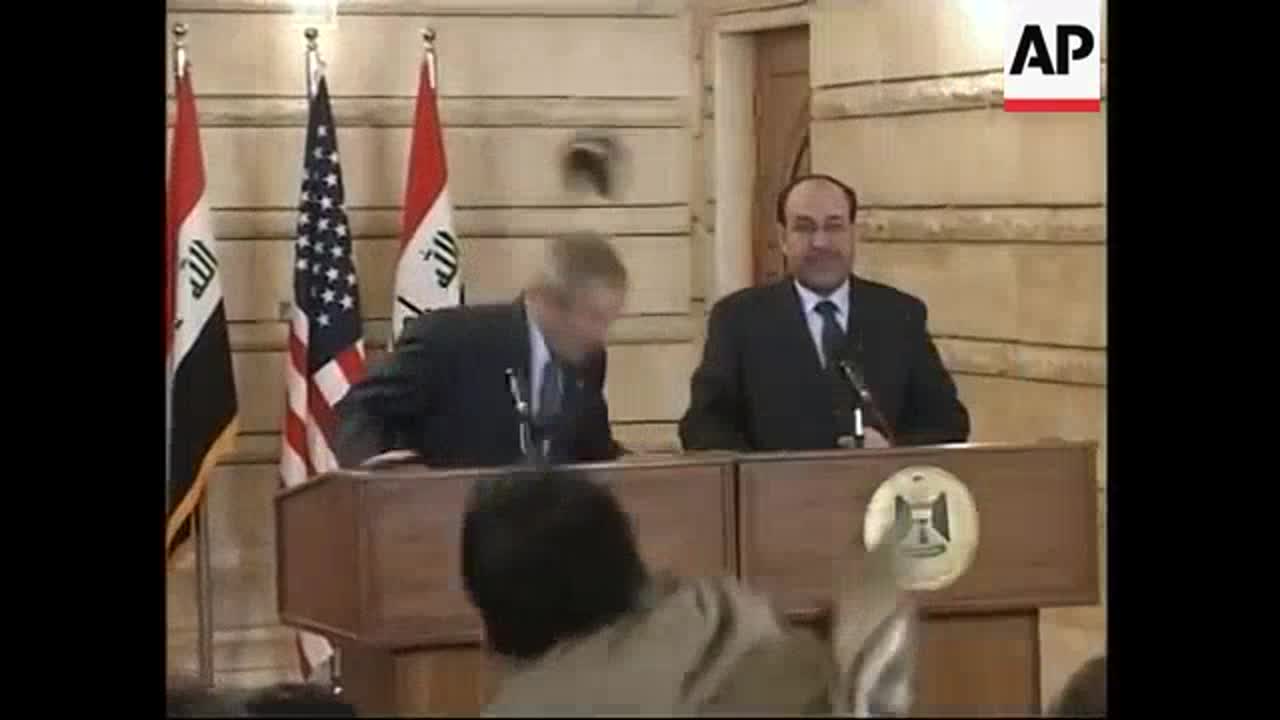
Honestly, if you close your eyes and think about the late 2000s, there’s one image that probably pops into your head faster than almost anything else from the Iraq War era. It isn’t a graph of troop surges or a map of the Green Zone. It’s a pair of size 10 black loafers flying through the air toward the head of the leader of the free world. George W. Bush and the shoe incident is one of those rare moments in history that felt like a fever dream but was actually a deeply calculated, culturally loaded act of defiance that still echoes today.
It happened on December 14, 2008. Baghdad was sweltering, even in December. President Bush was on a "farewell" trip, a victory lap of sorts before handing the keys of the White House over to Barack Obama. He was standing next to Iraqi Prime Minister Nouri al-Maliki, talking about how the war was "decisively on its way to being won." Then, the air changed.
Muntadhar al-Zaidi, a 29-year-old journalist for the Al-Baghdadia TV station, stood up. He didn't ask a question. He didn't yell a slogan. He just whipped his right shoe at the President’s face. "This is a farewell kiss from the Iraqi people, you dog!" he screamed in Arabic. Bush ducked—fast. Like, surprisingly fast for a guy in his 60s. Then came the second shoe. "This is for the widows and orphans and all those killed in Iraq!"
Bush ducked again. The second shoe whistled past and thudded against the American flag.
Why the Shoe Was Such a Big Deal
To an American viewer, throwing a shoe might seem like a weird, almost goofy way to protest. It’s not a rock; it’s not a weapon. But in the Middle East, this was the ultimate "F-you."
Basically, the sole of the shoe is considered the filthiest thing you own because it touches the ground. Showing someone the bottom of your feet is an insult, but actually throwing the shoe at them? That is a declaration of total contempt. It was a symbolic way of saying that the person is lower than the dirt on the street.
The Man Behind the Toss
Muntadhar al-Zaidi wasn't just some guy who snapped. He had been planning this for years. He later told reporters that he’d been waiting for a chance to confront the man he held responsible for the "shock and awe" campaign that tore his country apart. Al-Zaidi had seen the bodies. He’d reported on the orphans.
He chose his seat in the back row specifically. Why? Because he figured if security opened fire on him, there wouldn't be anyone behind him to get hit by stray bullets. He really thought he might die that day.
Instead of being killed, he was tackled by security, dragged out of the room screaming, and later sentenced to three years in prison (which was eventually reduced to nine months for good behavior). He claimed he was beaten and tortured while in custody—broken ribs, internal bleeding, the whole nine yards.
The Aftermath: From Villains to Heroes
While the U.S. media was busy replaying the clip and joking about Bush's "Matrix-like" reflexes, the Arab world was turning al-Zaidi into a folk hero.
- A giant bronze shoe monument was actually built in Tikrit to honor him.
- The Turkish company that made the shoes, Baydan Shoe, saw a massive spike in orders. They even renamed the model the "Bye-Bye Bush" shoe.
- Wealthy businessmen offered him sports cars and gold-saddled horses as gifts upon his release.
Bush, for his part, handled it with his characteristic "W" shrug. He joked about it almost immediately, telling reporters, "If you want the facts, it's a size 10 shoe that he threw." He tried to frame it as a sign of a "free society"—the idea being that in a democracy, people are free to express themselves, even if it involves footwear.
What People Get Wrong
One of the biggest misconceptions about George W. Bush and the shoe is that it was a random act of a "crazy" person. It wasn't. It was a deeply political performance.
Another thing? People think the shoes were saved or put in a museum. Nope. Security forces actually tore them apart looking for explosives and then destroyed them. There is no "Bush Shoe" sitting in a glass case anywhere, despite what some urban legends say.
Where is Muntadhar al-Zaidi now?
The guy didn't just disappear. He moved to Beirut for a while, wrote a book called The Last Salute to President Bush, and eventually ran for a seat in the Iraqi parliament in 2018. His campaign was basically "I'm the guy who threw the shoe, and I'm still against corruption." He didn't win, but he’s still active, still vocal, and—honestly—still has zero regrets. In 2023, he told CBS News that his only regret was that he only had two shoes.
Actionable Insights: Lessons from a Flying Loafer
If you’re looking at this incident as more than just a funny YouTube clip, there are a few real takeaways:
- Understand Cultural Nuance: Never assume an insult in one culture translates the same way in another. What looked like a prank to some was a profound political statement to millions.
- Crisis Management: Bush’s "shrug-and-joke" strategy prevented the incident from becoming a larger diplomatic disaster. By not reacting with anger, he de-escalated the narrative.
- The Power of Symbolism: You don't need a complex manifesto to change a narrative. One simple, well-timed act can become a permanent part of a leader's legacy.
To really understand the legacy of the Iraq War, you have to look past the policy papers and look at that flying loafer. It was the moment the "mission accomplished" narrative met the reality of a population that felt deeply unheard.
If you want to dive deeper into this era of history, start by looking into the "Bye-Bye Bush" shoe manufacturer or reading al-Zaidi’s own accounts of the trial. It provides a perspective on the war that you simply won't find in American history books.