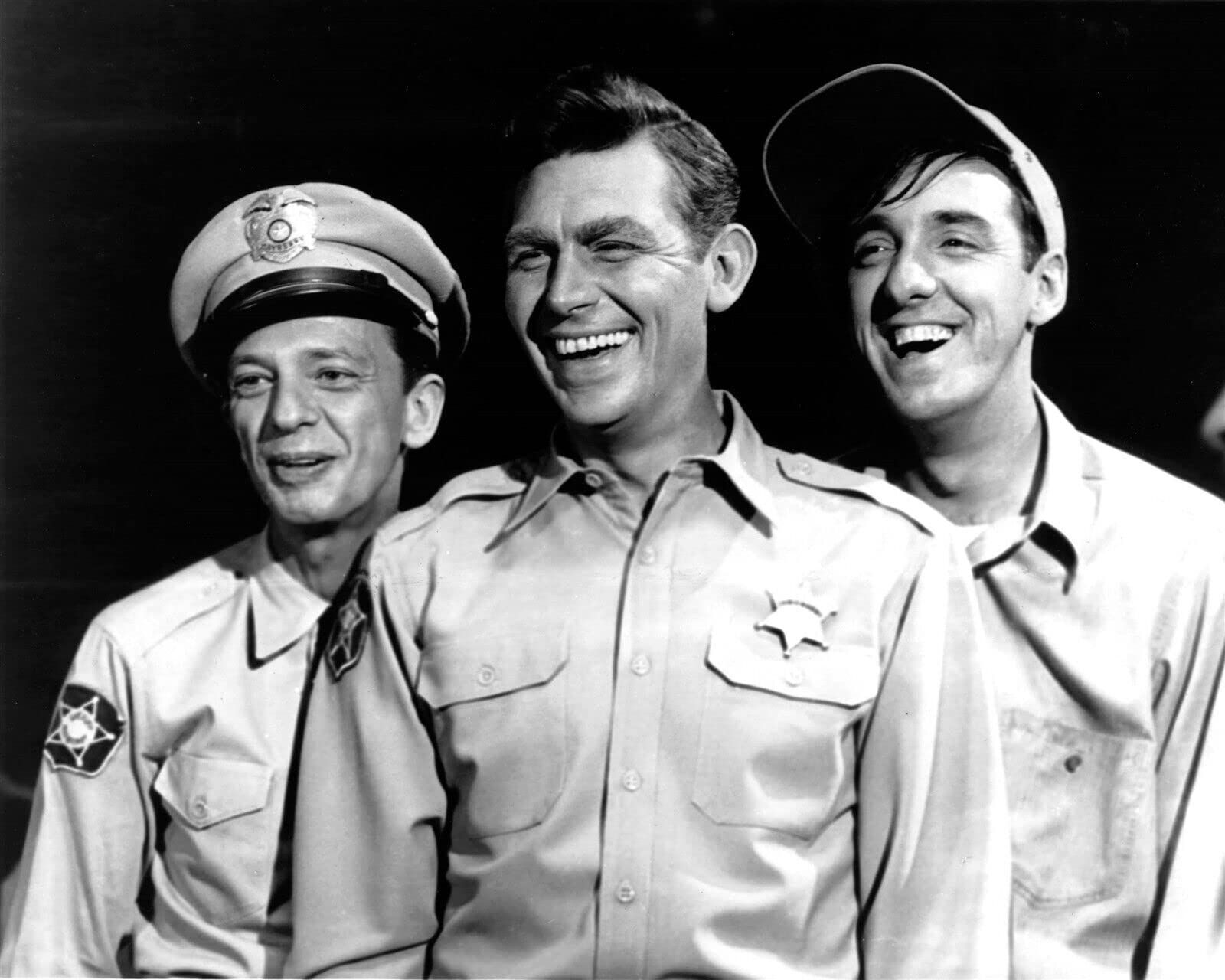
You know that voice. Not the booming, operatic baritone that could shake the rafters of a cathedral, but the other one. The high-pitched, nasal "Gol-ly!" that became the soundtrack of 1960s television. It’s wild to think about, but Gomer Pyle was never even supposed to be a regular character.
He was a happy accident.
When we look back at Gomer Pyle on The Andy Griffith Show, we usually see the bumbling, wide-eyed gas station attendant at Wally’s Filling Station. He was the guy who didn't quite "get" how a bank robbery worked or why you shouldn't tell a secret to the whole town. But behind the scenes, the creation of Gomer was a mix of lucky timing and a nightclub discovery that changed the course of sitcom history.
The Night Andy Griffith Found a Star in a Tavern
Andy Griffith wasn't looking for a new sidekick. It was 1962, and the show was already a massive hit. But Andy happened to walk into a Santa Monica nightclub called "The Horn." There, he saw a young man named Jim Nabors performing a cabaret act.
Nabors was doing something weird.
He would tell stories in this exaggerated, rural Southern drawl—characters he’d cooked up based on his childhood in Sylacauga, Alabama—and then suddenly break into a flawless, professional singing voice. It was a total disconnect. Andy was floored. He didn't just like the act; he saw the future of Mayberry.
Initially, Gomer Pyle was hired for a single episode. That's it. One and done. But the chemistry was so instant, so undeniably sweet, that the producers knew they couldn't let him go. He ended up appearing in 23 episodes between 1962 and 1964, effectively filling the "lovable dimwit" void whenever Don Knotts’ Barney Fife was too busy being neurotic.
Why Gomer Pyle on The Andy Griffith Show Worked
People often ask why Gomer resonated so deeply. Honestly, it’s because he represented a pure, unrefined innocence that even Barney Fife lacked. Barney was arrogant and insecure; Gomer was just... happy.
Take the episode "The Bank Job." Gomer is trying to help Barney prove the bank is easy to rob. He ends up using a blowtorch on the vault because he thinks he's just being a helpful citizen. It’s that lack of guile. He wasn't stupid, exactly. He was just operating on a level of moral simplicity that the rest of the world had moved past.
Then there’s his relationship with Andy. While Andy often had to play the "parent" to Barney, with Gomer, he was more like a big brother protecting a kid from himself. You can see it in "Gomer the House Guest." When Wally fires Gomer and he has to move in with Andy, the chaos is driven by Gomer's desperate desire to be helpful. He’s the guy who fixes your toaster and accidentally shorts out the whole block, but he does it with a smile so genuine you can't even get mad.
The Backdoor Pilot and the Marine Corps Shift
By 1964, Jim Nabors was too big for a supporting role. CBS wanted more Gomer.
The transition happened in the Season 4 finale, titled "Gomer Pyle, U.S.M.C." This was a "backdoor pilot," a clever TV trick where you air an episode of one show to test if a spin-off will work. In this case, Gomer decides to join the Marines.
It’s a classic setup. The most civilian man in America enters the most rigid institution in America.
Andy tags along for the first day, and in a move that’s actually pretty devious for Sheriff Taylor, he tricks the drill instructor, Sergeant Vince Carter (played by the legendary Frank Sutton), into thinking Gomer is the son of a high-ranking General. He did it to make sure Gomer wouldn't get washed out immediately.
That one lie set the stage for five seasons of Gomer Pyle, U.S.M.C., which became one of the most successful spin-offs in history.
The Mystery of the Missing War
There is a weird fact about the Gomer Pyle era that modern viewers often miss. The spin-off ran from 1964 to 1969. If you know your history, you know what was happening then: The Vietnam War.
Yet, Gomer and Sgt. Carter never went to Vietnam. They never even mentioned it.
The show existed in a bubble of "peacetime" military life, focused on base inspections and KP duty. Some critics at the time found it jarring, but for the American public, Gomer was a necessary escape. He represented the "ideal" soldier—loyal, hardworking, and fundamentally good—at a time when the reality of the military was becoming much more complicated for the average family.
Little-Known Facts About Gomer Pyle on The Andy Griffith Show
- The Name Origin: The name "Gomer" actually came from a real person. Writer Everett Greenbaum met an incompetent gas station attendant and used the first name "Gomer" (borrowed from writer Gomer Cool) and the last name "Pyle" (borrowed from actor Denver Pyle, who appeared on the show).
- The "Other" Pyle: Most people forget that Gomer’s cousin, Goober Pyle (George Lindsey), was brought in to fill the gap when Jim Nabors left for his own show. Goober was essentially a "Gomer Lite" at first, though he eventually carved out his own distinct personality.
- The Singing Reveal: The first time audiences heard Jim Nabors’ real singing voice was on The Andy Griffith Show in 1964. The episode "The Barney Fife Show" featured Gomer singing at a choir rehearsal. The audience response was so overwhelming that Nabors ended up recording over 30 albums during his career.
- The Promotion: While Gomer remained a Private First Class (PFC) for the entire run of his show, the real-life Marine Corps eventually "corrected" this. Jim Nabors was given an honorary promotion to Lance Corporal in 2001, Corporal in 2007, and finally, Sergeant in 2013.
What Most People Get Wrong
There’s a common misconception that Gomer was a "hick" stereotype meant to mock rural people. If you watch the episodes closely, it’s actually the opposite.
The "city people" or the "authority figures" are usually the ones who look foolish because they lack Gomer’s integrity. Gomer wins not because he’s smart, but because he’s consistent. He treats everyone—from a drunk in the gutter to a General—with the exact same level of respect.
In "A Date for Gomer," Barney tries to set Gomer up with a "plain" girl as a joke. Gomer doesn't see her as plain. He sees her as a person. He treats her with such genuine kindness that the "joke" falls apart, and the audience ends up rooting for Gomer’s sincerity over Barney’s cynicism.
Why Gomer Still Matters in 2026
We live in a loud, cynical world. Gomer Pyle on The Andy Griffith Show represents the last gasp of a specific kind of American folklore: the Wise Fool.
He is the character who doesn't understand the rules of the "rat race" because he doesn't care about winning. He cares about whether his friends are okay. He cares about doing a good job at the filling station.
That simplicity is why the show is still on the air in syndication more than 60 years later. We don't just watch Gomer to laugh at him; we watch him because, deep down, we wish we could be that unburdened by the world's nonsense.
Actionable Insights for Fans and Collectors
If you're looking to dive deeper into the world of Gomer Pyle, here is how you can actually engage with the history today:
- Watch the "Transition" Trilogy: To see the full arc, watch "The Bank Job" (S3, E13), "Gomer the House Guest" (S4, E4), and the backdoor pilot "Gomer Pyle, U.S.M.C." (S4, E32) back-to-back. It shows the evolution of the character from a background extra to a leading man.
- Listen to the Baritone: Find a recording of Jim Nabors singing "The Impossible Dream." It provides the necessary context for why the producers were so desperate to keep him on television; the contrast between Gomer's speaking voice and Nabors' singing voice is one of the greatest "gimmicks" in entertainment history.
- Visit the Statues: If you're ever in Clarksville, Tennessee, there is a statue of Frank Sutton (Sgt. Carter). While Jim Nabors is the star, the Gomer Pyle legacy is just as much about the "straight man" who had to react to him.
Gomer Pyle wasn't just a character; he was a phenomenon that proved kindness, even when wrapped in a "shazam" and a "golly," is the most enduring quality a person can have.