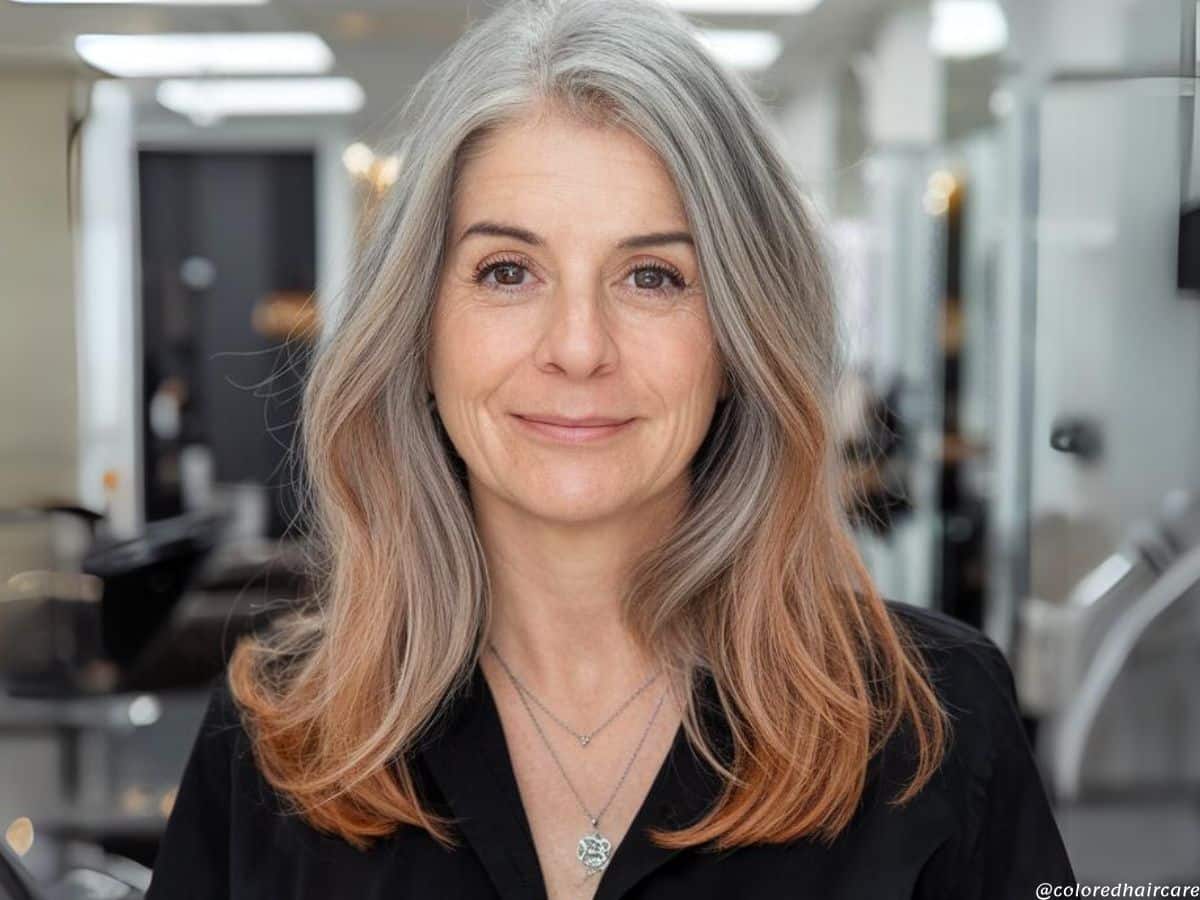
You’re standing in front of the bathroom mirror, squinting. There it is. That first—or fiftieth—shimmering wire of silver sticking straight up like a tiny antenna. Honestly, the knee-jerk reaction for most of us has always been "hide it." We run to the salon, sit in the chair for three hours, and get a solid root touch-up that looks great for exactly twelve days. Then the "skunk line" appears. It’s exhausting. But lately, there’s been this massive shift in how we handle the transition. Instead of obliterating the silver, people are leaning into gray hair with lowlights, and it’s kinda changing the game for anyone who is sick of the three-week salon cycle.
It’s not just about being lazy. It’s about depth.
When you dye your hair one solid dark color to cover gray, you lose all the natural dimension. Real hair isn't a flat wall of pigment. By using lowlights—which are just sections of hair dyed darker than your base—you’re basically creating a "shadow" that allows the gray to look like intentional highlights. It’s a bit of visual sorcery.
The big lie about "covering" grays
Most people think the only way to look younger is to erase every trace of silver. That’s actually a bit of a myth. As we age, our skin tone changes. That jet-black or deep chestnut brown you rocked in your 20s can start to look harsh or "inky" against your complexion in your 40s or 50s. It washes you out.
Gray hair with lowlights works because it bridges the gap. You aren't "covering" the gray; you're blending it. Celebrity colorist Jack Martin, who famously helped stars like Jane Fonda and Sharon Osbourne go silver, often talks about this transition. He doesn't just slap on a toner. He looks at the pattern of the gray. Everyone has a "gray pattern." Some people are salt-and-pepper in the back and pure white at the temples. Others have a soft "mist" of gray throughout.
Lowlights allow a stylist to go in and add "ribbons" of darker color—usually a demi-permanent shade that matches your original natural level—to mimic the way hair naturally behaves. This breaks up the solid block of silver and prevents that "washed out" look. It’s sophisticated. It’s deliberate. And most importantly, it doesn't leave a harsh line when it grows out.
Why lowlights beat highlights for the silver transition
Wait. Shouldn't you just get highlights? Not necessarily.
If you already have a high percentage of gray (say, 50% or more), adding more blonde highlights can sometimes make you look even more "solid" and bright. You lose the contrast. Contrast is what makes hair look thick and healthy. When you choose lowlights, you are putting the "pepper" back into the "salt."
Think of it like a painting. If you just have a white canvas, you can't see the detail. You need the shadows to see the shape.
Typically, a stylist will use a technique called "lowlighting" to deposit color. They’ll pick out specific strands and apply a shade that is two or three shades darker than the gray. This creates a "multi-tonal" effect. It’s the difference between a cheap wig and a high-end hair restoration. You want the movement. You want the "lived-in" feel.
Does it damage your hair?
Not really. This is the best part.
Highlighter (bleach) is what wreaks havoc on your hair's cuticle. Since gray hair is already more porous and prone to dryness because it lacks melanin and natural oils, hitting it with high-volume developer can turn it into straw. Lowlights, however, are a "deposit-only" process. You aren't stripping the hair; you're putting color into it. Most modern demi-permanent dyes are loaded with conditioners. Your hair might actually feel softer after a lowlight session than it did before.
The "Blended" reality: Maintenance and what to expect
Let’s be real for a second. You’re still going to the salon. But the frequency is what changes. Instead of every 3 weeks, you might find yourself going every 8 to 12 weeks.
- The first appointment is the longest. If you’re transitioning from a solid permanent dye, your stylist has to strip the old "box color" or salon tint first. This is a marathon, not a sprint.
- The "In-Between" phase. You might see some fading. Lowlights on gray hair can sometimes turn a bit "muddy" if the wrong tone is used. Ashy tones are usually safer than warm tones, which can turn orange-y against silver.
- Purple shampoo is still your best friend. Even with lowlights, your gray can turn yellow due to minerals in your water, sun exposure, or heat styling. A good violet-pigmented shampoo (like the ones from Fanola or Oribe) keeps the silver crisp and the lowlights from looking dingy.
I've seen people try to do this at home with a cap and a box of "Dark Ash Brown." Please don't. Lowlighting gray hair requires a very specific "weave" of the hair sections. If the sections are too thick, you get "stripes" like a zebra. If they are too thin, they just disappear. A professional knows how to "drop" the lowlight an inch away from the root to make the grow-out even more seamless.
Real talk: The psychological shift
There’s a weird mental hurdle with gray hair with lowlights. For years, we’ve been told gray equals "old." But honestly? Seeing a woman with a sharp, well-maintained silver-and-charcoal blend looks incredibly "high-fashion." It signals confidence. It says you aren't fighting a losing battle against biology; you’re just optimizing the new version of yourself.
It’s also about texture. Gray hair has a different "personality." It’s wiry. It’s stubborn. By adding lowlights, the dye actually helps to "soften" the cuticle of those wiry strands, making them lay flatter and play nice with the rest of your hair.
Actionable steps for your next salon visit
If you're ready to jump off the permanent-dye hamster wheel, here is how you actually execute the move to gray hair with lowlights without ending up with a mess.
- Stop the "box" now. If you've been using drugstore permanent color, stop. It builds up a "stain" on the hair shaft that is incredibly hard to lift. Let your roots grow out at least an inch so your stylist can see your true gray percentage and natural base color.
- Ask for "Dimensional Lowlighting." Tell your colorist you want to transition to your natural gray but want to avoid a harsh line. Ask them to use a demi-permanent color for the lowlights. Why demi? Because it fades out gradually over 24 washes, which helps the blending process stay soft.
- Specify "Ash" or "Neutral." Unless you have very warm skin, warm lowlights (gold, copper, red) tend to look "off" against silver hair. You want tones like "Mushroom Brown" or "Slate" to keep the palette sophisticated.
- Invest in a "Clear Gloss." In between appointments, get a clear gloss treatment. It doesn't add color, but it seals the cuticle and makes the gray and the lowlights shine. Gray hair reflects very little light, so it can look "matte" or dull. Shine is the secret to making gray look expensive.
- Adjust your makeup. Once you have more silver and darker lowlights near your face, your old foundation might look too heavy. Switch to a more sheer, dewy formula. You might also need a slightly "cooler" blush tone to match the new cool tones in your hair.
The transition isn't just a hair change; it's a lifestyle change. You're trading the anxiety of "roots" for the luxury of "dimension." It might take a few sessions to get the balance exactly where you want it, but once you hit that sweet spot of salt-and-pepper perfection, you'll wonder why you spent all those years trying to paint over the most interesting part of your hair.
Forget the "skunk line." Embrace the shadow. Lowlights are the bridge to a much easier, much more stylish relationship with your hair.