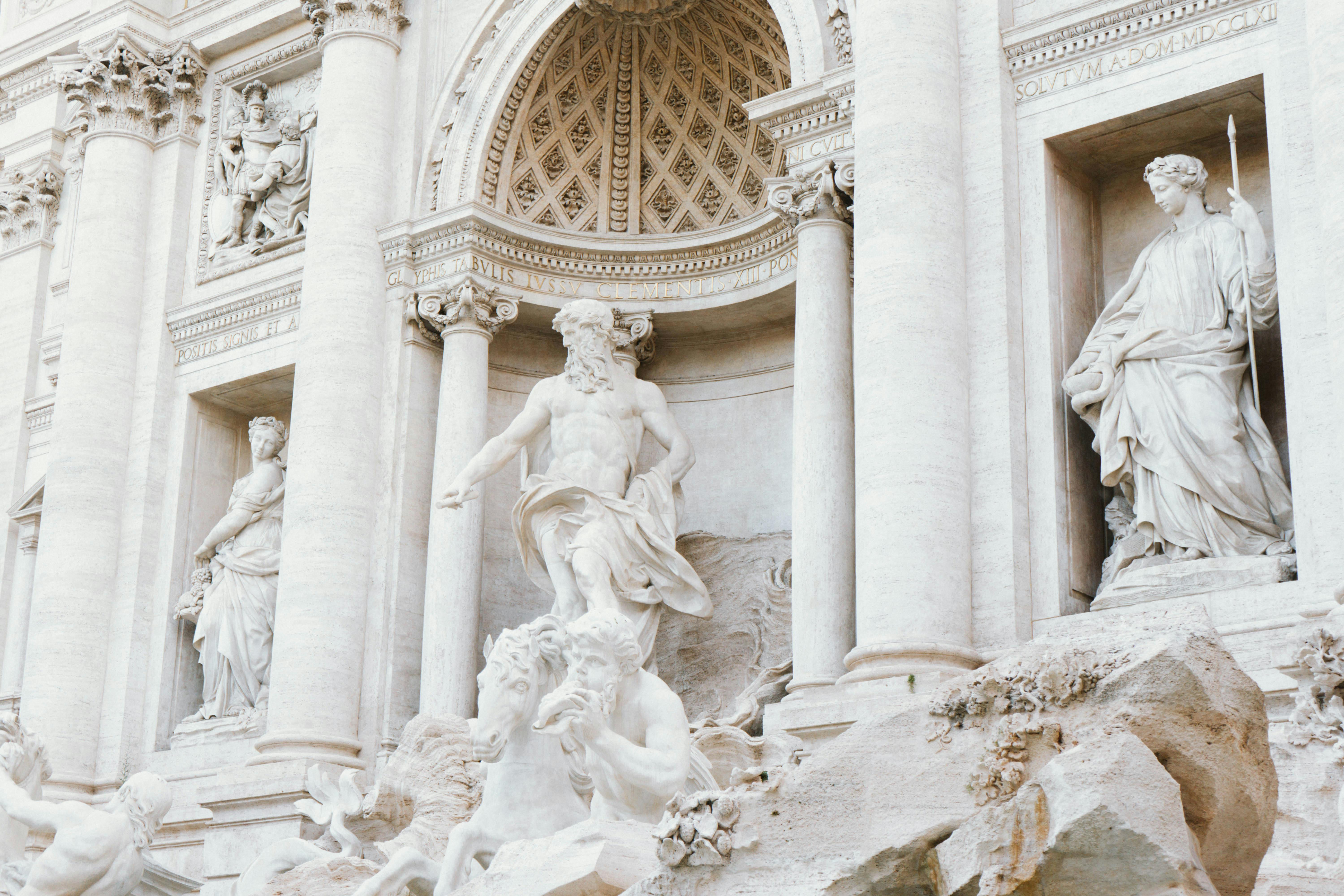
Walk into the British Museum or the Louvre today and you’ll see a sea of blinding white marble. It’s elegant. It’s "classical." It’s also completely wrong. For centuries, we’ve been conditioned to think of the ancient world as this sterile, monochromatic place where philosophers in white robes wandered past bleached-white temples. We built our entire concept of "Western Beauty" on this aesthetic. But if you actually stepped back into 5th-century BCE Athens, you’d probably think it looked more like a psychedelic circus or a vibrant comic book. Greek statues with color were the norm, not the exception.
The truth is, those pristine white figures are basically skeletons. The skin is gone. The clothes have rotted away. What we’re looking at is the bare bone of the art, stripped of its soul by time, wind, and—honestly—some pretty aggressive "cleaning" by museum curators in the 18th and 19th centuries who thought they were "restoring" the art by scrubbing off the "dirt." That dirt? It was the original paint.
The Great Whitewashing of History
How did we get it so wrong? It wasn't just a mistake. It was a choice. During the Renaissance, when artists like Michelangelo started digging up buried Roman copies of Greek originals, the paint had already flaked off after a thousand years underground. They assumed the statues were meant to be white. Because they worshipped the ancients, they started carving their own masterpieces out of pure white Carrara marble. Fast forward to the 18th century, and you have Johann Joachim Winckelmann, the guy basically known as the father of art history. He famously said, "The whiter the body is, the more beautiful it is." He tied whiteness to purity and intellectual superiority.
It stuck.
We spent hundreds of years ignoring the physical evidence. Even when 19th-century archaeologists found traces of pigment on newly excavated finds, the art world mostly looked the other way. They liked the white version better. It felt more "civilized." But let’s be real: to a Greek sculptor like Phidias or Praxiteles, leaving a statue unpainted would have looked unfinished, cheap, and weirdly morbid.
Science Doesn't Lie: How We See the Invisible
You can't see the color with the naked eye most of the time, but it’s there. Since the 1980s, archaeologists like Vinzenz Brinkmann and Ulrike Koch-Brinkmann have been using high-tech tools to prove it. They use something called Ultraviolet Reflectography. Basically, they shine a light on the stone, and the different chemicals in the old mineral pigments fluoresce differently. Even if the color is gone, the "ghost" of the pattern remains etched into the surface because the paint actually protected the marble from weathering at different rates.
Then there’s X-ray fluorescence (XRF). This allows researchers to identify the specific elements in the crusty bits of residue left in the crevices of the marble. If they find arsenic, it was probably a bright yellow. If they find copper, it was likely an Egyptian blue or a malachite green. They’ve found cinnabar for bright red lips and charred bone for deep blacks. These weren't subtle pastels, either. We’re talking saturated, loud, almost garish colors.
What They Actually Looked Like
Think about the Peplos Kore. She’s one of the most famous "white" statues from the Acropolis Museum. For decades, she looked like a serene, pale maiden. But the reconstruction? It’s wild. She’s wearing a bright red dress with elaborate blue and green embroidery patterns. Her hair is auburn. Her eyes are sharply defined with black liner. Honestly, it looks a bit jarring at first because we aren't used to it. It looks "new."
The "Gods in Color" Exhibition
If you want to see how dramatic this is, look up the Gods in Color traveling exhibition. Brinkmann and his team created 3D replicas of famous works and painted them using the exact mineral pigments found in the traces. The Trojan Archer is probably the most famous example. In marble, he’s a noble, anonymous warrior. In color, he’s wearing patterned leggings that look like something out of a 1970s disco—bright diamonds of yellow, blue, and red. He’s vibrant. He’s alive.
The Greeks used a technique called encaustic. They mixed their pigments with hot wax. This didn't just add color; it gave the marble a translucent, skin-like quality. Pure white marble is actually quite reflective and cold. The wax and pigment allowed the light to sink into the surface, making the "flesh" of the statue look soft and warm. They even used different shades of brown and ochre for skin tones. Contrary to the "white marble" myth, the Greeks were very aware of different ethnicities and used color to depict them realistically.
Why Does This Matter Today?
This isn't just a fun fact for art nerds. It changes how we perceive the ancient world and, by extension, ourselves. When we see Greek statues with color, the distance between "us" and "them" shrinks. They weren't these cold, distant intellectuals living in a museum. They were people who loved pattern, flash, and visual storytelling.
It also challenges some uncomfortable legacies. The "White Marble" myth was weaponized by 19th-century white supremacists to claim that the Greeks were a "pure" white race, distinct from the colorful, "decadent" cultures of the East. Knowing that Greek temples were actually painted with Egyptian Blue and featured patterns influenced by Persian textiles completely flips that narrative. The Mediterranean was a melting pot, and their art proved it.
The Texture of Life
Imagine the Parthenon. Now, stop imagining it as a bleached ruin. Imagine the frieze—the long wrap-around carving of the procession—painted with a bright blue background so the figures popped out in 3D. Imagine the shields of the soldiers glinting with gold leaf. Imagine the gods having actual iris and pupil details in their eyes, making them look like they were staring right at you. It would have been overwhelming. It would have been a sensory overload.
Archaeologist Mark Abbe once noted that the idea of unpainted ancient sculpture is "the most successful lie of Western art history." We’ve fallen in love with the ruin, but the ruin isn't the reality.
Acknowledging the Skeptics
Of course, not everyone loves the reconstructions. Some art historians argue that the "Gods in Color" versions are too bright—that they lack the nuance of the original artists. They point out that we can detect the pigment, but we can’t always detect the shading or the artistic blending the Greeks might have used. That’s a fair point. We might be seeing the "base coat" and missing the subtle artistic flourishes that made the statues truly masterful. But even a loud base coat is closer to the truth than the lie of the white marble.
How to Experience the "Real" Ancient Greece
If you want to see this for yourself, you have to know where to look. Most museums still keep the "colorful" research in a side gallery or as a small digital display.
- Visit the Acropolis Museum in Athens: They have some of the best-preserved traces of pigment on the Kore statues. They use special lighting to help you see the patterns that are invisible in flat light.
- Look for the "ghosts": Next time you’re near a Greek or Roman statue, look at the eyes. Often, you’ll see a slight difference in the texture of the marble where the pupil was painted. That’s the "ghost" of the color.
- Check out the Metropolitan Museum of Art (The Met): They’ve done extensive work on the "Chroma" project, creating digital and physical reconstructions of their own collection.
The ancient world was loud. It was colorful. It was messy. It was human. The next time you see a white marble statue, try to "paint" it in your mind. Add some ochre to the skin, some deep crimson to the robes, and some gold to the hair. Suddenly, the statue isn't an object in a museum anymore. It’s a person.
Actionable Insights for the History Enthusiast
- Stop using "Classical" as a synonym for "White": When discussing history or design, acknowledge that the ancient aesthetic was maximalist, not minimalist.
- Support Digital Restorations: Follow projects like the Stiftung Archäologie which continues to map pigments on ancient artifacts using non-invasive technology.
- Read the Source Material: Check out The Color of Gods (Brimmer/Centrale Montemartini) for the most detailed scientific breakdown of pigment analysis.
- Question the "Clean" Aesthetic: When visiting local museums, ask docents about the "polychromy" of the pieces. The more interest the public shows, the more museums will prioritize showing the colored versions rather than just the "bone" marble.