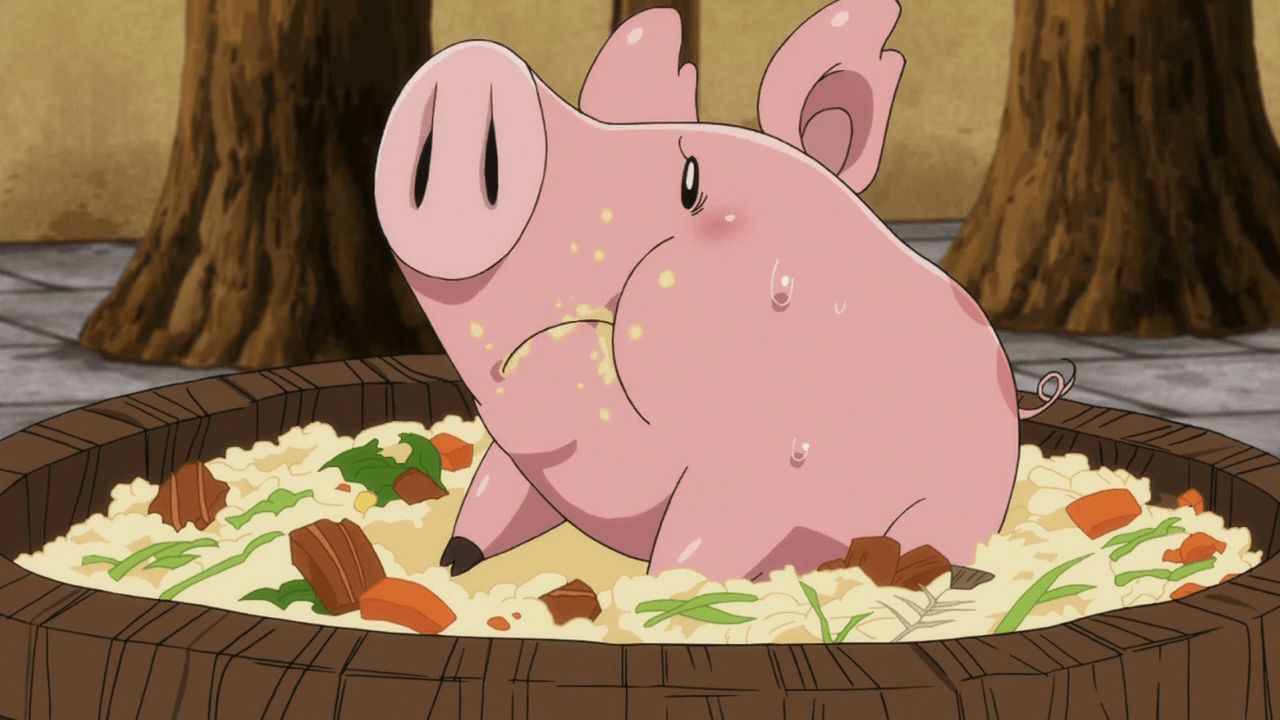
You’re watching The Seven Deadly Sins, and there he is. A pink, round pig with a clover-shaped birthmark. He’s loud. He’s arrogant. He calls himself the Captain of the Order of Scraps Disposal. Honestly, when Hawk from Seven Deadly Sins first wanders onto the screen, you probably figured he was just the "Pikachu" of the show—a cute mascot designed to sell plushies and provide a quick laugh when Meliodas gets a bit too creepy with Elizabeth.
But you’d be wrong.
Hawk isn't just some livestock with a voice box. He is arguably one of the most complex, tragic, and surprisingly powerful characters in Nakaba Suzuki’s entire universe. If you’ve finished the manga or the anime, you know his backstory involves literal portals to purgatory and a brother he didn't even know existed. If you haven't? Well, hold onto your leftovers, because the lore goes way deeper than just a pig who eats kitchen scraps.
The Scraps Disposal Captain’s Secret Origin
For the longest time, we just assumed Hawk was a normal pig who could talk. In the world of Britannia, where giants roam and fairies hide in forests, a talking pig isn't the weirdest thing on the menu. But the truth about Hawk from Seven Deadly Sins is actually tied to the Demon King himself.
He wasn't born in a barn. Hawk is actually a creature from Purgatory.
His real name is Mild’s younger brother, and he was kidnapped by the Demon King millions of years ago (in Purgatory time, at least). The Demon King used him as a literal "window" to spy on Meliodas. That’s why he was sent to the living world. He’s a bridge between dimensions. Think about that next time he’s complaining about the quality of Ban’s cooking. He’s a cosmic surveillance tool shaped like a ham.
Why Does He Have Transporkation?
One of the coolest—and most underrated—parts of Hawk’s kit is his "Transpork" ability. It sounds like a joke. It looks like a joke. But it’s actually a localized version of power absorption.
When Hawk eats something with magical properties, he physically transforms to take on those traits.
- Red Demon ear? He grows horns and gains fire-breathing capabilities.
- Grey Demon scrap? He turns into a stone-cold tank.
- Sky Fish? He grows fins and starts flying.
It’s a biological quirk that reflects his Purgatory origins. Most living things would just die or turn into a mess if they tried to digest demonic matter. Hawk just gets a new coat of paint and a power boost. It’s a testament to his durability, which, quite frankly, puts some of the Holy Knights to shame. He has survived hits from characters that would evaporate a normal human being. Remember when Hendrickson blasted him? Everyone thought he was dead. He came back as a tiny, pocket-sized version of himself, but he survived a direct hit from a guy fueled by demon blood.
The Emotional Heart of the Boar Hat
Let’s be real for a second. Meliodas is a 3,000-year-old demon with some serious baggage. Ban is an immortal thief who can’t die but feels everything. King is a fairy king who lost his memory. These aren't exactly "relatable" characters in the traditional sense.
Hawk from Seven Deadly Sins provides the grounding.
He’s the one who calls people out on their nonsense. He’s the one who fiercely protects Elizabeth when Meliodas is being... well, Meliodas. There’s a genuine bravery in a character who knows he’s the weakest person in the room but still stands in front of a god to protect his friends. That’s not mascot energy; that’s hero energy.
What People Get Wrong About His Power Level
Stop looking at his "Power Level" numbers. If you look at the official stats early on, Hawk is sitting at a measly 30. For context, an average Holy Knight is in the hundreds or thousands.
But power levels in Nanatsu no Taizai are notoriously unreliable.
Hawk’s true value isn't in his "Attack" or "Magic" stats. It’s in his "Spirit." He is the only character who can navigate Purgatory with any semblance of sanity (outside of Ban and Meliodas). His body is naturally adapted to the harshest environment in the series. The atmosphere in Purgatory literally rots the flesh off of regular souls, yet Hawk's species thrives there. If the show were set entirely in the underworld, Hawk would be the apex predator.
The Wild Connection: Wild and Mild
One of the most tear-jerking moments in the later stages of the story is the introduction of Wild.
Wild is a massive, boar-like creature in Purgatory who has spent millennia looking for his lost brother. When he meets Ban and Meliodas, the realization hits: he’s looking for Hawk. The tragedy of their separation—and the eventual reunion—adds a layer of weight to Hawk’s character that most fans never expected. He isn't just a stray pig Meliodas found in a cave. He’s a lost prince of Purgatory.
It changes how you view his arrogance. He isn't just being annoying; he’s acting like the royalty he actually is.
Beyond the Scraps: Actionable Insights for Fans
If you're looking to dive deeper into the lore of Hawk from Seven Deadly Sins, don't just stick to the main anime series. There are layers to his character that only come out when you look at the spin-offs and the creator’s notes.
- Check out the "Seven Deadly Sins: Prisoners of the Sky" movie. While its place in the strict canon is debated, it gives a great look at Hawk’s "White Sky Pig" ancestors and how his species is viewed as divine in some cultures. It’s a fun perspective on why he thinks so highly of himself.
- Read the Purgatory Arc in the manga (Chapters 271-273). The anime does a decent job, but the manga truly captures the desolation of Purgatory and the sheer badassery of Wild. It puts Hawk’s lineage into a much clearer focus.
- Pay attention to the "Combined Attacks." Hawk isn't just a solo fighter. His involvement in the "Rolling Ham Attack" or his coordination with Ban shows he has a tactical mind. He’s a support class character who thinks he’s a DPS.
- Analyze the "Seven Deadly Sins: Four Knights of the Apocalypse" sequel. Without spoiling too much, the legacy of the original sins and their companions (including our favorite pig) continues to ripple through the world.
Hawk is the glue. He’s the one who keeps the Boar Hat running, keeps the Sins in check, and reminds us that sometimes, the bravest person in the room is the one who’s most likely to be eaten. He’s a reminder that even in a world of gods and monsters, loyalty and a big appetite can take you a long way.
Next time you see a clip of him shouting about "Scraps Disposal," remember that you're looking at a Purgatory-born survivor who looked the Demon King in the eye and didn't blink. That’s the real Hawk.
Practical Next Steps for Fans
- Re-watch Season 1, Episode 24: Look closely at Hawk’s "sacrifice" and the subsequent transformation. It foreshadows his Purgatory durability way before the writers officially revealed it.
- Compare Hawk to Wild: If you’re a character designer or writer, look at the visual language used for Wild vs. Hawk. It’s a masterclass in taking a "cute" design and making it "feral" while keeping the family resemblance.
- Track the "Transpork" forms: Make a list of every creature Hawk eats throughout the series. It’s a fun way to see how the power scaling of the enemies he consumes mirrors the Sins' own growth.