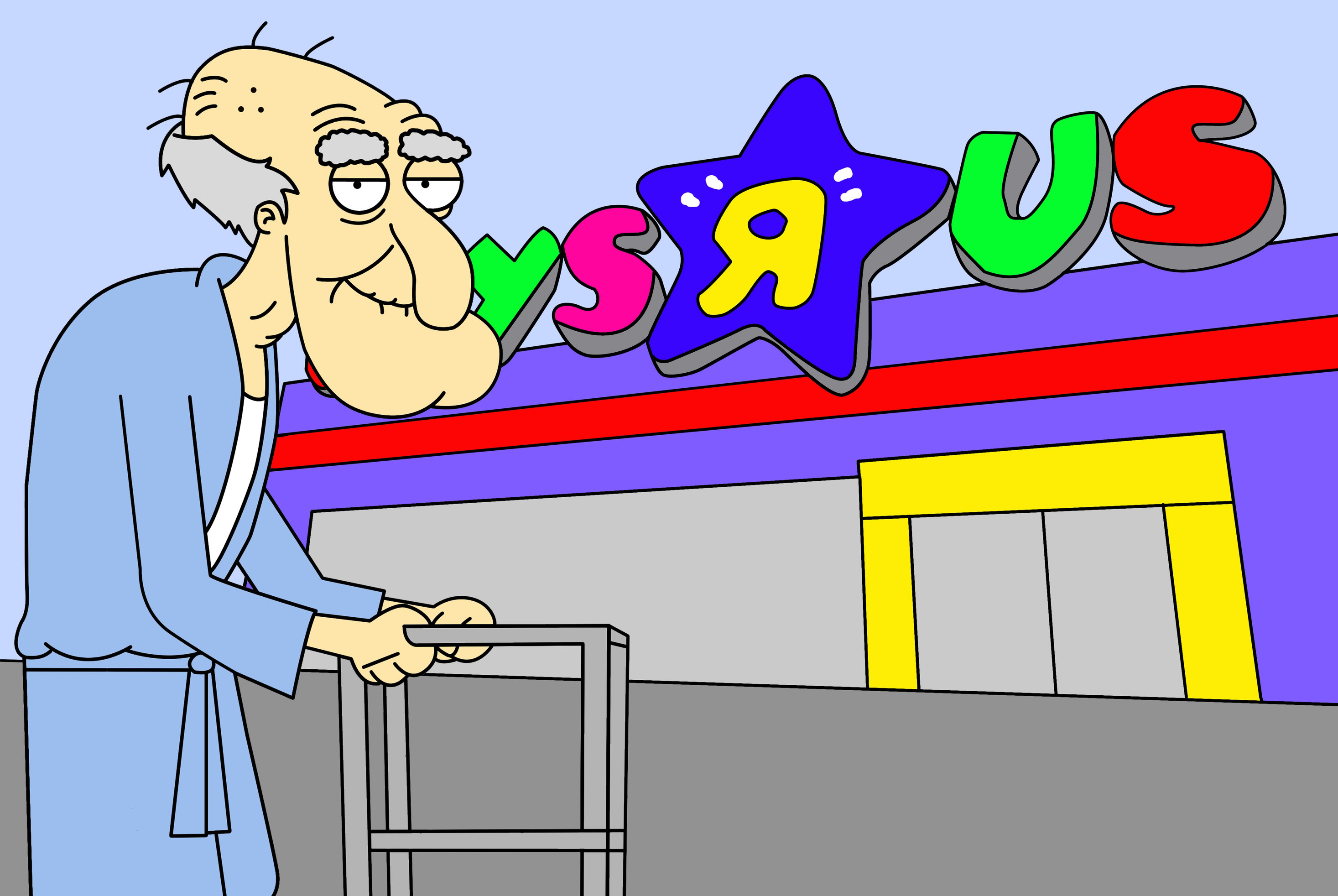
You’ve seen him. The light blue bathrobe, the walker that clicks with every agonizingly slow step, and that high-pitched, whistling lisp that makes your skin crawl. Honestly, if you’ve watched more than five minutes of Family Guy, you know exactly who John Herbert is. He’s the guy who lives down the street from the Griffins, the one who is uncomfortably—and very explicitly—obsessed with Chris.
It’s weird. In the world of Quahog, where a talking dog dates supermodels and a baby tries to commit matricide, Herbert still manages to be the most jarring part of the show. He isn't just a "creepy neighbor" trope. He is a full-blown personification of a pederast, used as a recurring gag for over two decades.
The Voice and the Origin of the Whistle
Ever wonder why Herbert sounds like a boiling tea kettle? That signature whistle isn't just a random choice. Mike Henry, the long-time voice actor and writer for the show, actually created the character. Before he was the voice of Cleveland Brown or Consuela, Henry was riffing on a guy he knew.
Basically, the voice was inspired by an elderly man Henry encountered at a grocery store while he was in college. The man had that specific, sibilant whistle whenever he spoke. Henry thought it was funny, tucked it away in his mental Rolodex, and eventually pitched it to Seth MacFarlane.
Initially, Herbert wasn't written as a predator. He was just meant to be a frail, funny-sounding old man. But this is Family Guy. "Normal" doesn't stay normal for long. The writers lean into the darkness. They decided to give this sweet-sounding voice the darkest possible motivation, creating a juxtaposition that defined the character’s humor for years.
That One Episode That Changed Everything
For a long time, Herbert was just a background creep. He’d show up, say something wildly inappropriate to Chris, and then shuffle away. But then "German Guy" happened. This was Season 9, Episode 13, and it gave us a backstory nobody really expected.
We find out Herbert was a World War II veteran. He was a prisoner of war in a Nazi concentration camp.
Sounds heavy, right? It was. The episode introduced Franz Schlechtnacht, a former Nazi guard who had moved to Quahog. This led to a geriatric fight scene that was both pathetic and strangely intense. Seeing Herbert in a dress uniform, singing "God Bless the USA," gave the character a weirdly patriotic layer that made his other... habits... even more confusing for the audience.
Why We Don't See Him Much Anymore
If you’ve been watching the more recent seasons of Family Guy, you might have noticed a shift. Herbert has basically disappeared into the "Z-tier" of background characters. He’s still there, sure. He might pop up in a crowd shot or a quick cutaway, but the big Herbert-centric episodes are a thing of the past.
Why? Because the world changed.
Cultural sensibilities shifted significantly since the early 2000s. Jokes that were considered "edgy" or "boundary-pushing" in 2005 often feel different in 2026. The showrunners have made a conscious effort to evolve. Look at Quagmire. He went from being a cartoonish sexual predator to a grumpy, cat-loving neighbor with a complicated relationship with his dad.
You can't really "evolve" a character like Herbert.
If you take away his obsession with young boys, what do you have? Just an old man with a walker. There’s no secondary personality trait to lean on. He was built on a single, controversial joke. Once that joke started to feel more "cringe" than "funny" to the general public, his screen time plummeted.
Is Herbert Actually Immortal?
There is a bizarre fan theory—and some canon evidence—that Herbert might be supernatural. In the episode "Chris Cross," Herbert "explodes" with joy when he thinks Peter is a teenage boy. Later, Jesse (his dog, who is just as decrepit as he is) plants a piece of Herbert in a pot.
He sprouts back up like a "Groot" version of himself.
"I am Herbert," he squeaks. It’s one of the few times the show played with the idea that he isn't quite human. It adds a layer of cartoonish absurdity that helps some viewers stomach the character. If he’s a weird plant-monster-man, maybe the "real world" rules don't apply.
Real Talk: The Controversy
Critics have been slamming Herbert for years. Organizations like the Parents Television Council (PTC) have cited him as one of the primary reasons Family Guy is "unfit" for television. They argue that making light of child exploitation is a line that should never be crossed, even in satire.
On the flip side, some fans argue that the joke isn't about the act, but about the absurdity of Herbert's transparency. Everyone in Quahog knows what he is, yet they treat him like a harmless neighborhood fixture. It’s a critique of suburban apathy. Or maybe it’s just a cheap laugh. Honestly, it’s probably both.
What You Should Take Away
If you're looking back at the legacy of Herbert from Family Guy, it’s a masterclass in how much "shock humor" has changed.
- The Voice is Iconic: Whether you love him or hate him, Mike Henry’s vocal performance is legendary.
- The Satire has Limits: Herbert proves that some tropes have an expiration date.
- Context Matters: Watching an episode from 2002 feels like looking at a different era of comedy.
Next time you're doing a rewatch, pay attention to how the other characters react to him. Usually, they just ignore him. It’s that silence from the rest of Quahog that’s actually the darkest joke of all.
If you want to understand the history of adult animation, you have to look at the characters that made people uncomfortable. Herbert is at the top of that list. He’s a relic of a "no-holds-barred" era that the show has largely moved past, but his whistling sibilance will probably haunt the reruns forever.
To see how the show has shifted, compare an early Herbert episode like "To Love and Die in Dixie" with a modern-day Quagmire arc. The difference in tone tells you everything you need to know about where TV comedy is headed.