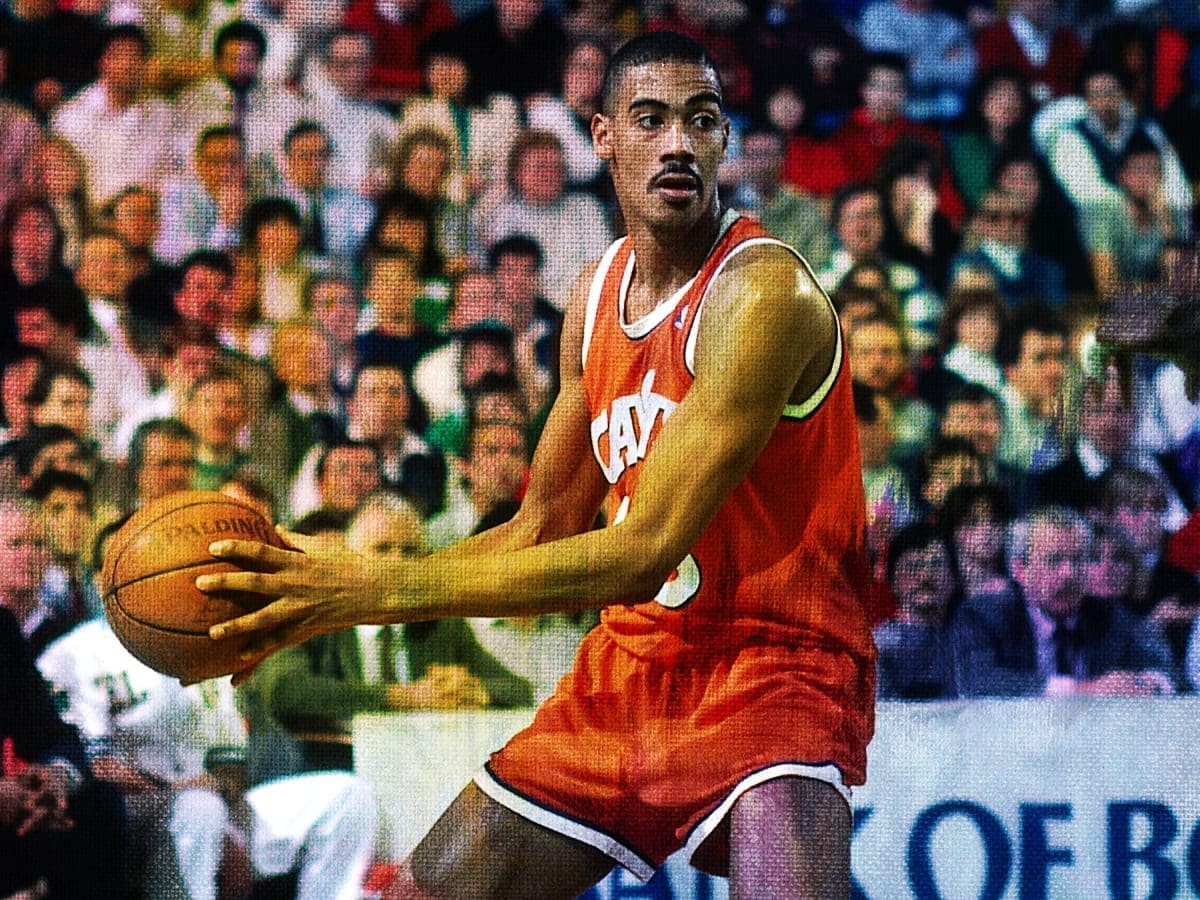
John "Hot Rod" Williams was a basketball enigma. He didn't look like a superstar, and if you just glanced at his career scoring average, you'd probably shrug. 11 points a game? Fine. Serviceable. But the raw hot rod williams stats tell a story of a guy who was, for a brief moment in 1990, the highest-paid player in the entire NBA.
Yeah, you read that right. He was making more than Michael Jordan. More than Magic Johnson.
To understand why a guy who spent most of his time coming off the bench was worth that much, you have to look past the box score. Hot Rod was the glue that held those legendary late-80s Cleveland Cavaliers teams together. He was 6-foot-11 but moved like a wing, a defensive menace who could switch onto guards and then retreat to swat a shot into the third row.
Honestly, he was basically the prototype for the modern "unicorn" big man, just 30 years too early.
The Number That Defined a Career: 1,200 Blocks
If you want to talk about his impact, you start with the defense. For nearly two decades, Hot Rod held the Cavaliers' franchise record for career blocks. He finished his time in Cleveland with 1,200 swats. It took a 7-foot-3 Zydrunas Ilgauskas years to finally catch him in 2009.
What made his shot-blocking special wasn't just the volume; it was the timing.
In the 1989-90 season, arguably his peak, he averaged 2.0 blocks per game while playing nearly 34 minutes a night. He wasn't just a rim protector. He was a versatile defender who could play the "four" or the "five."
Most people don't realize he actually played 887 career games. That’s a lot of mileage for a big man in that era. Over those 13 seasons, he maintained a career average of 1.6 blocks per game. That’s elite. You’ve got to respect the consistency.
That Mind-Blowing 1990 Contract
Okay, let's address the elephant in the room. The money.
In the summer of 1990, the Miami Heat were a young, hungry expansion team. They saw Hot Rod as the missing piece and threw a massive curveball at the Cavs: a seven-year, $26.5 million offer sheet.
- Year 1 Salary: $5 million.
- Context: Michael Jordan made $2.5 million that same year.
Cleveland matched it. They had to. Without Hot Rod, the core of Mark Price, Brad Daugherty, and Larry Nance would have crumbled defensively. While fans at the time joked he was the "richest backup in history," the internal value was undeniable.
His 1989-90 stat line justified the hype: 16.8 points, 8.1 rebounds, and 2.0 blocks. He did all that while starting only 29 games. He was the ultimate weapon off the bench, a guy who could change the geometry of the court the second he checked in.
Tulane and the "Scandal" Stats
Before the NBA, Williams was a force at Tulane. He's still 4th all-time in scoring for the Green Wave with 1,841 points. He averaged 16 points and 7 rebounds over four years.
But his college career ended in a mess. There was a point-shaving scandal that nearly ended his professional life before it started. He was eventually found not guilty, but the drama caused him to slip to the second round (45th overall) in the 1985 draft.
He didn't even play his first NBA season. He spent 1985-86 in the USBL with the Rhode Island Gulls, where he was named Player of the Year. It’s wild to think that a guy who would later be the league's highest-paid player was once a second-round "risk" playing in a minor league.
Why the Advanced Stats Love Him
If you’re a nerd for the deeper numbers, Hot Rod looks even better. His Win Shares (a stat that measures how much a player contributes to winning) totaled 70.5 for his career.
To put that in perspective, that’s higher than many All-Stars from that era.
He was incredibly efficient for a big man who didn't just camp under the hoop. He shot 48% from the field over 13 seasons. He wasn't a three-point shooter (he only made two in his entire career), but his mid-range game was solid enough to keep defenses honest.
Key Career Totals
- Total Points: 9,784
- Total Rebounds: 5,998
- Total Blocks: 1,456
- Free Throw Percentage: 72.6% (very respectable for a 6-11 guy)
He eventually moved on to the Phoenix Suns in 1995 in a trade for Dan Majerle. Even as he aged, his rebounding stayed steady. In his first year with Phoenix, at age 33, he still managed to grab 6 boards a game in limited minutes.
The Legacy of Number 18
Hot Rod Williams died in 2015 at the age of 53, taken by cancer way too soon. But his impact on the game—and specifically on the Cleveland Cavaliers—is permanent. He was inducted into the Cavs' Wall of Honor in 2019.
He wasn't flashy. He didn't have a signature shoe. He was just a guy who did the dirty work at an elite level.
When you look at hot rod williams stats, don't just see the 11 points. See the blocks. See the $26 million contract that proved how much GMs valued him. See the 13 years of being the guy nobody wanted to drive against in the paint.
Actionable Insights for Basketball Historians:
If you're researching the most undervalued players of the 90s, start with Hot Rod's defensive rating compared to other centers of the era. You’ll find that during Cleveland's 57-win season in 1991-92, the team's defensive efficiency plummeted whenever he sat. For a deeper look, compare his per-36-minute stats to modern defensive specialists like Al Horford; the similarities in versatility and "glue-guy" impact are striking.