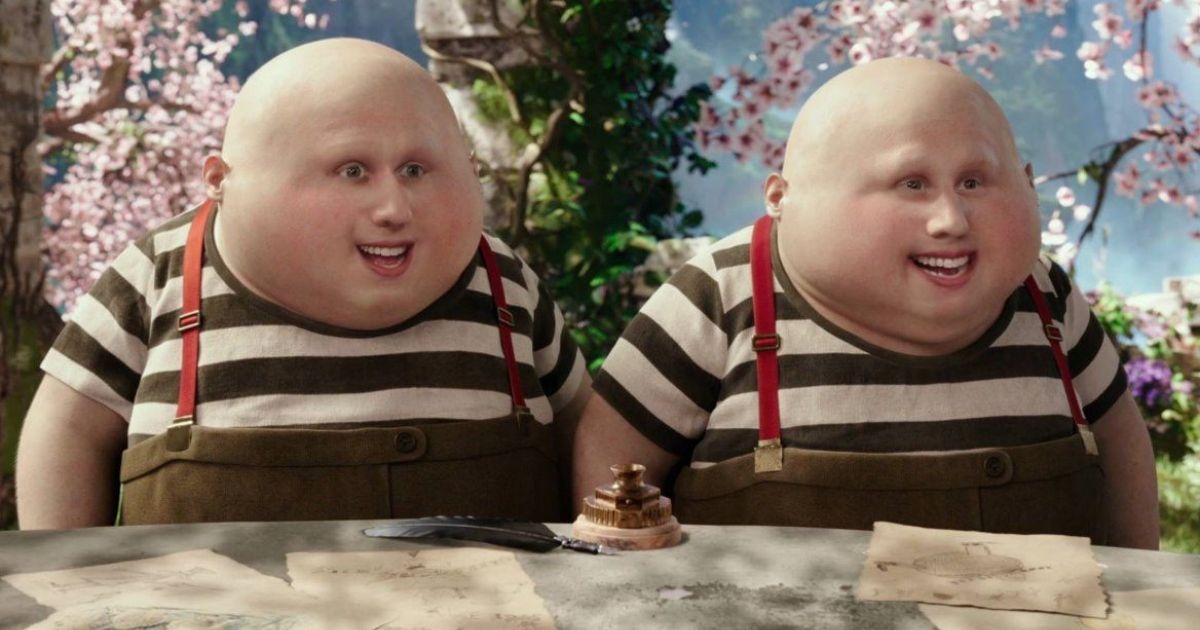
When you think about the 2010 reimagining of Alice in Wonderland, your brain probably goes straight to Johnny Depp’s neon-orange hair or Helena Bonham Carter’s literal bobblehead. But there is something deeply unsettling about the way Tim Burton Tweedle Dee and his brother were brought to life. It wasn't just a costume change. It was a complete overhaul of how we view Lewis Carroll’s classic duo.
Most people remember the animated Disney version from 1951. You know the one—two bouncy, roly-poly guys with propellers on their heads and bright red shorts. They were annoying, sure, but mostly harmless. They were basically the comic relief of the woods.
Burton didn't want that. He went in a direction that feels much more like a fever dream. Honestly, if you look closely at the CGI and the performance by Matt Lucas, you start to realize these characters aren't just goofy sidekicks. They’re weirdly tragic figures trapped in a perpetual state of infantile confusion.
The Digital Anatomy of Tim Burton Tweedle Dee
The look of the 2010 Tweedles is arguably one of the most polarizing design choices in the film. They aren't humans in suits. They are entirely digital creations, though they are built on the skeleton of British comedian Matt Lucas.
This matters.
By using one actor to play both parts, Burton leaned into the idea of "twinning" to an extreme degree. It creates this uncanny valley effect. You’ve got these massive, pear-shaped bodies and tiny little legs, topped with faces that look like they’ve seen too much but can’t quite process any of it. Their movements are jerky. It’s almost like they’re being puppeted by someone who hasn't quite figured out the controls yet.
Kinda creepy, right?
The design team, led by legendary costume designer Colleen Atwood and the VFX wizards at Sony Pictures Imageworks, went for a desaturated, monochromatic look. Gone are the bright yellows and reds. In their place, we get striped shirts that look like Victorian pajamas or old-school prison uniforms. This visual shift tells us everything we need to know: these versions of Tim Burton Tweedle Dee and Tweedle Dum aren't here to sing "How Do You Do and Shake Hands." They are part of a world that has been crushed under the thumb of the Red Queen.
Why Matt Lucas Was the Only Choice
Casting Matt Lucas was a stroke of genius. At the time, Lucas was famous for his sketch comedy work in Little Britain, where he mastered the art of playing grotesque, larger-than-life characters.
He didn't just provide a voice. He provided the "performance capture" that gave the twins their specific rhythm.
If you watch his face during their scenes, there’s a vacant stare. It’s brilliant. It captures that Lewis Carroll "nonsense" logic perfectly. The twins don't really have a linear thought process. They argue over words. They contradict each other mid-sentence. Lucas managed to make them feel like a single unit with two heads, rather than two separate people who happen to look alike.
The Subtext of Nursery Rhymes and Nightmares
People often forget that the original Tweedledee and Tweedledum weren't even from Alice’s Adventures in Wonderland. They actually show up in the sequel, Through the Looking-Glass.
Burton merged the stories.
In the 2010 film, the twins are some of the first creatures Alice meets when she returns to Underland. They are her guides, but they are incredibly unreliable ones. There’s a specific scene where they’re arguing about whether she’s the "Right Alice" or the "Wrong Alice."
This isn't just a gag.
It’s about the loss of identity. In Burton’s world, everything is decaying. The landscape is charred. The sky is a weird bruised purple. In this context, Tim Burton Tweedle Dee represents the total breakdown of logic. He can't even agree with himself—or his literal mirror image—on the basic facts of reality.
That is the essence of Burton’s "Gothic" touch. He takes something childish and finds the existential dread hiding underneath the surface. The twins aren't just funny; they’re a reminder that in Wonderland (or Underland), your own mind can be your worst enemy.
Breaking Down the Visual Effects
Let's talk technical for a second because how they made these guys is actually fascinating.
- The Teardrop Shape: The animators intentionally gave them a "teardrop" silhouette to make them feel unbalanced.
- Head Replacement: Matt Lucas wore a specialized suit, but his head was later digitally grafted onto the oversized CGI bodies.
- The Texture: If you look at high-definition stills, their skin looks almost waxy, like a doll’s.
This wasn't an accident. Ken Ralston, the Senior Visual Effects Supervisor, has talked about how they wanted the characters to feel like they didn't quite belong in the "real" world Alice comes from. They are "creatures of the imagination," and they look the part.
What Most People Get Wrong About the Twins
There’s a common misconception that the Tweedles are just there for filler. Critics often panned the 2010 movie for being "style over substance," and the twins were frequently cited as examples of "needless CGI."
But that’s a bit of a surface-level take.
If you look at the narrative structure, Tim Burton Tweedle Dee and Dum serve as the emotional tether to Alice’s childhood. They are the only ones who remember her clearly, even if they can't agree on who she is now. When they get snatched by the Jubjub Bird, it’s a genuine "oh no" moment. It’s one of the few times Alice shows real fear early in the film.
Their capture by the Red Queen’s forces also highlights the stakes. These aren't just cartoon characters who can bounce back from anything. They can be hurt. They can be imprisoned. They can be turned into "furniture" for a tyrant.
The Legacy of the Look
Since 2010, the "Burton-esque" Tweedle has become a staple of cosplay and Halloween culture. It’s a complete departure from the 19th-century John Tenniel illustrations.
Tenniel’s twins looked like grumpy, middle-aged schoolboys.
Burton’s twins look like giant, pale toddlers who might accidentally bite you.
It’s a shift from political satire (which is what Carroll was often doing) to psychological horror-lite. And honestly? It works for the 21st century. We like our fairy tales with a bit of grit. We want our childhood icons to be a little bit "off."
Comparing the 2010 and 2016 Versions
When James Bobin took over for the sequel, Alice Through the Looking Glass, he kept the design for Tim Burton Tweedle Dee and Tweedle Dum mostly intact. Why? Because you can’t really go back once you’ve established something that iconic.
However, the second film leaned more into their family dynamic. We see them as babies. We see the origin of their "twinning." Even though Burton wasn't in the director's chair for that one (he stayed on as a producer), his visual DNA was everywhere. The twins remained the weird, wobbly heart of the franchise.
How to Capture the Tweedle Vibe Today
If you're a creator or a fan trying to tap into that specific Tim Burton Tweedle Dee aesthetic, you have to focus on the contrast. It’s about the mix of the innocent and the grotesque.
- The Palette: Stick to greys, blacks, and faded whites. Avoid primary colors.
- The Proportions: Everything should be slightly "out of whack." Big heads, small shoulders, or vice versa.
- The Eyes: This is the most important part. The eyes should look like they are perpetually surprised or slightly confused.
Burton’s career has always been about the "outsider." The Tweedles are the ultimate outsiders because they don't even fit in with each other. They are a constant contradiction.
Final Thoughts on Underland's Duo
The 2010 Alice in Wonderland wasn't a perfect movie, but its character design was undeniably bold. By turning the Tweedles into pale, striped, CGI oddities, Burton managed to breathe new life into characters that were over a century old.
They aren't just a meme. They aren't just a visual gag. They are a specific manifestation of Burton's obsession with the weird and the wonderful.
Next Steps for Fans and Creators:
To truly understand the evolution of these characters, your best move is to compare the original John Tenniel sketches from the 1871 edition of Through the Looking-Glass with the 2010 film's concept art by Bobby Chiu. Look for the "hidden" details in the film—specifically the way the twins' movements are synchronized even when they aren't looking at each other. If you're looking for more behind-the-scenes depth, tracking down the "Art of Alice in Wonderland" book by Mark Salisbury is the definitive way to see how those initial sketches of Tim Burton Tweedle Dee turned into the digital icons we recognize today.
Check out the "Wonderland" exhibit if it ever tours near you; seeing the actual performance capture suits helps you appreciate the physical comedy Matt Lucas brought to a role that could have easily been "just another CGI effect."