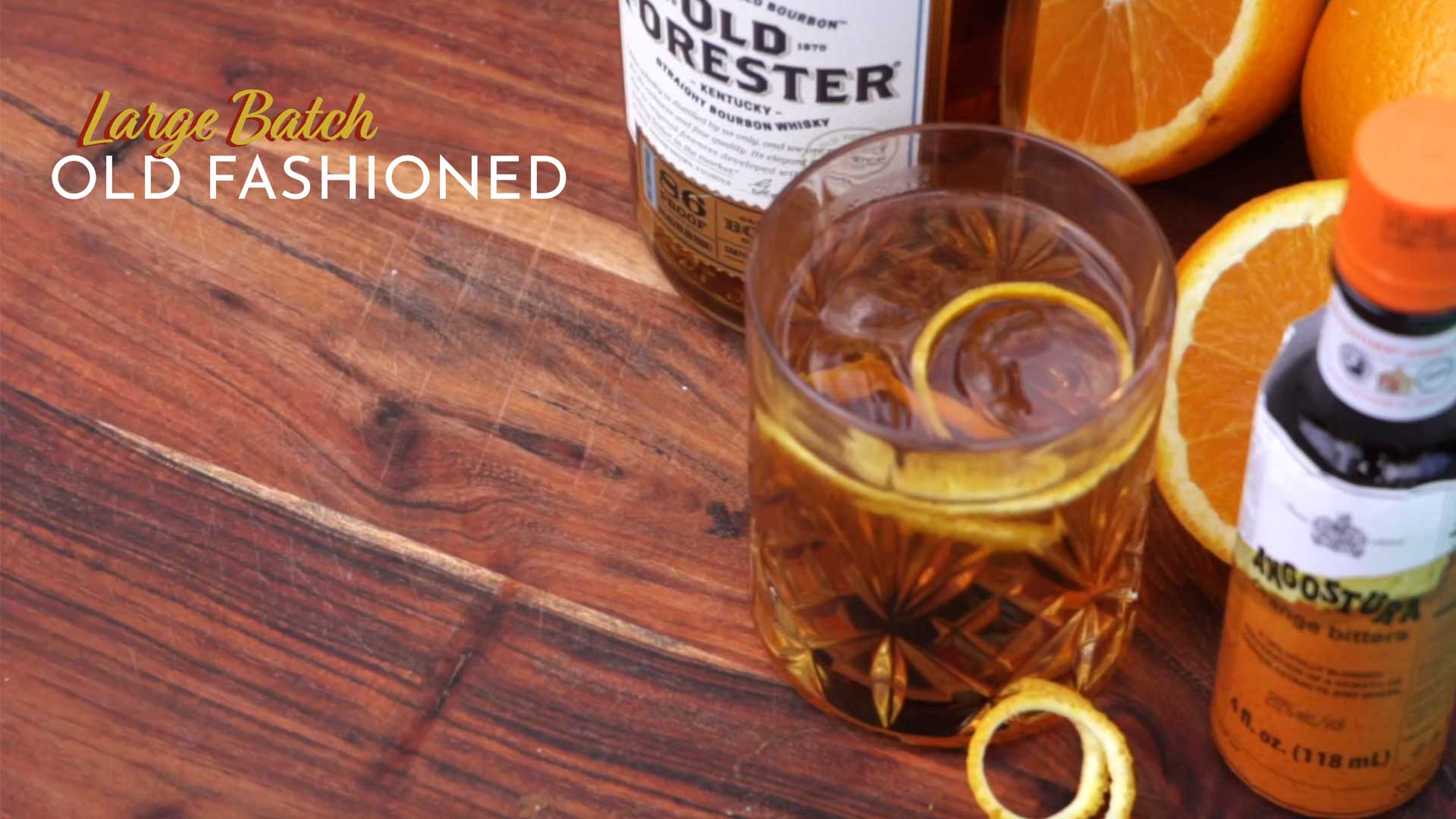
You're hosting a party. The music is perfect, the lighting is dim, and then it happens. Four people walk in and they all want an Old Fashioned. Suddenly, you aren't a host anymore. You’re a short-order cook. You’re standing there, hunched over the counter, measuring out half-teaspoons of syrup and splashing bitters while your guests talk about things you can’t hear over the sound of ice hitting a tin. It’s a mess.
This is exactly why a batch old fashioned recipe is the only way to survive hosting without losing your mind.
Most people screw this up because they think they can just multiply a single drink by twelve. They can't. If you just scale the numbers, the bitters become overwhelming, the sugar doesn’t dissolve right, and the whole thing ends up tasting like a medicinal cough syrup rather than a balanced cocktail. You have to account for dilution. You have to account for the way flavors marry over time. It’s basically chemistry, but the kind that gets you a little buzzed.
The Dilution Secret Most People Miss
Here is the thing about cocktails: water is an ingredient. When you stir a single drink, the ice melts. That melt-water—usually about 20% to 25% of the total volume—is what opens up the bourbon and softens the bite of the alcohol. If you mix a bottle of whiskey, a cup of sugar, and some bitters in a pitcher and put it in the fridge, you’re missing that water.
The result? A syrupy, high-proof punch in the face.
To fix this, we add "pre-dilution." We literally pour filtered water into the batch. This means you can pour the drink straight from the bottle into a glass over a single large ice cube, and it tastes exactly like a bartender just spent two minutes stirring it for you. It's effortless.
What You’ll Actually Need
Don’t go buying the $80 bottle of bourbon for a batch. You’re wasting money. Once you add bitters and sugar and let it sit, the nuances of a rare, small-batch toasted oak barrel-strength bourbon get a bit lost. Honestly, you want something sturdy. Something like Old Grand-Dad Bonded, Buffalo Trace, or Wild Turkey 101. You need that higher proof (100 or more) so the whiskey flavor doesn't vanish once it's diluted.
For the sugar, skip the white cubes. Use Demerara syrup. It’s got that rich, molasses-y depth that makes the drink feel expensive. You make it by heating equal parts Demerara sugar and water until the sugar dissolves. Let it cool. Don't use it hot, or you'll throw off the temperature of your whole batch.
Bitters are the "salt" of the cocktail world. For a 750ml bottle of bourbon, you’re looking at about 1 ounce (30ml) of Angostura bitters. Some people like to split this—maybe 20ml of Angostura and 10ml of orange bitters. It adds a layer of bright citrus that cuts through the oak.
The Math That Works
For a standard 750ml bottle of bourbon, follow this ratio:
- 750ml Bourbon (One full bottle)
- 3.5 to 4 ounces Demerara Syrup (Depending on how sweet you like it)
- 1 ounce Bitters (Angostura is the gold standard)
- 6 ounces Filtered Water (This is your dilution)
Basically, you just dump the bourbon into a large glass pitcher or a clean 1-liter bottle. Add the syrup and the bitters. Then, add the water. Stir it gently. Don’t shake it—this isn't a Margarita. You aren't trying to create bubbles; you're trying to create a seamless, silky texture.
Why Time Is Your Friend (And Enemy)
If you make this five minutes before guests arrive, it’ll be fine. If you make it 24 hours in advance, it’ll be incredible. When the bitters sit with the sugar and the spirit, the harsh spice notes of the cloves and cinnamon in the Angostura start to mellow out. It becomes one singular flavor rather than a list of ingredients.
However, don't add the garnishes to the batch.
I’ve seen people throw orange peels or maraschino cherries directly into the pitcher. Don't do that. The white pith of the orange peel will sit in the alcohol and leach out a deep, muddy bitterness that will ruin the drink after about four hours. Keep your garnishes separate. Express a fresh orange peel over the glass right before serving. The oils on the surface of the drink are half the experience.
The Glassware and Ice Dilemma
You’ve gone to the trouble of making a professional-grade batch old fashioned recipe, so don’t serve it in a red plastic cup. Use heavy-bottomed rocks glasses.
And for the love of everything holy, use big ice.
Small, cloudy ice from a freezer tray melts too fast. By the time your guest finishes half their drink, it’ll be watery. Large 2-inch cubes or spheres have less surface area, meaning they chill the drink without watering it down further. You already added the perfect amount of water to the batch; you don't need the ice to add more.
Common Mistakes to Avoid
- Using cheap bitters. There is no substitute for Angostura. Those "craft" bitters with weird flavors like chocolate or celery have their place, but not in a classic batch. Stick to the yellow cap.
- Ignoring the proof. If you use an 80-proof bourbon, the final drink will feel weak once diluted. Go high-proof.
- Over-sweetening. You can always add a splash more syrup to an individual glass, but you can't take it out once it's in the bottle. Start with 3 ounces of syrup and taste it before adding more.
- Using tap water. If your tap water tastes like chlorine, your cocktail will taste like a swimming pool. Use filtered or bottled water.
Jeffrey Morgenthaler, a legendary bartender and author of The Bar Book, is a huge advocate for batching. He argues that it actually produces a better drink than making them one by one because the precision is higher when you're measuring in ounces rather than dashes. It’s hard to be consistent with a "dash" of bitters. It’s very easy to be consistent with a measuring cup.
Serving the Crowd
When it’s time to serve, you just pull the bottle out of the fridge or the ice bucket. Pour about 3 to 3.5 ounces into each glass. Twist a piece of orange peel over the top, drop it in, and walk away. You’re done. You’ve just served four people in thirty seconds, and you still have a drink in your own hand.
The beauty of this method is the lack of waste. If you don't finish the batch, it stays perfectly good in the refrigerator for weeks. Because the alcohol content is so high, it won't spoil. In fact, some bars "bottle-age" their Old Fashioneds for months to develop a smoother profile.
Actionable Steps for Your Next Party
If you want to pull this off perfectly this weekend, here is your checklist:
- Buy the right bourbon: Get a 100-proof bottle. Look for "Bottled in Bond" on the label.
- Make the syrup early: Combine 1 cup Demerara sugar and 1 cup water in a pan. Heat just until clear. Chill it in the fridge for at least 3 hours before mixing.
- Find a vessel: You need something that holds at least 1.2 liters to account for the whiskey plus the water and syrup. An empty, cleaned-out 1.5L wine bottle works great if you don't have a fancy carafe.
- Measure precisely: Use a kitchen scale if you have one, or a standard liquid measuring cup. Don't eyeball the water.
- Prep the garnish: Peel your oranges before the party starts. Put the peels in a damp paper towel inside a Ziploc bag so they stay springy and oily.
- The "Final Touch" Test: Pour a small taster over ice an hour before the party. If it feels too sharp, add another half-ounce of syrup. If it feels too thick, add a splash more water.
Batching is about reclaiming your time. It transforms you from a frantic bartender back into a guest at your own party. Once you start doing it, you'll never go back to muddling sugar cubes one by one ever again.