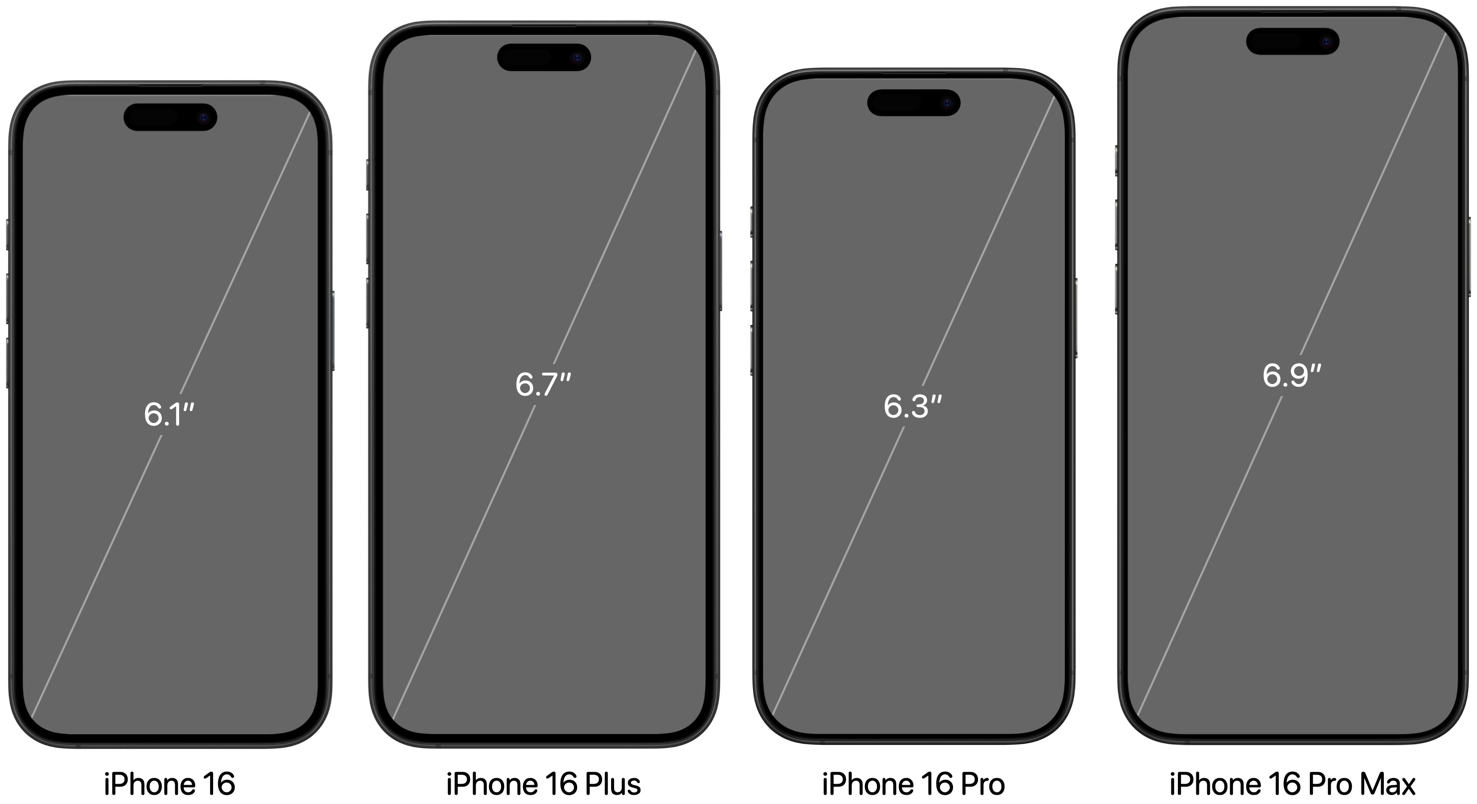
Size is personal. Honestly, when Apple dropped the iPhone 16 lineup, the chatter wasn't just about the new "Camera Control" button or the faster chips. It was about the physical footprint. We’ve hit a weird point in smartphone history where "big" got even bigger, but "small" stayed exactly the same. If you’re looking at the iPhone 16 different sizes, you’re essentially choosing between a device that disappears into your pocket and a slab of glass that feels like a mini movie theater.
It’s confusing.
Apple didn't just scale everything up uniformly. They played a game of millimeters with the Pro models while keeping the standard ones tethered to the past. You've got four distinct models, but they fall into two very different camps of ergonomics.
The big shake-up in iPhone 16 different sizes
For years, we were stuck in a loop. The Pro and the regular model were both 6.1 inches. The Plus and the Max were both 6.7 inches. That’s dead now.
Apple decided the Pro users wanted more "pro" surface area. So, they bumped the iPhone 16 Pro up to 6.3 inches and the iPhone 16 Pro Max to a staggering 6.9 inches. This is the largest iPhone ever made. Period. Meanwhile, the base iPhone 16 and the iPhone 16 Plus stayed exactly where they were last year—6.1 and 6.7 inches, respectively.
It feels like a tiered system now. If you want the biggest screen, you have to go Pro. If you want a "normal" sized phone that doesn't stretch your thumb to the breaking point, the standard 16 is your best bet.
Why 0.2 inches actually matters
You might think a 0.2-inch increase is a marketing gimmick. It isn't. When you hold the 6.3-inch iPhone 16 Pro next to the 6.1-inch base model, the difference is immediate. It’s not just the screen; it’s the weight. The Pro models use Grade 5 Titanium, which is light, but the denser internals and larger batteries make them feel significantly more substantial than the aluminum standard models.
The 6.1-inch iPhone 16: The "Goldilocks" zone?
The base iPhone 16 remains the most approachable of the iPhone 16 different sizes. It weighs about 170 grams. That’s light. It’s the kind of phone you can use with one hand while holding a coffee or a subway pole. Because the dimensions are 147.6mm by 71.6mm, it fits into most jeans pockets without peeking out.
But there’s a trade-off.
The screen is "only" 60Hz. In 2026, that feels a bit sluggish if you’re used to the high-refresh rates of the Pro. But for someone coming from an iPhone 12 or 13? It feels like home. It’s a familiar shape. No learning curve for your muscles.
Understanding the Pro Max "Gigantism"
The iPhone 16 Pro Max is a beast. 6.9 inches. To make this work without turning the phone into a tablet, Apple shrunk the borders—the "bezels"—to record-breaking levels. They are incredibly thin.
- Height: 163mm
- Width: 77.6mm
- Weight: 227 grams
Let’s be real: this is a two-handed device for most people. If you have smaller hands, reaching the top corners is impossible without using the "Reachability" shortcut or shifting your grip constantly. However, the sheer real estate for editing 4K video or playing Resident Evil is unmatched. It’s basically a handheld computer.
The iPhone 16 Plus: The overlooked middle child
The Plus is an interesting bird. It shares the 6.7-inch screen size with the old Pro Max models but weighs much less (around 199 grams). It’s for the person who wants a massive screen for TikTok and Netflix but doesn't want to carry a literal brick in their pocket. It’s thinner and lighter than the Pro Max because it lacks the heavy triple-camera system and the massive heat sinks.
The Ergonomics of the New Camera Control Button
Here is something nobody talks about: the placement of the buttons relative to the size. On the iPhone 16 different sizes, the new "Camera Control" (that sapphire crystal-covered button on the right side) is positioned in the same relative spot.
On the 6.1-inch model, your index finger (if you're holding it horizontally) or your thumb (vertically) hits it perfectly.
On the 6.9-inch Pro Max? It’s a stretch. If you have average-sized hands, you might find yourself shuffling the phone just to zoom in or out using the button's haptic slide feature. Size affects how you use the "new" features, not just how you see the screen.
Comparison of Dimensions
| Model | Screen Size | Height | Width | Weight |
|---|---|---|---|---|
| iPhone 16 | 6.1" | 147.6mm | 71.6mm | 170g |
| iPhone 16 Plus | 6.7" | 160.9mm | 77.8mm | 199g |
| iPhone 16 Pro | 6.3" | 149.6mm | 71.5mm | 199g |
| iPhone 16 Pro Max | 6.9" | 163.0mm | 77.6mm | 227g |
You’ll notice the iPhone 16 Pro is actually narrower than the base iPhone 16, despite having a larger screen. This is thanks to those tiny bezels. It’s taller, but thinner. This makes it feel "sleek" rather than "big."
Real-world usage: Which size wins?
If you spend four hours a day on your phone, the 6.9-inch screen is a godsend for your eyes. Less squinting. More text on the screen. Better for reading long-form articles or spreadsheets.
But if you’re an active person? The 6.1-inch or 6.3-inch models are the winners. They don't flop around in gym shorts. They don't fall out of your car's cup holder as easily.
There's also the "pocketability" factor. Tight jeans and a 16 Pro Max don't mix. It’s a recipe for a bent frame or a very uncomfortable walk. Most women’s clothing, which notoriously has tiny pockets, can barely accommodate the 6.1-inch model, let alone the 6.9-inch titan.
Battery life is tied to size
You can't talk about iPhone 16 different sizes without talking about juice.
- Small Body, Small Battery: The 6.1-inch 16 has the smallest physical battery. It’ll get you through a day, but don't expect miracles if you're using GPS and 5G all afternoon.
- The Sweet Spot: The 16 Pro (6.3") has a surprisingly decent battery because the A18 Pro chip is so efficient, but it’s still not the king.
- The Endurance Kings: The 16 Plus and the 16 Pro Max are the marathon runners. Because the chassis is so big, Apple shoved massive batteries inside. For many, the choice isn't about screen size—it's about not needing a charger at 6 PM.
How to choose the right one for you
Don't just look at the specs. Go to a store. Hold them. But if you can't, here is the shorthand logic:
Get the 6.1-inch iPhone 16 if: You hate bulky tech, you have smaller hands, or you want the lightest possible device. It’s the most "invisible" phone in the lineup.
Get the 6.3-inch iPhone 16 Pro if: You want the best technology (120Hz, Pro cameras) but you still want to be able to use your phone with one hand most of the time. It’s the enthusiast's choice.
Get the 6.7-inch iPhone 16 Plus if: You want the "Big Screen Experience" but you don't care about the Pro's fancy cameras or titanium. It’s the best value for media consumers.
Get the 6.9-inch iPhone 16 Pro Max if: You use your phone as your primary computer, you play high-end games, or you have large hands and want the absolute maximum battery life possible.
The hidden cost of size: Accessories
One last thing people forget. Cases and screen protectors. If you’re upgrading from an iPhone 15 Pro (6.1") to an iPhone 16 Pro (6.3"), your old cases will not fit. The phone is physically taller. The button placement for the Camera Control also requires a specific cutout.
Larger phones also mean more expensive screen protectors and often more expensive cases. Even your car mount might struggle with the width of the Pro Max if it’s an older spring-loaded model.
Final Steps for Your Purchase
Before you pull the trigger on a specific size, do these three things:
- Measure your current phone: Compare your current device’s height and width to the table above. A 2mm difference in width sounds small, but it changes how your palm wraps around the edge.
- Check your "Screen Time" stats: If you’re averaging 5+ hours, your eyes will thank you for the 6.7" or 6.9" panels. If you're a "quick glance" user, stay small.
- Test the "Reachability" feature: Go to an Apple Store and try to swipe down from the top right corner on the Pro Max. If you have to use your second hand every single time, you might find the size frustrating within a week.
Choosing between the iPhone 16 different sizes is ultimately a trade-off between portability and capability. Apple has made the gap wider this year by physically changing the Pro dimensions. Make sure you're picking the one that fits your lifestyle, not just the one that looks the coolest on the spec sheet.