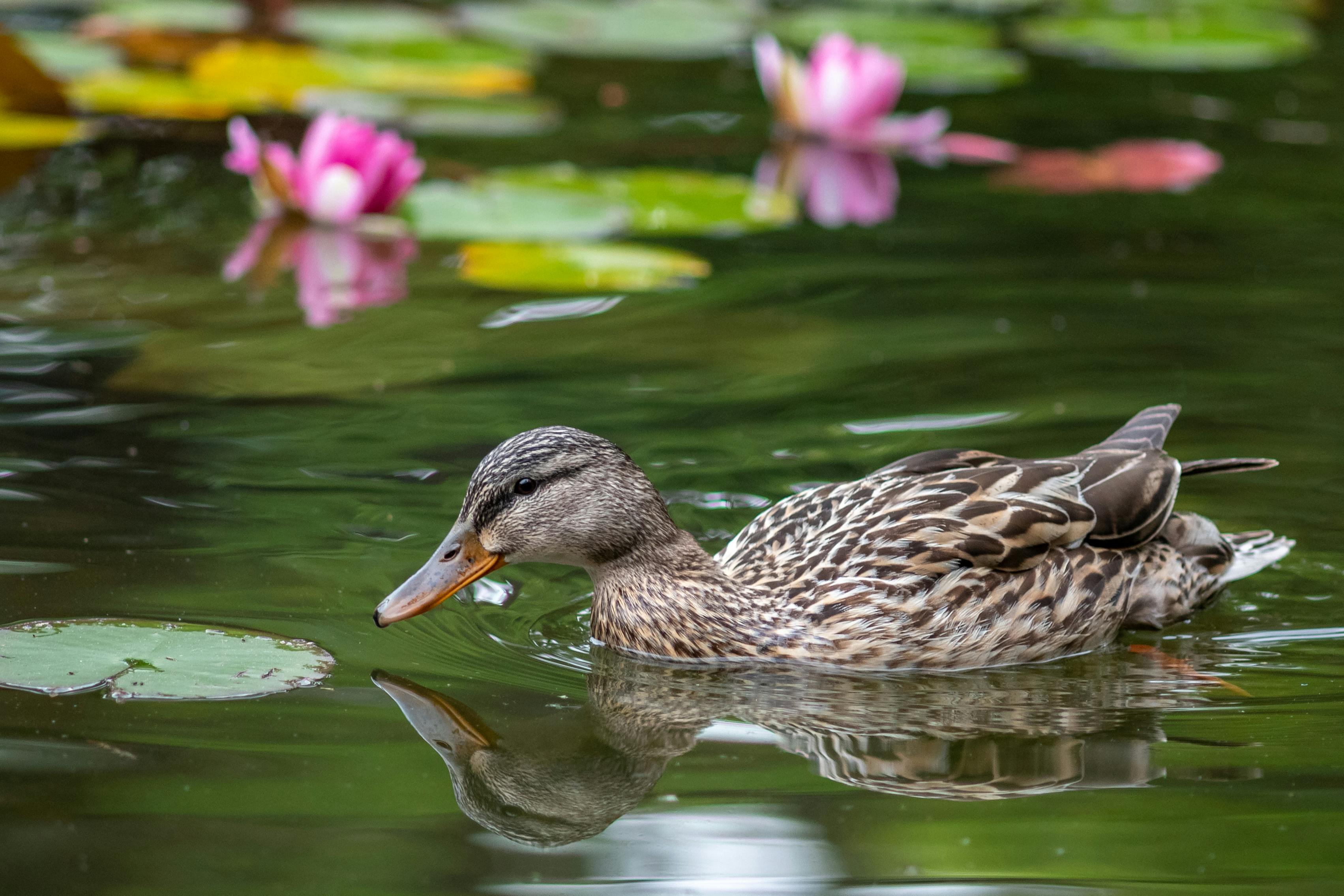
When British scientists first laid eyes on a preserved platypus skin sent from Australia in 1799, they literally thought it was a prank. George Shaw, a botanist and zoologist at the British Museum, actually took scissors to the pelt. He was certain some clever taxidermist had sewn a duck's beak onto a beaver's body just to mess with him. It’s hard to blame the guy. Even today, asking is a duck billed platypus a mammal feels like a trick question because this animal refuses to follow the "mammal starter pack" rules we all learned in grade school.
It has fur like a mole. It has a bill like a bird. It has venomous spurs like a snake. Oh, and it lays eggs.
Despite the chaos of its anatomy, the answer is a definitive yes. The Ornithorhynchus anatinus is a mammal, though it belongs to a very exclusive, very weird club called monotremes. These are the evolutionary outliers that survived while the rest of the mammalian world moved toward live births. If you feel confused by that, you’re in good company—the scientific community spent nearly a century arguing over how to classify this thing.
Why the Platypus Breaks Every Rule in the Book
Biology likes neat boxes. Mammals are supposed to have hair, produce milk, and give birth to live young. Reptiles lay eggs. It’s simple, right?
Not for the platypus.
The primary reason we classify it as a mammal is its mammary glands. While it doesn't have nipples—instead, it literally "sweats" milk out of pores in its skin for the puggles (yes, baby platypuses are called puggles) to lap up—the biological intent is the same. It produces nutrient-rich milk to feed its offspring. That is the golden ticket into the mammalian class.
But the contradictions are staggering. Unlike almost every other mammal on the planet, the platypus has a cloaca. This is a single opening for both waste and reproduction, a trait it shares with birds and reptiles. In fact, the word "monotreme" literally means "single hole."
It gets weirder. Most mammals have a pair of sex chromosomes (XX or XY). The platypus has ten. You read that right. Five X and five Y chromosomes determine its sex, some of which actually share genetic sequences with birds. When you look at its genome, it’s a mosaic. It’s as if nature took the blueprints for three different animal classes and threw them into a blender.
The "Leaking Milk" Mystery and Other Evolutionary Oddities
If you were to see a mother platypus nursing, you wouldn't see a traditional feeding session. Because they lack nipples, the milk pools in grooves on their abdomen. This seems inefficient, yet it has worked for millions of years.
Honestly, the platypus is a living fossil. It diverged from the main mammalian lineage about 166 million years ago. While our ancestors were developing placentas and more "modern" ways of raising young, the platypus ancestors stayed in their lane, chilling in the freshwater streams of what would become Australia.
Electroreception: The Sixth Sense
Another reason people struggle with the question is a duck billed platypus a mammal is how it hunts. It doesn't use sight or smell underwater. When a platypus dives, it shuts its eyes, ears, and nostrils tight. It becomes functionally blind and deaf.
So how does it find shrimp and crawfish in the muck?
It uses electroreception. Its bill is packed with thousands of sensitive cells that detect the tiny electrical impulses generated by the muscular contractions of its prey. This is a trait commonly found in sharks and some fish, but in the world of mammals, it’s incredibly rare. Only the platypus and the echidna (another monotreme) have mastered this. It’s essentially a biological metal detector attached to its face.
The Venom Factor: Why You Shouldn't Pet One
We usually think of venom as a reptile or insect trait. Think cobras or scorpions. But the male platypus is one of the few venomous mammals on Earth. It has calcified spurs on its hind ankles connected to a venom gland.
While the venom isn't usually lethal to humans, it is excruciating.
Dr. Bryan Fry, a renowned venom expert at the University of Queensland, has described the pain as "immediate" and "intense." It’s also resistant to morphine. People who have been spurred often report that the pain can last for weeks, or even turn into a long-term hypersensitivity to pain. The venom production peaks during the breeding season, suggesting it's less about hunting and more about dudes fighting over territory and mates. It’s a very aggressive way to handle a dating life.
Egg-Laying Mammals: A Genetic Time Capsule
The fact that they lay eggs is the biggest hurdle for most people. When the female platypus is ready to give birth, she retreats into a deep burrow and lays one to three leathery eggs, similar to those of a lizard. She curls her tail around them to keep them warm.
Ten days later, the puggles hatch.
They are born tiny, blind, and hairless, looking more like pink jellybeans than actual animals. This reproductive strategy is a glimpse into the past. It shows us what the very first mammals were likely doing before the evolution of the uterus and the placenta. We didn't just "spawn" live-birth babies; there was a middle ground, and the platypus is the last major sentinel of that era.
The Survival of the Weirdest
For a long time, people thought the platypus was an evolutionary dead end. They assumed it was "primitive" and would eventually go extinct because it wasn't as advanced as placental mammals.
That turned out to be totally wrong.
The platypus is an apex predator in its niche. It is perfectly adapted to the river systems of Eastern Australia and Tasmania. It has a thick, waterproof coat that traps a layer of air to keep it warm in freezing water—a coat so dense that it has about 600 to 900 hairs per square millimeter.
However, they aren't invincible. Climate change, damming of rivers, and plastic pollution are hitting them hard. Because they are so specialized, they can't just move to a new pond if their home dries up or becomes polluted. In 2020, researchers from the University of New South Wales pushed for the platypus to be listed as "vulnerable" because their habitat is shrinking rapidly.
How to Help and What to Know Next
If you're fascinated by the fact that the platypus is a mammal, the best thing you can do is support riparian (riverbank) conservation. These animals depend on healthy, flowing water and stable banks to dig their burrows.
- Avoid using "yabby traps" or enclosed nets in Australian waterways, as these frequently drown platypuses.
- Support the Australian Conservation Foundation or the Australian Platypus Conservancy. They do the heavy lifting in monitoring populations.
- Spread the word. The more people realize how unique these creatures are, the more political will there is to protect their habitats.
The platypus isn't a "mistake" or a "joke." It is a specialized, venomous, egg-laying, milk-sweating masterpiece of evolution. It reminds us that nature doesn't have to follow the rules of a textbook to be successful. It just has to survive.
To truly understand the platypus, you have to stop looking at it as a "half-bird" or "half-reptile." It is 100% mammal, just a version of a mammal that we aren't used to seeing. It's a reminder that the world is much weirder than we think, and that's probably a good thing.
The next time someone asks you about the platypus, tell them it’s the ultimate survivor. Tell them about the milk pores and the electric bill. And definitely tell them to stay away from the spurs.
For those looking to see them in the wild, the best spots are currently in the Eungella National Park in Queensland or the hidden creeks of the Otway Ranges in Victoria. Just remember to keep your distance and keep the water clean. They’ve been here for 160 million years; it would be a shame if we were the ones to end that streak.