If you drive about seventeen miles southwest of Mount Rushmore, the pine-thick horizon of the Black Hills shifts. Suddenly, a massive granite arm reaches out from the side of Thunderhead Mountain. It’s huge. Honestly, the scale is hard to wrap your head around until you're standing at the base looking up at a face that is nine stories tall. But the first thing almost every visitor asks when they pull into the gravel lot is: is Crazy Horse monument done yet?
The short answer is no. Not even close.
It’s been over seventy-five years since the first blast of dynamite echoed across Custer County in 1948. Since then, the project has become a strange mix of architectural marvel, slow-motion art piece, and a lightning rod for controversy. You’ve probably seen the posters or the old postcards showing what it’s supposed to look like—a warrior on a charging horse, pointing toward the lands where his dead lie buried. Right now, though? It’s mostly just the face and the rough outline of that outstretched arm.
The Vision vs. The Reality of the Mountain
Korczak Ziolkowski, the original sculptor, didn't start this on a whim. He was invited by Lakota Chief Henry Standing Bear. The Chief famously wrote to Korczak, saying, "My fellow chiefs and I would like the white man to know that the red man has great heroes, too." That’s the emotional core of the whole thing.
But here is the thing about carving a mountain: granite is stubborn.
The project is massive. To give you some perspective, the four heads on Mount Rushmore could basically fit inside Crazy Horse’s hair. We are talking about a finished statue that will be 641 feet long and 563 feet high. Because of that scale, progress feels glacial to the casual observer. People visit in the 90s, come back in 2024 or 2025, and feel like nothing has changed.
That isn't true, of course.
The work has shifted from "big blasts" to precision engineering. For a long time, the focus was entirely on the face, which was dedicated in 1998. Since then, the crew has been obsessing over the "thinning" of the hand and the top of the horse's head. They use thermal torching now—essentially giant blowtorches that flake off the rock—rather than just blowing chunks of the mountain into the valley. It’s slower. It’s safer. It’s infinitely more detailed.
Why hasn't it been finished?
Money is the obvious hurdle, but maybe not for the reasons you think. The Crazy Horse Memorial Foundation famously refuses all federal or state funding. They’ve turned down millions of dollars from the government multiple times. Why? Because Korczak believed that if the government paid for it, they’d eventually take it over, change the vision, or just abandon it when the political winds shifted.
So, the whole thing is funded by admissions and private donations.
There’s also the sheer technical nightmare of the rock itself. Geologists have found "vugs" or pockets of air and soft rock inside the mountain that Korczak couldn't have seen with 1940s technology. Every time they hit a bad patch of stone, the plans have to shift. You can’t just glue granite back on once it’s gone.
The transition of leadership
When Korczak died in 1982, he left behind detailed books and "blueprints" carved into the walls of his studio. His wife, Ruth, took over and made a pivotal executive decision: finish the face first. Originally, Korczak wanted to work on the horse, but Ruth knew that if people couldn't see a human face, they’d stop donating. She was right. The face gave the project a soul.
Now, the next generation of the Ziolkowski family and a board of directors run the show. They aren't just building a statue; they’re building a campus. There’s a massive museum, a university, and a medical training center for Native Americans. Some critics argue this "mission creep" has distracted from the mountain carving. If you ask the foundation, they’ll tell you the carving is just one part of a larger promise to the Lakota people.
The controversy you won't see in the brochure
Is the monument actually "Native American"? That depends on who you ask.
While Henry Standing Bear initiated the project, many Lakota people today aren't fans. Some see it as a second desecration of the Black Hills—which are sacred ground—following the carving of Mount Rushmore. Others point out that Crazy Horse himself was a man of extreme humility. He never allowed his photograph to be taken. He didn't want to be "owned" by a likeness.
The idea of carving a 500-foot statue of a man who hated being photographed is, to some, a massive irony.
Then there’s the aesthetic critique. Lame Deer, a famous Lakota holy man, once joked that the monument turned a beautiful mountain into a "man-made stone pile." It’s a complicated legacy. You have to weigh the educational benefits of the Indian Museum of North America, which is on-site and genuinely excellent, against the physical alteration of the landscape.
What is happening on the mountain right now?
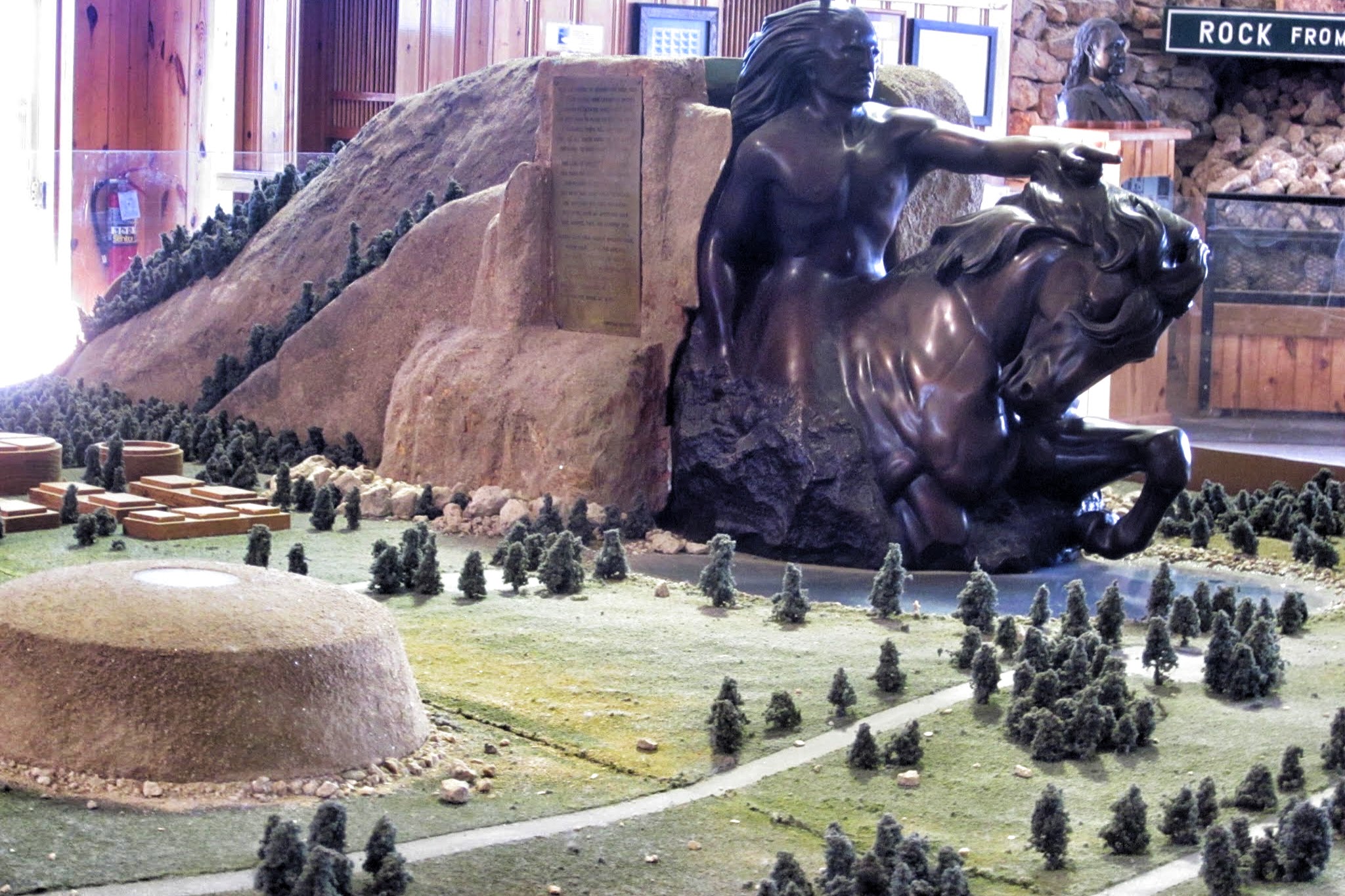
If you visit today, you’ll see the crew focusing on the horse's mane and the outstretched arm. They are using sophisticated 3D laser scanning to map the mountain. This allows them to compare the current rock face to Korczak's 1/34-scale model with millimeter precision.
Current technical milestones:
- The Finger: Work is progressing on the pointing finger, which is roughly 25 feet long.
- The Arm: Specifically, the "underpart" of the arm is being cleared to create the void between the man and the horse.
- The Horse's Head: This is the next "big reveal." Once the horse's head starts to take shape, the visual impact of the monument will double.
Don’t expect a ribbon-cutting ceremony anytime soon. There is no official completion date. If you press the staff for a timeline, they’ll usually just smile and say it depends on the weather, the money, and the mountain. Some estimates suggest it could take another 50 to 100 years to finish the horse.
How to visit without being disappointed
If you go there expecting a finished product like the Lincoln Memorial, you’re going to be annoyed. You have to view Crazy Horse as an active construction site. It’s performance art on a geological scale.
The best way to see it is to take the bus trip to the base of the mountain. It costs a few extra bucks, but standing at the "toe" of the mountain looking up gives you a sense of the sheer audacity of the project. You can see the drill marks. You can hear the heavy machinery. It feels alive in a way that the static faces of Mount Rushmore don't.
Also, check out the laser light show at night. It’s a bit touristy, sure, but it uses the mountain as a screen to project what the finished carving will look like. It helps bridge the gap between the gray rock you see during the day and the vision Korczak had in 1948.
Practical Steps for Travelers
If you’re planning a trip to the Black Hills to see if the is Crazy Horse monument done question has a new answer, keep these things in mind:
- Timing is everything. The mountain is in a high-altitude environment. Fog can roll in and completely obscure the carving. Check the local Custer, South Dakota weather forecast before paying the entrance fee.
- Budget for the "extra" experiences. The base admission gets you into the museums and the viewing deck. If you want to go up onto the arm (the "Vanishing Point" tour), it requires a much larger donation (usually around $125 or more). It’s expensive, but it’s the only way to stand next to the face.
- Respect the culture. Take time to walk through the Indian Museum of North America. It houses artifacts from dozens of nations, not just the Lakota. It provides the context that the rock carving alone can't give you.
- Visit both "Big Carvings." Do Mount Rushmore in the morning and Crazy Horse in the afternoon. They are polar opposites. One was a government-funded project completed in 14 years; the other is a private, multi-generational marathon. Seeing them both in one day highlights the weird, wonderful, and complicated history of the American West.
The monument may not be "done" in our lifetime, or even our children’s. But that’s almost the point. It’s a testament to a specific kind of stubbornness—the idea that some things are worth doing even if you’ll never see the end result. Whether you think it’s a masterpiece or a mistake, you can’t deny that it’s one of the most ambitious things humans have ever tried to do with a pile of rocks.
Next Steps for Your Trip
To make the most of your visit to the Black Hills, start by monitoring the official Crazy Horse Memorial webcam. This gives you a real-time view of the current work zones and weather conditions on Thunderhead Mountain. Next, look into the "Volksmarch" dates; twice a year, the memorial allows the public to hike up the mountain and stand on the arm of the carving. These events are usually held in early June and late September and offer the only opportunity to walk on the monument without a high-level donor pass. Finally, if you are interested in the technical side, visit the Mountain Museum on-site to see the actual equipment used by Korczak Ziolkowski in the early days of the project.