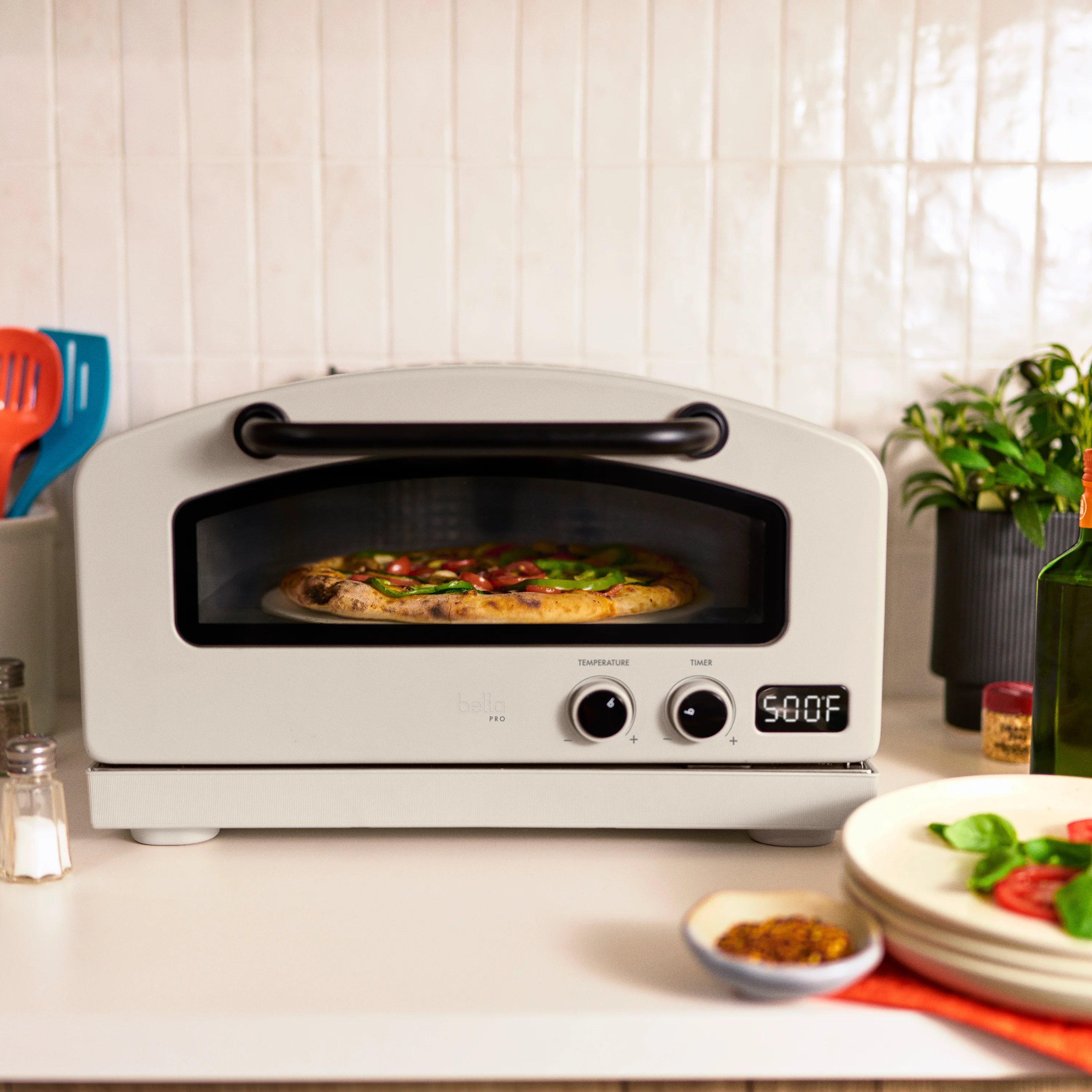
You want a pizza. Not a soggy, delivery-box mess that tastes like cardboard and regret, but a real, blistered-crust masterpiece. Most people think they need a massive $900 wood-fired rig in the backyard to get that. Then they see the Bella Pro Pizza Oven sitting on a shelf at Best Buy for a fraction of that price and wonder if it’s a toy or a tool.
Honestly, it’s a bit of both.
The Bella Pro Series 12" Pizza Oven has carved out a weird, specific niche in the kitchen gadget world. It’s an indoor electric unit that claims to hit temperatures your standard wall oven could only dream of. We’re talking about a jump from the standard 500°F max to a blistering 800°F. That difference is everything. It's the gap between "baked dough" and "authentic Neapolitan char." But let’s be real: high heat in a compact kitchen appliance usually comes with a learning curve that can frustrate even a seasoned home cook.
What the Bella Pro Pizza Oven Gets Right (and Wrong)
Most electric ovens are boring. This one looks like something out of a retro-future diner with its stainless steel finish and chunky dials. It’s heavy. It feels substantial. When you unbox it, you realize this isn't just a glorified toaster oven.
The heating elements are the star here. You’ve got top and bottom heating, which is crucial because pizza is a game of thermodynamics. You need the stone to be screaming hot to crisp the base, but you need the ambient air temperature to be high enough to melt the cheese and puff the crust before the bottom turns into charcoal.
Does it actually hit 800 degrees?
Mostly. If you give it a solid 20 to 30 minutes to preheat, the stone temperature gets impressively high. However, there’s a catch. Like many affordable electric ovens, the recovery time is a factor. You slide one pizza in, it cooks in about six minutes, but if you immediately slide a second one in, the stone has lost its heat. You’ve got to wait. Patience is a requirement here, not a suggestion.
The Power of the 12-Inch Stone
Size matters. A 12-inch pizza is the standard "personal" size, but in a small oven, it leaves very little room for error. If your launch is slightly off-center, you’re hitting the heating elements or the back wall.
One thing that genuinely surprises people is the smoke. This is a high-heat machine. If a piece of pepperoni falls off or a bit of flour catches fire on the stone, your kitchen will smell like a campfire. It's not a defect; it's physics. You need a vent hood or a window nearby. Don't say nobody warned you.
Comparing the Bella Pro to the Big Names
When people look at the Bella Pro Pizza Oven, they are usually comparing it to the Ooni Volt 12 or the Breville Smart Oven Pizzaiolo. Those units cost between $800 and $1,000. The Bella is often found for under $150 on sale.
That price gap is massive.
The Breville uses "Element iQ" technology and fancy sensors to mimic a wood-fired environment. It’s smart. It’s precise. The Bella is... manual. It’s basically a box with two very hot sticks of fire inside. You are the computer. You have to watch that pizza like a hawk. There is no "set it and forget it" here. If you look away for 30 seconds, you might find a blackened disc of disappointment.
But here’s the thing: for the price of one Breville, you could buy five Bellas. For someone just starting their pizza journey, the lower entry price makes the inevitable "first-timer burnt crust" much easier to swallow.
Why the Dough Matters More Than the Oven
People blame their ovens for bad pizza. Usually, it's the dough.
If you take a standard grocery store dough ball and throw it into an 800-degree Bella Pro, it might fail. Why? Because those doughs often contain sugar or oil. At extreme temperatures, sugar burns instantly. You end up with a bitter, black crust and raw middle.
To really make this oven sing, you need a high-hydration Neapolitan-style dough. Just flour, water, salt, and yeast. That’s it. Ken Forkish, author of Flour Water Salt Yeast, emphasizes that the "soul" of the pizza is in the fermentation. When you use a long-fermented dough in the Bella, the high heat causes the gases in the dough to expand rapidly—a phenomenon called "oven spring." This creates those beautiful airy bubbles in the crust.
The Technical Specs You Actually Need to Know
Let’s look at the guts of the machine without the marketing fluff.
The unit pulls about 1500 to 1800 watts. If you have it on the same circuit as your microwave and try to run both, you will trip a breaker. Trust me. It uses a corded electric plug, obviously, and features a viewing window. That window is your best friend.
The temperature controls are separate for the top and bottom. This is a pro-level feature hidden in a budget machine. If your cheese is browning too fast but the bottom is pale, you turn down the top dial. It gives you a level of granular control that most cheap ovens lack.
- Temperature Range: Up to 800°F (427°C)
- Preheat Time: 15-20 minutes for the air, 30 minutes for the stone
- Capacity: 12-inch pizzas
- Material: Stainless steel housing with a removable pizza stone
The stone itself is cordierite. It’s durable and handles thermal shock well, but it’s porous. If you spill sauce on it, it will stain forever. Embrace the stains. They are a badge of honor.
Common Pitfalls and How to Avoid Them
The biggest mistake? The "Launch."
Launching a pizza from a peel into a hot oven is a high-stress event. If the dough sticks to the peel, you end up with a "pizza calcification"—a crumpled heap of ingredients at the back of the oven.
Use semolina flour or parchment paper. Purists hate parchment paper, but if it's your first time, it's a lifesaver. Just pull the paper out after the first 60 seconds once the crust has set.
Another issue is the "cold spot." No matter how good the oven is, electric elements have hot and cold zones. You must rotate the pizza. About halfway through the cook, get your turning peel in there and give it a 180-degree spin. If you don't, one side will be scorched while the other looks like it's still thinking about getting warm.
Cleaning and Maintenance
Don't use soap. Ever.
The pizza stone is like a cast-iron skillet. Soap will soak into the pores and make your next ten pizzas taste like Dawn dish detergent. If you have stuck-on bits, crank the oven to max heat for 20 minutes to carbonize the debris, then scrape it off with a metal spatula once it cools.
The exterior is stainless steel, so it fingerprints easily. A quick wipe with a damp cloth is usually enough. Just make sure the unit is completely unplugged and cold before you go poking around the heating elements.
Is It a Lifestyle Upgrade?
The Bella Pro Pizza Oven changes how you entertain. It’s not just an appliance; it’s an activity. Instead of ordering three large pizzas for a Friday night, you set out bowls of toppings and let everyone make their own.
It’s tactile. It’s messy. It’s fun.
But it’s also a commitment. This isn't a "toss a frozen pizza in" kind of machine—though it can cook a frozen pizza better than your big oven can. It’s for the person who wants to geek out over hydration percentages and flour types. It’s for the person who doesn't mind a little smoke in the kitchen in exchange for a crust that actually crunches.
Real Talk: The Durability Question
Because this is a more affordable unit, some users have reported issues with the thermostat over long-term use. It’s important to remember that these are consumer-grade appliances, not commercial deck ovens. If you are running a pop-up pizza shop out of your kitchen and firing 50 pizzas a night, the Bella will likely give up the ghost.
But for a family of four having a pizza night once a week? It’s built well enough for that.
Final Verdict on the Bella Pro
If you have the counter space (it’s bulky) and you have the patience to learn the quirks of high-heat baking, it’s a steal. You get 90% of the performance of a high-end electric pizza oven for about 20% of the cost.
It’s not perfect. The timer is basic, the exterior gets very hot to the touch, and it requires a bit of "babysitting" during the cook process. But the results—the actual pizza—can be stunningly good. We are talking restaurant-quality results in a suburban kitchen.
Actionable Next Steps for New Owners
- Buy a Digital Infrared Thermometer: Don't trust the dials on the front. Point a laser at the stone. When it hits 750°F, you are ready to launch.
- Master the 24-Hour Cold Ferment: Mix your dough the day before. Let it sit in the fridge. The flavor development and the way it chars in the Bella will be night and day compared to fresh dough.
- Get a Metal Turning Peel: The oven is small. A large wooden peel is great for the launch, but you need a small, circular metal peel to rotate the pizza mid-cook without losing all your heat.
- Start Simple: Your first pizza should just be sauce and cheese. Don't load it with heavy toppings. Heavy toppings lead to soggy middles, especially when you're still learning how the heat cycles in this specific oven.
- Manage Your Power: Ensure the oven is plugged directly into a wall outlet, not an extension cord. High-wattage heating elements need a stable power draw to maintain those high temperatures.
The journey to the perfect slice is a rabbit hole. The Bella Pro Pizza Oven is just the gateway. Once you see that first crust bubble up and char, there’s no going back to delivery. Take the leap, watch your eyebrows around the heat, and start stretching that dough.