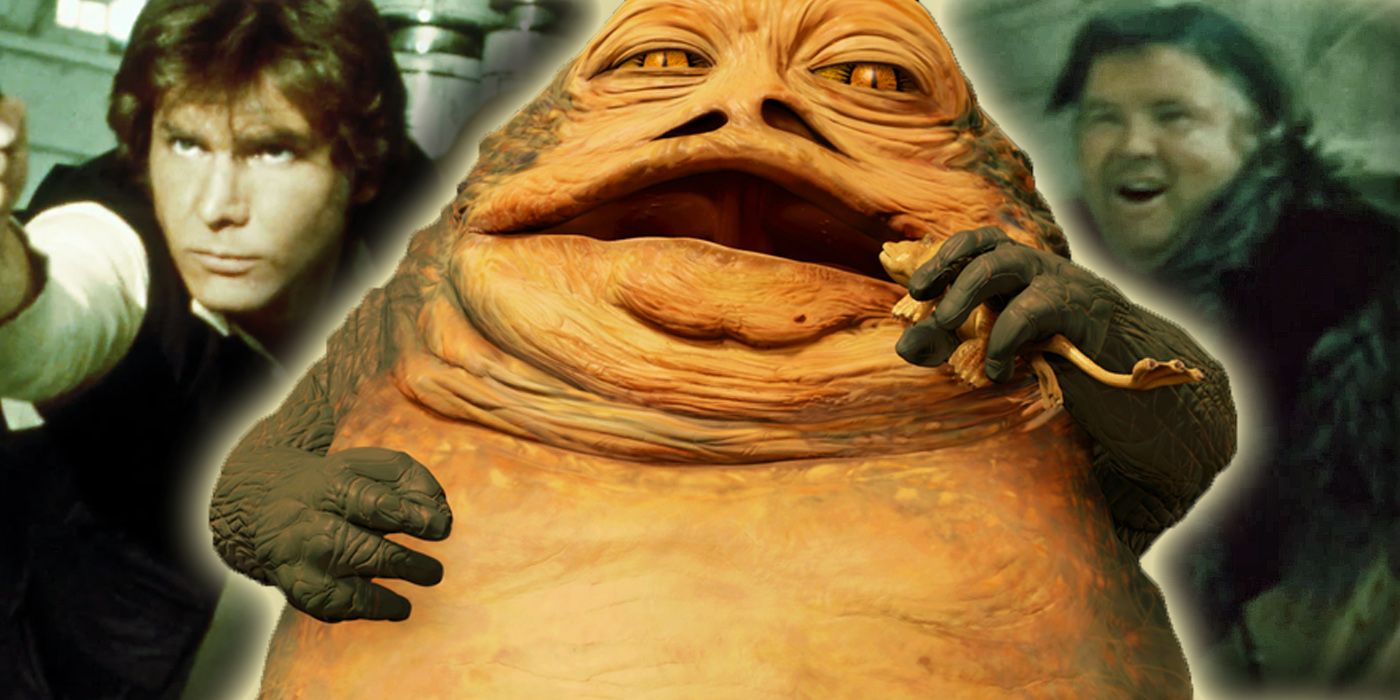
Most people think of Jabba the Hutt as a massive, sweating mountain of space-slug. You know the one. He sits on his dais in Return of the Jedi, eating frogs and laughing like a drain. But if you’re looking into the jabba star wars original history, you’ll find it’s a total mess of deleted scenes, Scottish actors in furry vests, and some of the most controversial CGI "fixes" in cinematic history. It wasn't always a slug. Honestly, for a long time, Jabba was just a guy.
Basically, the Jabba we saw in 1977 wasn't there at all. If you walked into a theater on opening day, Jabba the Hutt was just a name mentioned by Greedo and Han Solo. He was a looming threat, a shadow over Han’s shoulder, but he had no face. It stayed that way for twenty years. Then, in 1997, George Lucas decided he’d finally "finish" the movie by shoving a digital slug into a scene he’d cut decades prior. It changed the rhythm of the movie forever, and not everyone thinks it was for the better.
The Scottish mob boss you never saw
Let’s talk about Declan Mulholland. He’s the "original" Jabba, even though he technically isn't. When Lucas was filming A New Hope—which was just called Star Wars back then—he actually shot a scene where Han Solo is confronted at Docking Bay 94.
Mulholland was a round, jovial-looking Irish-born actor wearing a shaggy brown costume. He played Jabba as a human being. A mobster. In the script, Jabba was described as a "fat, slug-like creature," but the budget just wasn't there. Lucas figured he could maybe matte a creature over Mulholland later, or just cut the scene if it didn't work. It didn't work. The scene was left on the cutting room floor because the technology to turn a man into a giant lizard-slug didn't exist in 1977.
If you watch the raw footage today, it’s kinda surreal. Harrison Ford is at the peak of his roguish charm, walking circles around a guy in a fur coat. At one point, Han actually walks behind Jabba. This became a massive technical nightmare later on when they tried to put a digital tail there. How do you have a person walk over a giant slug’s tail without it looking like garbage?
Why the Jabba Star Wars original scene changed the character
When the Special Edition hit in '97, the jabba star wars original footage was resurrected. This was the first time we saw the CGI Jabba. It was rough. The lighting was off, the skin texture looked like wet plastic, and the physics were wonky.
But the real issue was the characterization.
In Return of the Jedi, Jabba is a terrifying, immovable object. He’s a kingpin who doesn't need to leave his throne. By putting him in the first movie, wandering around a dusty spaceport and letting Han Solo step on his tail—literally—he lost his edge. He went from a cosmic Godfather to a guy who gets bullied in an alleyway.
The 2004 "fix" and the evolution of the slug
Lucasfilm didn't stop in 1997. They knew the first digital Jabba looked a bit like a PlayStation 1 character. So, for the 2004 DVD release, they replaced him again. They used a high-res model that looked more like the puppet from Jedi. They also added Boba Fett to the background, basically just standing there to remind everyone he exists.
- The 1977 version: Jabba is a name, a mystery.
- The 1997 version: Jabba is a jittery CGI blob.
- The 2004 version: Jabba looks "real" but the scene still feels redundant.
Some fans argue that the scene actually ruins the pacing. We just saw Han kill Greedo. We know he’s in trouble. We don't need a second scene three minutes later telling us he's in trouble again. It’s repetitive storytelling, regardless of how good the slug looks.
Behind the slime: The Jedi puppet
The only "real" Jabba, according to many purists, is the one from 1983. This wasn't a guy in a suit or a bunch of pixels. It was a three-ton masterpiece of engineering. Toby Philpott, David Barclay, and Mike Edmonds were the puppeteers inside that massive rubber shell.
It took three grown men sweating their guts out to make Jabba blink, breathe, and move his tongue. One guy did the left arm and head. Another did the right arm and mouth. A third sat in the tail. It was cramped. It was hot. It was gross. But it had a weight to it that CGI still struggles to capture. When Jabba moves in Return of the Jedi, you feel the gravity. You feel the grease.
This is the version of the character that defined the legacy. When we talk about the jabba star wars original design, we are talking about Ralph McQuarrie’s sketches and Phil Tippett’s creature work. They went through dozens of iterations. One early sketch had Jabba with multiple legs. Another looked like a weird, upright walrus. The slug won out because it felt the most decadent. It felt like a creature that had literally outgrown its own mobility through sheer greed.
The Han Solo problem
The most famous—or infamous—part of the "new" original Jabba scene is the tail-step. Because Harrison Ford walked behind the human actor Declan Mulholland in 1977, the CGI team had to figure out what to do with Han when the giant slug tail was in the way.
Their solution? They digitally slid Han Solo up a few inches as he walked, making it look like he stepped on Jabba’s tail. Jabba then makes a little "ouch" face.
It’s weird. It’s physically impossible. It makes Han look like a jerk and Jabba look like a pushover. This is the kind of detail that keeps Star Wars fans up at night. It’s a perfect example of how trying to fix the past can create entirely new problems that nobody asked for.
Why the original mystery worked better
Honestly, there is a power in not seeing the monster. In the theatrical cut of the 1977 film, Jabba is a boogeyman. When Han tells Greedo, "Even I get boarded sometimes. Do you think I had a choice?" you feel the desperation. You imagine what kind of horror could make Han Solo—the coolest guy in the galaxy—that nervous.
By showing Jabba early on, the movies lose that tension. It's the same reason Jaws is scarier because you don't see the shark for an hour. Once you see the slug, the mystery is gone. You realize he’s just a big, slow lizard who can be choked out by a princess in a gold bikini.
Actionable insights for the modern viewer
If you want to experience the "true" version of this history, you have to look beyond the standard Disney+ versions. Here is how to actually navigate the Jabba rabbit hole:
- Watch the "Despecialized" Editions: These are fan-made restorations that remove the CGI Jabba and return the film to its 1977 theatrical glory. It’s the only way to see the movie as it was originally intended without the digital clutter.
- Study the Phil Tippett documentaries: If you want to see how the puppet was built, look for behind-the-scenes footage of Return of the Jedi. It’s a masterclass in practical effects that shows why the 1983 Jabba is still the gold standard.
- Compare the 1997 vs 2004 CGI: It’s a fascinating look at the evolution of digital effects. The 1997 version is almost unrecognizable compared to the 2004 polish. It’s a time capsule of an era where George Lucas was obsessed with what could be done, rather than what should be done.
- Find the Declan Mulholland footage: It's widely available on YouTube. Seeing Han Solo talk to a guy in a vest makes you realize just how much of Star Wars was built on hope and scotch tape.
The jabba star wars original saga is a reminder that film is a living thing. It changes. But just because you can add a digital alien to a scene from forty years ago doesn't mean you should. Sometimes, the best version of a character is the one that stays in your imagination.
For those diving deep into the lore, focus on the McQuarrie concept art. It reveals the DNA of the character before the budget and the technology forced Lucas to make compromises. Understanding the "why" behind the slug helps you appreciate the "how" of the puppet. Stick to the practical effects when you want the real soul of the series. The CGI is just a coat of paint on a house that was already perfectly built.