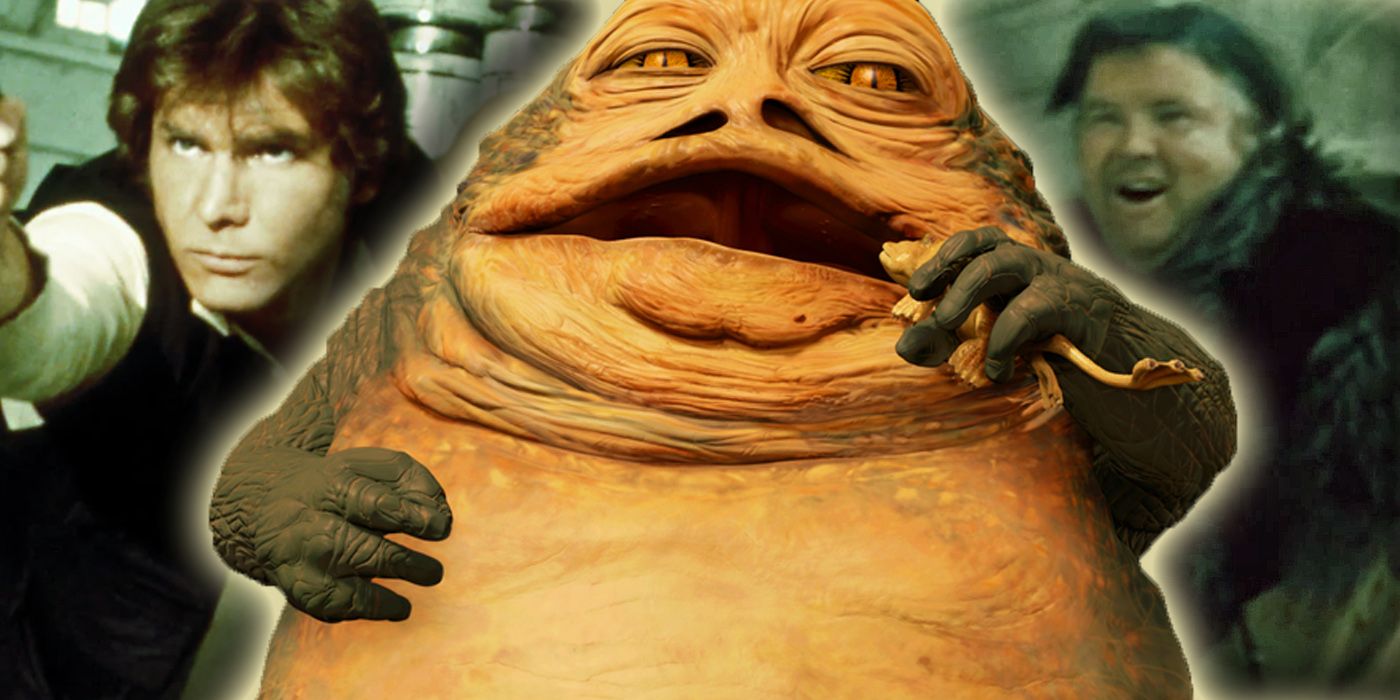
George Lucas was in a bind in 1976. He had this vision of a massive, slug-like gangster for his space opera, but the technology just wasn't there yet. If you look back at the Jabba the Hutt original Star Wars appearances, you’ll find a mess of deleted scenes, Scottish actors in furry suits, and some of the most controversial CGI "fixes" in cinematic history. Most people think Jabba first appeared in Return of the Jedi. Technically? They’re right. But the story of how he was supposed to be in A New Hope is way weirder than a giant space toad eating Kowakian monkey-lizards.
Honestly, the original Jabba wasn't even a puppet.
When Lucas was filming the first movie at Pinewood Studios, he actually shot a scene where Han Solo confronts Jabba at Docking Bay 94. But instead of the 2,000-pound animatronic masterpiece we saw in 1983, Jabba was played by a human actor named Declan Mulholland. Mulholland wore a shaggy brown vest and spoke his lines in a thick Irish accent. The plan was to overlay a stop-motion creature over him later, but the budget ran dry. Lucas literally couldn't afford to finish his monster.
The Human Jabba and the 1977 Disappearance
The scene was cut. For twenty years, the Jabba the Hutt original Star Wars footage lived only in archives and the imaginations of fans who read the Marvel comics or the film's novelization. In those early adaptations, Jabba’s design was all over the place. In the 1977 Marvel Star Wars #2, artist Howard Chaykin drew Jabba as a tall, slender biped with a walrus-like face and a bright yellow outfit. It was a far cry from the "Hutt" we know today.
Why does this matter? Because it proves how much of Star Wars was built on the fly. Lucas didn't have a "Hutt Bible" in 1977. He had a script that called for a "soft, fat creature" and a production schedule that was falling apart.
When the Special Edition arrived in 1997, Lucas finally put Jabba back into A New Hope. But he used the CGI technology of the mid-90s, which, let’s be real, looked a bit like a melting potato. Because Mulholland (the human actor) was much smaller than a giant slug, the digital team had to have Han Solo "step" on Jabba’s tail to explain why Han was walking in a circle where the actor had been. It's one of the most clunky moments in the franchise. Fans hated it. Or at least, the purists did.
Designing the Slug: Phil Tippett and the 1983 Breakthrough
By the time Return of the Jedi rolled around, the production had the money and the manpower to do Jabba right. This is the version that defined the Jabba the Hutt original Star Wars legacy. Phil Tippett, the legendary creature designer, took inspiration from various sources. He looked at the anatomy of annelid worms, the skin texture of snakes, and the facial expressions of Sydney Greenstreet in The Maltese Falcon.
It took three months to build him.
This wasn't just a costume. It was a three-ton piece of engineering. Inside the shell, three puppeteers—Toby Philpott, David Barclay, and Mike Edmonds—lived in a cramped, sweaty space for days. One guy did the left arm and head. Another did the right arm and jaw. A third sat in the tail, wagging it. They had to coordinate their movements perfectly to make Jabba look like a living, breathing organism. They even used a special "slime" made of Methocel to keep his skin glistening under the hot studio lights.
The Linguistic Mystery of Huttese
Ever wonder why Jabba sounds so menacing? Ben Burtt, the sound designer who basically invented the "voice" of Star Wars, didn't just have an actor growl into a mic. He listened to recordings of Quechua, an indigenous language from the Andes mountains. He liked the phonetic structure. He then processed the voice of actor Larry Ward, lowering the pitch and adding "squishy" foley sounds—like the sound of a hand sloshing around in a bowl of cheese casserole—to give Jabba that repulsive, wet vocal quality.
It worked. Jabba became the embodiment of greed. He doesn't just want money; he wants to own people. He wants them as wall decor.
Why the "Special Edition" Changes Still Spark Debates
The debate over the Jabba the Hutt original Star Wars edits isn't just about "Han Shot First." It's about the preservation of practical effects. In the 2004 DVD release, the 1997 CGI Jabba was replaced again with a more refined digital model that looked closer to the Return of the Jedi puppet.
But here's the thing:
- The original 1977 theatrical cut had no Jabba.
- The 1997 Special Edition added a weird, bouncy CGI Jabba.
- The 2004 (and current Disney+) versions have a "fixed" CGI Jabba.
The puppet from 1983 remains the gold standard. It has a weight and a presence that pixels just can't replicate. When Jabba pulls Princess Leia toward him, you see the physical tension in the chain. You see the way the light hits his damp skin. It’s visceral.
The Cultural Impact of the Great Pit of Carkoon
The Jabba sequence in the original trilogy serves a massive narrative purpose. It’s the first time we see Luke Skywalker as a fully realized Jedi Knight. But more than that, it shows the scale of the Star Wars underworld. Jabba isn't a Sith. He doesn't care about the Force or the Rebellion. He’s a businessman. A gross, murderous businessman.
He represented the "scum and villainy" Obi-Wan warned us about. If you look at the recent Book of Boba Fett or The Mandalorian, the shadow of Jabba still hangs over Tatooine. The "Hutt Space" lore started right there in the smoke-filled throne room of a puppet controlled by three sweaty guys in 1982.
Misconceptions About the Slave Leia Scene
We can't talk about Jabba without mentioning the bikini. It’s become a massive point of contention in modern years. Carrie Fisher famously hated the outfit, calling it "what supermodels will eventually wear in the seventh ring of hell." But from a character perspective, the Jabba the Hutt original Star Wars encounter was Leia’s big "Vengeance" moment.
She didn't wait for Luke to save her. She used the very chain Jabba used to enslave her to throttle him to death. It's a brutal, practical-effects-heavy death scene that stood out in a movie otherwise filled with cute Ewoks.
Summary of the Jabba Timeline
- 1976: Filmed as a human (Declan Mulholland) for Star Wars.
- 1977: Completely deleted from the theatrical release.
- 1983: Debuts as a massive puppet in Return of the Jedi.
- 1997: Digitally inserted into A New Hope (Version 1).
- 2004: Digital model updated to look more like the 1983 puppet (Version 2).
How to Experience the "True" Jabba Today
If you really want to understand the artistry behind Jabba, you have to look past the CGI. Seek out behind-the-scenes footage of the 1983 production. Watch the way the puppeteers worked in sync. The nuance in Jabba's eyes—which were controlled by remote—is far more expressive than many modern digital characters.
For the most authentic experience, try to find a copy of the "Despecialized Editions" or the original 1980s VHS tapes. Seeing the movie without the added CGI Jabba in A New Hope makes the reveal in Return of the Jedi much more impactful. It turns Jabba from a recurring nuisance into a looming, mysterious threat that Han Solo has been terrified of for three whole movies.
To dive deeper into the technical side of the original trilogy, research the work of the Industrial Light & Magic (ILM) crew during the early 80s. Their transition from stop-motion to full-scale animatronics with Jabba was a pivotal moment in film history. You can also visit the Museum of Pop Culture in Seattle, which has occasionally hosted original Star Wars props, to see just how massive these practical effects really were. Next time you watch, pay attention to Jabba’s nostrils; there was a specific crew member whose entire job was to puff smoke and air through them to make the "breathing" look real.