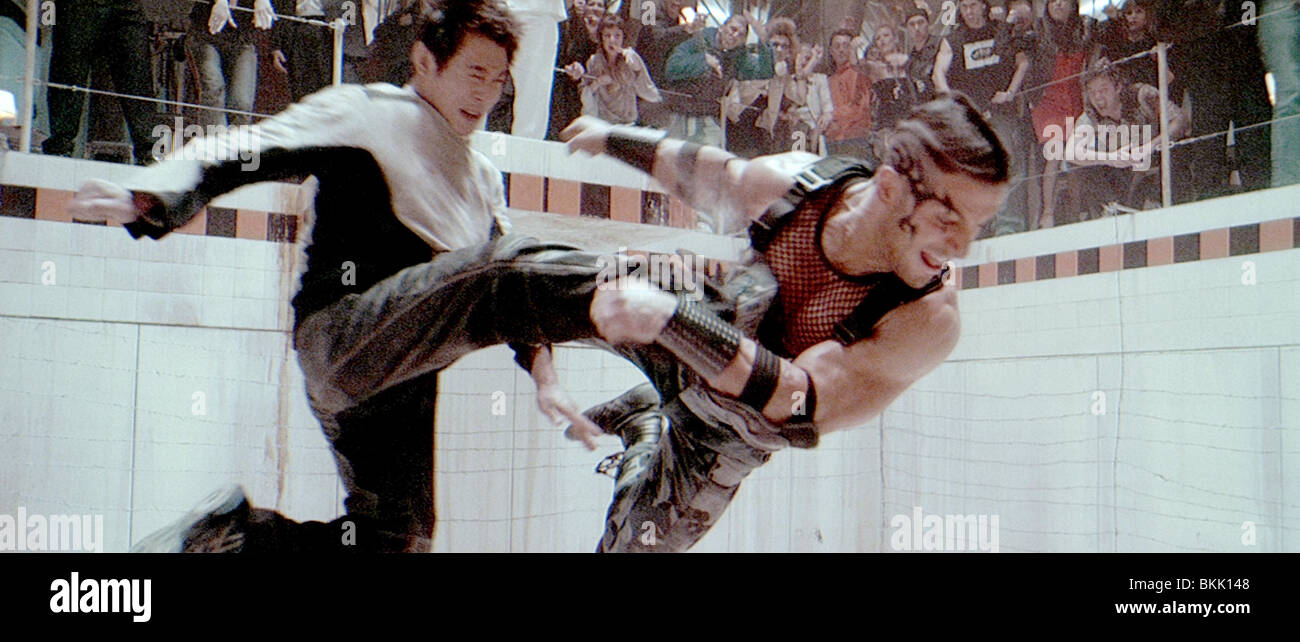
Honestly, if you grew up watching Jet Li in the early 2000s, you probably remember him as the guy who barely spoke, looked incredibly cool in a leather jacket, and kicked people through drywall. He was the stoic hero of Romeo Must Die and the high-flying monk in Shaolin Temple. But then 2005 happened. Jet Li Danny the Dog—released as Unleashed in many regions—hit theaters and basically broke everyone’s expectations of what a martial arts movie could be. It wasn't just another action flick; it was a bizarre, heartbreaking, and violently visceral character study.
It’s been over two decades, yet people still talk about this one. Why? Because it’s the only time Western audiences truly saw Jet Li act with his whole soul, not just his hamstrings.
The Weird, Gritty Premise of Jet Li Danny the Dog
The setup sounds like a fever dream. Imagine a Glasgow loan shark named Bart (played with terrifying, scenery-chewing energy by the late Bob Hoskins) who raises a man like a literal animal. This man is Danny. He lives in a cage. He eats out of tin cans with his hands. He wears a metal collar.
When the collar is on, Danny is a catatonic, docile shell of a human. When Bart takes the collar off? Danny becomes a whirlwind of bone-snapping destruction. He doesn't fight like a traditional Wushu master. There are no graceful circular movements or "pretty" forms here.
Working with legendary choreographer Yuen Woo-ping, Jet Li developed a style for this film that felt feral. He bites. He headbutts. He uses his surroundings like a cornered beast. It’s messy and uncomfortable to watch, which is exactly why it works.
A Stark Departure from Hollywood Glitz
Most of Jet Li's English-language films at the time, like Cradle 2 the Grave or The One, were heavily stylized. They had hip-hop soundtracks and a lot of "cool" factor. Jet Li Danny the Dog felt like it came from a different planet. Written by Luc Besson and directed by Louis Leterrier, the film has this bleak, desaturated European aesthetic. The Glasgow setting—rainy, grey, and industrial—adds a layer of grime that makes the violence feel heavier.
When the "Dog" Finds a Home
The movie takes a massive turn when Danny is separated from Bart and taken in by Sam, a blind piano tuner played by Morgan Freeman. This is where the movie usually loses the "just here for the fights" crowd, but it's actually the best part.
Seeing Jet Li—a global icon of masculine strength—playing a man who is essentially a traumatized child is fascinating. He learns how to use a fork. He discovers that he likes ice cream. He realizes that music can trigger memories of his mother.
The Piano as a Narrative Anchor
The piano isn't just a prop. It's the bridge to Danny's humanity. Sam and his stepdaughter Victoria (Kerry Condon) treat Danny with a gentleness he’s never known. These scenes are long, sometimes a bit sentimental, but they give the eventual "unleashing" so much more weight. You aren't just cheering because he’s winning a fight; you’re terrified that he’s losing his soul again.
That Bathroom Fight Scene (You Know the One)
We have to talk about the action. Specifically, the close-quarters fight in the apartment bathroom. It is arguably one of the best-directed fight scenes in modern cinema history.
Most martial arts movies want space. They want wide shots to show off the choreography. Leterrier does the opposite. He traps Jet Li and a massive hitman in a tiny, tiled bathroom. It’s cramped. It’s claustrophobic. They’re smashing into sinks and toilets. It’s a masterclass in using "animalistic" movement in a restricted space. There’s no wire-work fluff here—just two guys trying to kill each other in a box.
Why It Still Matters Today
Look, many martial arts stars try to "go dramatic" and fail because they can't bridge the gap between their physical presence and their emotional range. Jet Li nailed it. He proved that his face was just as expressive as his fists.
- Emotional Stakes: It’s a movie about trauma and recovery disguised as a kung-fu movie.
- The Massive Attack Score: The soundtrack by Massive Attack is incredible. It’s moody, electronic, and perfectly captures Danny’s fractured mental state.
- Bob Hoskins’ Performance: Bart is one of the most detestable villains in action cinema. You genuinely want to see him get what's coming to him.
Misconceptions About the Movie
Some people think Unleashed and Danny the Dog are different movies. They aren't. Danny the Dog was the original title (and the name of the soundtrack), but North American distributors thought it sounded too much like a family comedy about a golden retriever. They changed it to Unleashed to make it sound more like a standard action movie. If you can, try to find the "Danny the Dog" cut—it often feels a bit more aligned with Besson’s original vision.
How to Revisit the Legend
If you're looking to rewatch or see it for the first time, don't go in expecting Fist of Legend. Go in expecting a dark drama that happens to have world-class violence.
Actionable Insights for Fans:
- Watch the Unrated Version: The theatrical cut trims some of the more brutal impacts. The unrated version shows the true "animal" nature of the choreography.
- Listen to the Lyrics: The Massive Attack tracks often mirror Danny's internal monologue—or lack thereof.
- Compare the Styles: Watch a scene from Hero (released around the same time) and then a scene from this. The contrast in Li's body language is a testament to his range.
Forget the generic titles and the "attack dog" marketing. At its core, this film is about the fact that no matter how much you break someone, kindness is a hell of a lot stronger than a collar.
To truly appreciate the film's impact, track down the original 2004 Massive Attack soundtrack titled Danny the Dog. The haunting melodies provide a much deeper context to the "piano" themes than the standard action trailer music ever could. Then, find a high-definition copy of the European cut to see the full, unedited vision of the apartment fight. It remains the definitive example of how to blend high-concept drama with bone-crunching martial arts.