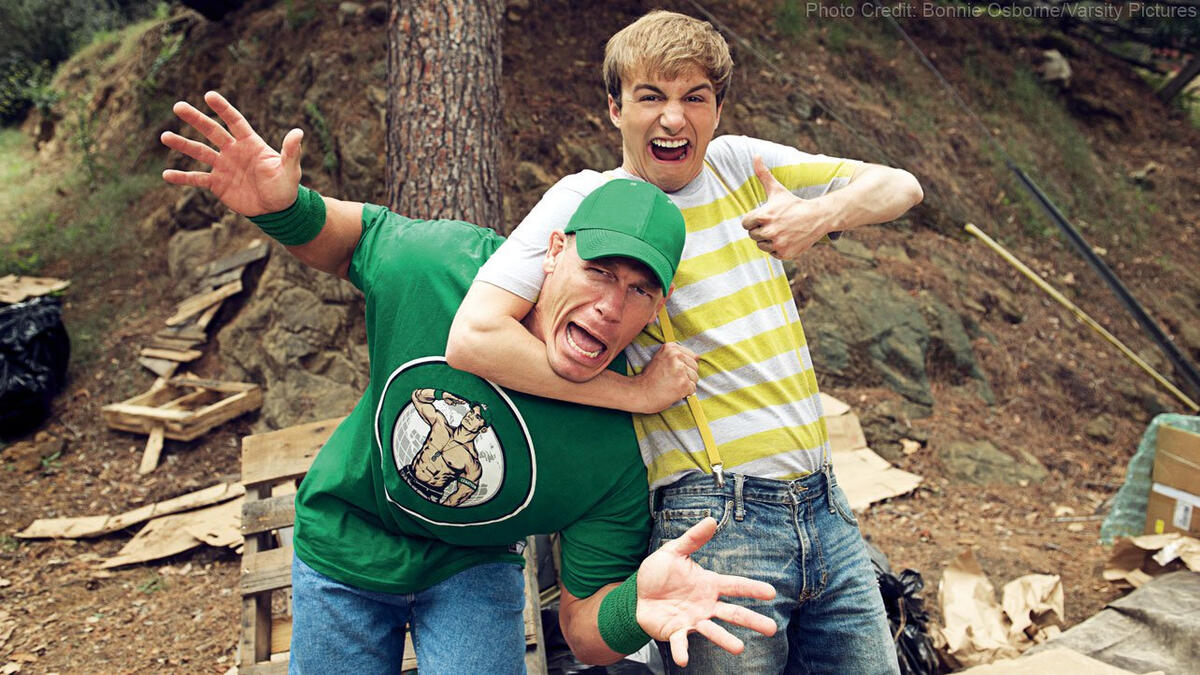
Honestly, if you were scrolling through Nickelodeon back in 2010, you probably saw something that felt like a fever dream. A high-pitched, screeching teenager named Fred Figglehorn was running around his kitchen, and suddenly, out of nowhere, John Cena—the face of the WWE, the "Hustle, Loyalty, Respect" guy—pops out of a refrigerator. It wasn't a hallucination. John Cena in Fred is a very real, very strange chapter of pop culture history that most people have tried to scrub from their brains. But here is the kicker: Cena himself credits these movies for actually teaching him how to act.
He didn't just show up for a five-second gag. He played Fred’s imaginary dad. He wore his full wrestling gear. He gave life advice to a kid who sounded like he’d inhaled a whole tank of helium. It was bizarre. It was loud. Critics absolutely hated it.
What was the deal with Dad Figglehorn?
In the world of the Fred movies—Fred: The Movie, Night of the Living Fred, and Camp Fred—Fred’s real father is basically out of the picture. His mom, played by Siobhan Fallon Hogan, usually tells him his dad is in jail. So, Fred does what any lonely, hyperactive kid with a vivid imagination would do: he imagines his dad is a world-famous professional wrestler.
John Cena appears in these "imagine spots" as a version of himself, but also as a weirdly aggressive mentor. He shows up in the kitchen, at the gym, or even at a WWE event to give Fred "manly" advice. Usually, this involves Cena telling Fred to stop being a "wuss" or to use "ruthless aggression" to solve his problems.
It’s meta-humor before meta-humor was cool. Cena was basically parodying his own public persona. He was poking fun at the idea of being this untouchable, hulking superhero by placing himself in the most ridiculous setting possible.
Why John Cena in Fred was a massive risk
Before the Fred trilogy, Cena was being groomed as the next big action star. He did The Marine. He did 12 Rounds. These were serious, gritty, "look at my muscles and the explosions behind me" kind of movies. And frankly? They weren't great. Cena has admitted in recent interviews, specifically with Chris Van Vliet, that he was doing those early movies as a "business decision" for WWE. He wasn't having fun.
Then came the offer for Fred: The Movie.
Most "serious" actors would have looked at a YouTube-to-TV movie crossover and run the other direction. It had a 0% on Rotten Tomatoes. The character of Fred was incredibly polarizing—you either loved the chaos or you wanted to put your TV through a woodchipper. But Cena saw something different. He saw a chance to stop being a "brand" and start being a character.
"It wasn't until the Fred movies, where I could parody myself... where I could have fun with the process and expect nothing out of it," Cena said.
That shift in mindset changed everything. By playing a muscular figment of a child's imagination who lives in a fridge, Cena learned that he was actually funny. He stopped trying to be Arnold Schwarzenegger and started trying to be John Cena.
Breaking down the Fred appearances
Cena didn't just do a one-off. He stuck with the franchise through its entire weird lifespan.
- Fred: The Movie (2010): This is the introduction. Cena pops up to help Fred win over his crush, Judy. He’s the ultimate "Alpha Dad" archetype, constantly encouraging Fred to be tougher than he actually is.
- Fred 2: Night of the Living Fred (2011): The stakes get weirder. Fred thinks his music teacher is a vampire. Cena returns, at one point even appearing in a scene filmed at a real WWE live event in South Carolina. This was actually a huge deal at the time—blending a Nickelodeon movie with a live wrestling broadcast.
- Fred 3: Camp Fred (2012): Fred goes to a run-down summer camp. Again, Cena is there as the imaginary motivator. By this point, the bit was established. Cena was the "inner voice" of a kid who clearly needed a lot of therapy.
The $25,000 paycheck and the Hollywood pivot
You’d think a massive star like Cena would be pulling in millions for a Nickelodeon project. Nope. Reports from Money Nation and SPORTbible suggest he was paid roughly $25,000 for his role in the first film. He earned about the same for the sequel.
For a guy who was headlining WrestleMania, that’s basically pocket change.
But the "ROI" (return on investment) wasn't about the money. It was about the demo. By appearing in Fred, Cena connected with a younger generation of fans in a way that The Marine never could. More importantly, it caught the eye of people in Hollywood who realized he had comedic timing.
Fast forward a few years. Judd Apatow and Amy Schumer are casting for Trainwreck. They need a guy who looks like a beast but can deliver a deadpan joke about his own physique. Because Cena had already proven he didn't take himself too seriously in the Fred universe, he got the part.
That role in Trainwreck led to Blockers. Which led to The Suicide Squad. Which led to Peacemaker.
If you look at the DNA of Cena's performance as Peacemaker—the bravado, the unintentional hilarity, the underlying sadness of a guy trying to live up to a "tough guy" image—you can see the seeds of it in John Cena in Fred. It’s the same character, just rated R and given a helmet.
The legacy of a 0% Rotten Tomatoes score
Is Fred: The Movie a good film? By traditional standards, absolutely not. It’s loud, obnoxious, and the editing feels like a caffeine overdose. But it serves a specific purpose in the timeline of John Cena.
It was his "blacklisted" era. Between 2010 and 2015, Cena basically didn't do "real" movies. He was stuck in this loop of WWE projects and Nickelodeon cameos. But that "dry spell" allowed him to fail. It allowed him to experiment.
Most people look back at their early, cringey work and want to hide. Cena does the opposite. He credits the Fred movies for his entire career. He’s one of the few actors who stays complimentary of his "bad" movies because he understands they were the stepping stones.
What can we learn from Cena's Fred era?
Basically, don't be afraid to look stupid. Cena was the biggest star in wrestling and he was willing to be a laughing stock for $25k because it was "creative fun."
If you’re trying to understand the career of the guy who played a "Kenmaid" in Barbie or a guy who dresses up like Britney Spears in Ricky Stanicky, you have to go back to the refrigerator. You have to look at the guy who told a screaming teenager to have "ruthless aggression" while wearing neon wristbands.
Next Steps for the Curious:
If you actually want to see this madness for yourself, the Fred movies are usually tucked away on streaming services like Paramount+ or available for rent on Amazon. Just a heads up: keep the volume low. Your ears will thank you. For a better look at how this evolved, watch Trainwreck right after Fred: The Movie. The leap in his acting ability is honestly impressive. You can see the moment he stops "acting" like a wrestler and starts acting like a comedian.