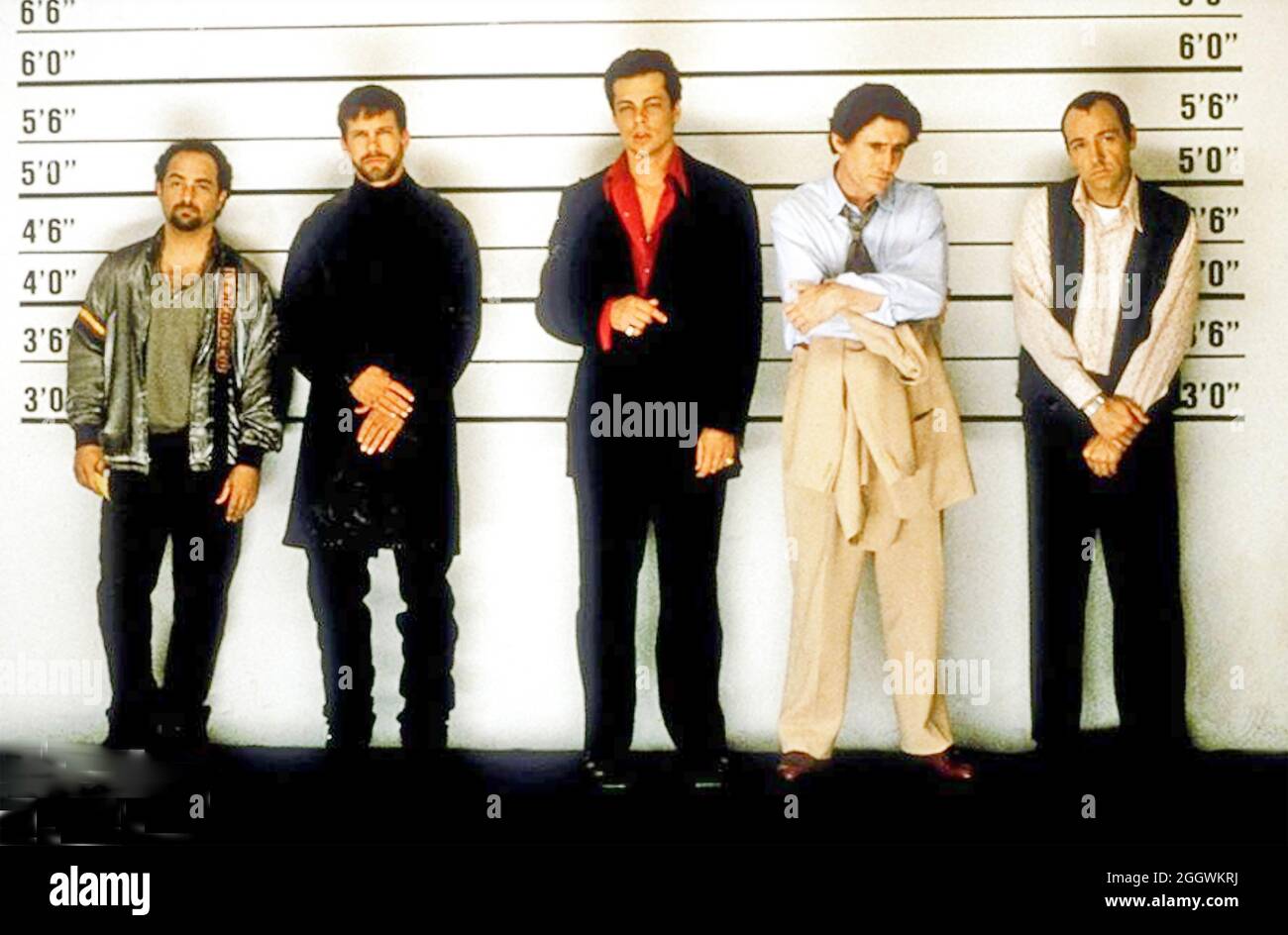
He limps. He fumbles with a Zippo. He looks like a guy who’d get bullied at a bus stop. Then, in the final sixty seconds of The Usual Suspects, everything we thought we knew about Roger "Verbal" Kint—and the man playing him—evaporates into the New York air.
Kevin Spacey in The Usual Suspects didn't just give us a performance; he gave us a tectonic shift in how movies handle the "unreliable narrator." It’s 2026, and while the actor's personal life has spent years under a microscopic, often legal, lens, the shadow of Keyser Söze hasn't actually shrunk. If anything, it’s grown weirder.
The Role That No One (And Everyone) Wanted
Back in 1994, Kevin Spacey wasn't a "star." He was that guy from Glengarry Glen Ross who could play a middle-manager sociopath better than anyone else. Bryan Singer and Christopher McQuarrie didn't hand him the keys to the kingdom immediately. In fact, they sent him the script without even telling him which role they wanted him for. Spacey, ever the shark, looked at the pages and basically told them he’d do anything—but he had his eye on the "Verbal" Kint part.
Why? Because Kint is the ultimate mask.
The production was a low-budget scramble. Six million dollars. Thirty-five days. A cast that included Gabriel Byrne, Stephen Baldwin, and a then-unknown Benicio del Toro who decided to speak like he had a mouth full of marbles just to see if he could get away with it. Singer actually kept the cameras rolling during the iconic lineup scene because the actors couldn't stop laughing. It wasn't supposed to be funny. It was supposed to be gritty. But that chaotic energy ended up being the secret sauce that made the chemistry feel real.
The Real-Life Horror Behind the Fiction
Most fans know the name "Keyser Söze" sounds cool, but the origin is darker than a standard Hollywood brainstorm. Christopher McQuarrie based the mythos of Söze on a real-life murderer named John List. In 1971, List killed his entire family in New Jersey, sat down to dinner, and then vanished for nearly twenty years. He started a new life, got remarried, and lived as a completely different person until America's Most Wanted finally caught up with him.
That idea—that a monster can simply "poof" and become your neighbor—is exactly what Spacey channeled. He didn't play a villain. He played a guy playing a victim.
Why the Twist Still Hits in 2026
We’ve seen a thousand "twist" endings since 1995. The Sixth Sense did it. Fight Club did it. But Kevin Spacey in The Usual Suspects remains the gold standard because the clues aren't just in the plot—they’re in the physical tics.
Spacey supposedly glued his fingers together to simulate the cerebral palsy limp and "the hand." It’s a bit of Method acting that, in hindsight, feels almost prophetic of the actor's ability to compartmentalize. When Chazz Palminteri’s Agent Kujan realizes the entire story was improvised from the "Skokie, Illinois" and "Quartet" labels on the bulletin board, the audience feels a genuine sense of violation. We weren't just watching a movie; we were being lied to by an expert.
- The Coffee Cup: That "Kobayashi" reveal is still the ultimate "oh crap" moment in noir history.
- The Gold Lighter: A tiny prop that serves as the bridge between the lie and the legend.
- The Limp: Watching that gait smooth out into a confident stride is the most satisfying five seconds of film from the 90s.
The Complicated Legacy
It's impossible to talk about this performance now without acknowledging the elephant in the room. As of January 2026, Spacey is still navigating a complex "comeback" trail. He’s been acquitted in multiple jurisdictions, yet the industry remains divided. Some see him as a "timeless monument" of craft—a sentiment echoed recently at festivals in Sicily and Cannes—while others can't separate the art from the allegations.
In a weird, meta way, the role of Verbal Kint has become a Rorschach test for his entire career. Was he always just "acting" the part of the polite, unassuming intellectual? Or is the brilliance of the performance something that exists entirely outside of the man who gave it?
Honestly, there’s no easy answer.
What Most People Get Wrong About the Ending
There is a persistent theory that Verbal Kint isn't Keyser Söze. Some die-hard fans argue he was just a mid-level crook who made up a scary story to get out of jail, and the "real" Söze is still out there.
Bryan Singer has shot this down multiple times, but the ambiguity is what keeps the film alive on streaming platforms and in film school deconstructions. If you watch the movie a second time, you notice that Spacey is barely in the frame during the big action set pieces. He’s always in the background. Watching. Calculating. It’s a masterclass in "hiding in plain sight."
Actionable Insights for the Modern Movie Buff
If you’re revisiting The Usual Suspects or showing it to someone who hasn't seen it (lucky them), keep these things in mind to get the full experience:
- Ignore the "Main" Plot: On a rewatch, don't focus on the heist. Focus on Spacey’s eyes while he’s looking at Agent Kujan’s office walls. You can actually see him "reading" the room to build his lie in real-time.
- The Turkish Clue: The name Söze comes from a Turkish phrase meaning "to talk too much." Roger "Verbal" Kint literally tells you who he is in his own name.
- The Sound Design: Listen to the change in Spacey’s voice in the final moments. The pitch drops. The stutter vanishes. It’s chilling.
The film ends with a quote that has been meme-d into oblivion: "The greatest trick the devil ever pulled was convincing the world he didn't exist." Whether you're a fan of the man or just a fan of the craft, there’s no denying that for two hours in 1995, Kevin Spacey convinced us he was the weakest man in the room.
And then he walked away without a limp.
To dive deeper into the technical side of the film's 1996 Oscar win, check out the original Academy Award archives for a look at the competition he beat out that year. You might also want to look into the 2026 legal updates regarding his upcoming civil trials in London to understand the current context of his career "reboot."