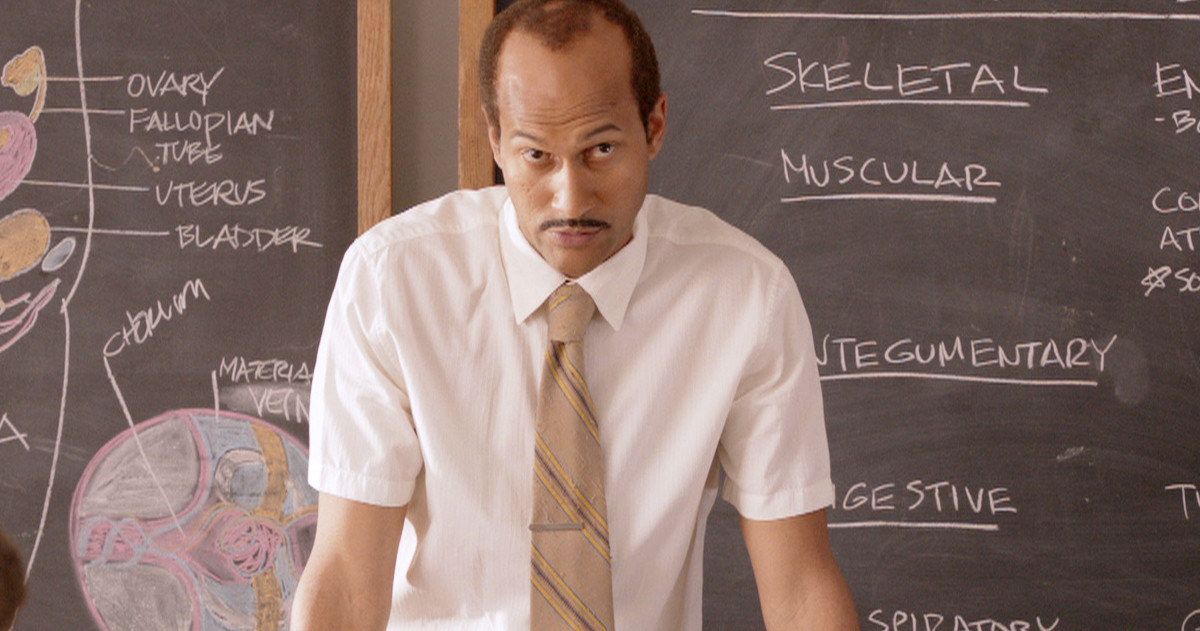
You know the feeling. Someone calls your name, but they butcher it so badly you actually have to pause and wonder if they’re talking to you. Usually, it's a mild annoyance. But in the world of Key and Peele Mr. Garvey, it’s a high-stakes battle for respect.
If you haven't seen the "Substitute Teacher" sketch in a few years, it’s worth a rewatch. Honestly, it’s basically the gold standard for how to handle cultural friction without being preachy. Keegan-Michael Key steps into the room as Mr. Garvey, a man who has spent twenty years teaching in the inner city and has exactly zero patience for what he perceives as "insubordinate and churlish" behavior from a room full of suburban kids.
The premise is dead simple: he takes attendance. That's it. But the way he mangles "Jacqueline" into "Jay-quellin" or "Aaron" into "A-A-Ron" has become part of the actual English lexicon.
The Weird Logic of Mr. Garvey
What makes the sketch work isn't just the funny voices. It’s the sheer, unshakeable confidence Garvey has. He’s not "wrong"—you are. When Denise (or "Dee-nice") tries to correct him, he doesn't just disagree; he views it as a personal attack on his authority.
It’s a classic flip. Usually, we see stories about white teachers struggling with "ethnic" names in urban schools. Key and Peele Mr. Garvey reverses that dynamic entirely. Suddenly, the names we think of as the default—Blake, Denise, Timothy—are the ones being treated as exotic or "incorrectly" spelled.
Key once mentioned in an interview with Terry Gross that he modeled the character on a real-life guidance counselor he had back in a Catholic elementary school. That guy was vigilant, aggressive, and always on the lookout for a "scam." That’s why Garvey is so intense. He isn't just a teacher; he’s a veteran of a different system, and he’s not about to let these "privileged" kids pull one over on him.
The Names That Broke the Internet
Let’s be real, we all have a favorite.
- Jacqueline (Jay-quellin): The first casualty. Her confusion is the audience's entry point.
- Blake (Ba-lah-kay): This one is arguably the most famous. It’s the way Key's voice drops an octave that makes it.
- Denise (Dee-nice): The moment Garvey breaks the clipboard. It’s pure physical comedy.
- Aaron (A-A-Ron): The breaking point. Poor Aaron gets sent to "O-Shag-Hennessy’s" office (Principal O'Shaughnessy).
The only kid who gets a pass? Timothy. Or, as Garvey calls him, "Tim-oh-thee." Played by Jordan Peele, Timothy is the only student who seems to understand the "rules" of the room. He answers with a weird, stressed-out "Pre-SENT!" that matches Garvey's energy perfectly.
Why We Are Still Talking About This in 2026
It is wild to think this sketch debuted in Season 2, Episode 4 of Key & Peele. It’s been over a decade. Yet, as of early 2026, the original YouTube clip has racked up well over 225 million views.
Why? Because it touches on "code-switching" without using the academic term. Both Keegan-Michael Key and Jordan Peele are biracial, and they’ve spent their lives navigating different cultural "settings." They know exactly what it feels like to have to change your voice, your posture, and your vocabulary depending on who you’re talking to.
Mr. Garvey is a man who refuses to code-switch. He brings his "inner-city" setting into a suburban classroom and demands that the world adjust to him. It’s a power move.
The Movie That Almost Was
There was a point around 2015 when Paramount actually picked up a feature film version of the character. The plan was for Garvey to be the lead, with Peele playing a rival teacher. Honestly, it’s probably for the best that it didn't happen. Some characters are perfect in four-minute bursts. Expanding a sketch about mispronounced names into a 90-minute narrative is a tall order, and the brevity of the original is what makes it so rewatchable.
The "A-A-Ron" Legacy
The impact of Key and Peele Mr. Garvey went way beyond Comedy Central. It even bled into professional sports. Remember when Aaron Rodgers appeared in a later sketch as "A.A. Ron Rodgers"? Key has said that every time he runs into Rodgers, the quarterback still quotes the "insubordinate and churlish" line to him.
If you’re looking to dive back into the Garvey-verse, here is how you can get the most out of it:
- Watch Part 1 first: It's the classic for a reason. Pay attention to the background actors—they were told to play it completely straight, which makes Garvey’s explosion feel much more "real."
- Check out Part 2: It’s in the Season 3 premiere. This time, the kids are trying to anticipate his mispronunciations, which creates a whole new level of tension.
- Look for the "East/West College Bowl" crossovers: While not the same character, the obsession with name pronunciation is a recurring theme that connects most of Key & Peele's best work.
The next time someone butchers your name at a coffee shop, just remember: it could be worse. You could be headed to O-Shag-Hennessy's office.
Actionable Next Steps
If you want to understand the deeper cultural impact of the series, look up Keegan-Michael Key’s interviews regarding "linguistic relativity." It explains why the way we name things—and how we say those names—defines our status in society. After that, go back and watch the "Substitute Teacher" sketches back-to-back to see how the character's physical intensity ramps up between seasons.